
Himachal Cabinet Clears Major Healthcare, Welfare and Infrastructure Push Under CM Sukhu
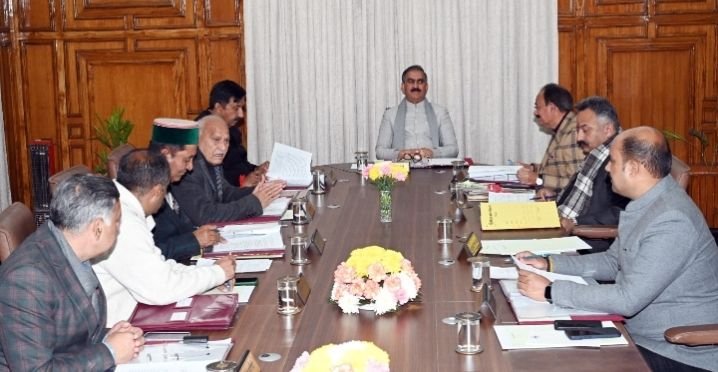
The Himachal Pradesh Cabinet, chaired by Chief Minister Thakur Sukhvinder Singh Sukhu, on Tuesday approved a wide-ranging set of decisions aimed at strengthening healthcare, social security, renewable energy, tourism, governance and employment generation, reflecting the government’s continued focus on people-centric and reform-driven governance.
One of the most significant decisions was the approval to establish a state-of-the-art Cancer Care Centre at Dr. Radhakrishnan Government Medical College, Hamirpur. The Cabinet also sanctioned the creation of 11 specialized departments within the centre along with the creation and filling of all required posts. This move is expected to substantially improve cancer diagnosis and treatment facilities in the region, reducing the need for patients to seek care outside the state.
In a major relief for pension beneficiaries, the Cabinet approved amendments to the Social Security (Pension and Allowance) Rules, 2010 to ensure time-bound disbursal of social security pensions. The decision aims to eliminate delays and ensure that elderly citizens, widows and other eligible beneficiaries receive financial support without procedural hurdles.
Focusing on sustainable and alternative energy sources, the Cabinet decided to adopt the National Policy on Geothermal Energy to promote exploration and development of untapped geothermal resources in Himachal Pradesh. The Directorate of Energy was approved as the nodal agency for implementation, and amendments to the Swaran Jayanti Energy Policy, 2021 were cleared to incorporate geothermal energy guidelines. This step aligns with the state’s long-term vision of clean and renewable energy.
To strengthen welfare schemes for vulnerable sections, the Cabinet approved the promulgation of an ordinance to levy an ‘Orphan and Widow Cess’ on petrol and high-speed diesel at the point of first sale in the state. The government clarified that the cess would not burden consumers but would ensure a steady flow of funds for welfare programmes targeting orphans and widows.
In the power sector, approval was granted for the allotment of four hydroelectric projects of up to 25 MW capacity — 6 MW Khauli-II, 24 MW Malana-III, 21.9 MW Manalsu and 18 MW Dhancho — to successful bidders following completion of the tendering process. These projects are expected to boost green energy generation and local employment.
Tourism received a major boost with the Cabinet approving the construction of a 4.3-kilometre-long Naddi Zipline Project near Dharamshala in Kangra district at an estimated cost of Rs. 7.41 crore. Once completed, it is expected to be Asia’s longest zipline and a major attraction for domestic and international tourists.
Key administrative and employment-related decisions included:
* Amendment of the Senior Resident Doctor Policy, fixing a 66.66 percent quota for in-service GDOs/MOs and 33.33 percent for direct candidates, with interchangeability in case of non-availability.
* Approval to fill 11 posts of Assistant Commissioner, State Taxes and Excise.
* Filling of 11 posts of various categories as job trainees at the Residential Institute for Mentally Challenged Children, Hiranagar.
* Creation and filling of 11 posts in the Disaster Management Cell of the Revenue Department.
* Filling of six posts of Tehsildar and re-engagement of retired revenue officers on fixed remuneration to expedite disposal of pending cases.
* Filling of four Junior Engineer (Horticulture) posts as job trainees in the Public Works Department.
* Creation and filling of four posts for the Volleyball Sports Hostel at Bhareri in Hamirpur district.
The Cabinet also approved a major amendment to the Assistant Staff Nurse policy, revising the age limit to 18–45 years, with an additional five-year relaxation for SC, ST and other eligible categories. Earlier, the age limit was 21–32 years, which had restricted many candidates.
Healthcare infrastructure was further strengthened with approval to construct eight additional blocks at AIIMS Bilaspur, enhancing its capacity to serve patients from across the state and neighbouring regions.
To promote industrial growth and employment, the Cabinet decided to extend the Himachal Pradesh Industrial Investment Policy, 2019 up to March 31, 2026. The extension aims to improve ease of doing business, attract new investments and support sustainable industrial development.
Other notable decisions included:
* In-principle takeover of the Institute for Children with Special Abilities at Dhalli, Shimla.
* Approval of standard operating procedures and guidelines for recruitment of crèche workers and helpers.
* Establishment of four new nutritional profiling and food testing laboratories in Kangra, Mandi, Shimla and Solan (Baddi), along with upgradation of the composite laboratory at Kandaghat.
* Permission for Alliance Air Aviation Ltd. to operate 46-seater aircraft daily on Delhi–Shimla–Delhi and Shimla–Dharamshala–Shimla routes.
* Approval for construction of a new ice skating rink in Shimla.
* Clearance of the Himachal Land Revenue Rules, 2025 to regulate the functioning, duties and service conditions of revenue and village officers.
Collectively, these decisions underline the Sukhu government’s emphasis on inclusive development, welfare of weaker sections, strengthening public services and creating employment opportunities. The Cabinet’s agenda reflects the Chief Minister’s stated commitment to governance that is accessible, responsive and closely aligned with the needs of the masses across Himachal Pradesh.