

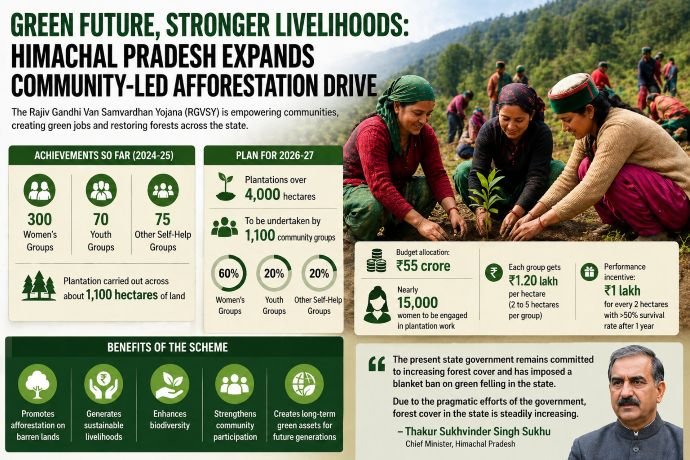
The state government’s combined focus on job creation and environmental sustainability is beginning to show tangible results, with community-driven plantation efforts emerging as a key pillar of this strategy. Under the Rajiv Gandhi Van Samvardhan Yojana (RGVSY), launched last year, a wide network of grassroots groups has actively participated in afforestation activities, covering nearly 1,100 hectares of land. The initiative has seen the involvement of around 300 women’s groups, 70 youth collectives and 75 self-help groups, reflecting a strong emphasis on inclusive and community-based development.
Encouraged by the initial success, the Forest Department has now set an ambitious roadmap for the financial year 2026–27. The department plans to expand plantation activities across approximately 4,000 hectares by mobilising nearly 1,100 community groups. The composition of these groups has been carefully structured to ensure broad participation, with 60 percent expected to be women’s groups, 20 percent youth groups and the remaining 20 percent comprising other self-help groups. To support this large-scale expansion, the government has earmarked a budget of about ₹55 crore for the scheme.
A key highlight of the programme is its potential to generate livelihood opportunities, particularly for rural women. It is estimated that nearly 15,000 women will be directly engaged in plantation activities under the scheme. Each participating group is provided financial assistance of ₹1.20 lakh per hectare and is eligible to undertake plantation work on 2 to 5 hectares of land. In addition, a performance-based incentive structure has been introduced to ensure accountability and long-term sustainability. Groups that achieve a plant survival rate exceeding 50 percent after one year are rewarded with an additional ₹1 lakh for every two hectares, encouraging careful maintenance and protection of planted areas.
The scheme has already demonstrated promising outcomes in promoting afforestation and ecological restoration. Community institutions such as youth clubs, women’s collectives and self-help groups are being encouraged to plant a mix of trees, including fruit-bearing and other ecologically beneficial species, particularly on degraded or unused land. Beyond environmental benefits, these efforts are also creating a steady source of income for rural households, thereby linking conservation with economic empowerment.
The government’s broader vision is rooted in sustainable development, with a strong emphasis on public participation in environmental initiatives. By fostering a sense of ownership among local communities, the programme aims to ensure long-term protection of green assets while simultaneously strengthening the rural economy. The promotion of diverse plant species is also expected to enhance biodiversity and improve ecological resilience across the state.
Chief Minister Sukhvinder Singh Sukhu reiterated the government’s commitment to expanding forest cover, highlighting that a complete ban on green felling has been enforced. He noted that sustained policy efforts and community involvement are contributing to a gradual increase in forest cover, positioning the state as a model for environmentally responsible development.
As the initiative scales up, it is expected to further deepen the link between environmental conservation and livelihood generation, creating a framework where ecological restoration goes hand in hand with inclusive economic growth.