
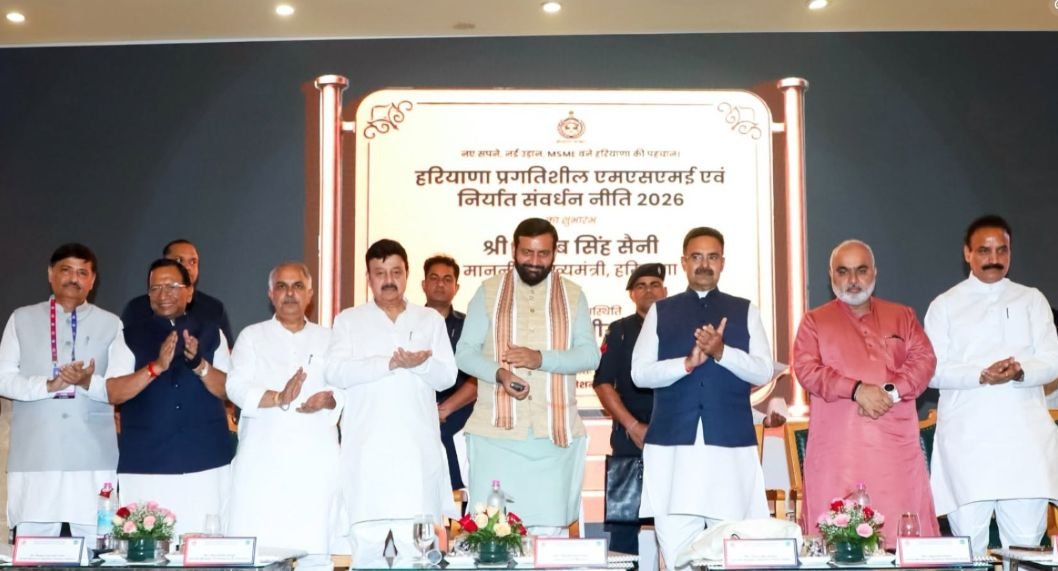
Haryana Chief Minister Nayab Singh Saini on Monday launched the Haryana Progressive MSME and Export Promotion Policy-2026 in Karnal, unveiling a new framework designed to strengthen small and medium enterprises, expand exports, encourage technological adoption and attract investment across the state.
The policy was launched during a special programme marking Haryana’s six-decade development journey and brought together representatives from the industry sector, MSMEs, exporters, financial institutions, industry associations and entrepreneurs from Haryana and neighbouring states.
At the centre of the new policy is an attempt to create a more comprehensive support ecosystem for MSMEs. The government has identified access to finance, industrial infrastructure, technology, skilled manpower, markets and export opportunities as key areas requiring greater institutional support.
Saini said the policy had been developed around the principles of ‘Make in India’ and ‘Make in Haryana’, with the objective of transforming Haryana into a stronger manufacturing and export hub.
One of the significant institutional measures announced alongside the policy is the creation of a dedicated Directorate of MSME. The move is intended to provide more focused administrative support to small businesses and entrepreneurs and improve coordination between government agencies and the industry.
The policy also places considerable emphasis on environmentally responsible industrialisation. A Green Investment Fund will be used to encourage investment in green technologies and environmentally sustainable business practices.
This environmental component reflects the growing pressure on industries to balance economic expansion with sustainability. Industry and Commerce Minister Rao Narbir Singh urged entrepreneurs to explore environmentally friendly production and packaging solutions, particularly materials that can be disposed of without causing long-term damage to the environment.
Technology and innovation are another important component of the policy. The government wants modern technologies to become more accessible to enterprises, allowing smaller businesses to improve productivity, quality and competitiveness.
The export component of the policy is equally significant. Haryana already has a strong industrial and manufacturing base, but the government wants locally produced goods to gain greater recognition in international markets.
Rao Narbir Singh called upon entrepreneurs to focus on quality and innovation so that products manufactured in Haryana could build a stronger identity in overseas markets.
The policy also seeks to make industrial opportunities available beyond the state’s major cities. Saini said the government wanted every district and region of Haryana to develop its own industrial identity, allowing local talent and resources to contribute to economic growth.
The underlying objective is to create a wider entrepreneurial base. Instead of industrial activity remaining concentrated in established centres, the government wants smaller cities and districts to become new locations for manufacturing, services and enterprise.
Haryana Assembly Speaker Harvindra Kalyan highlighted the state’s geographical and infrastructural advantages, particularly its proximity to Delhi and its existing connectivity and industrial facilities.
He said the policy should provide both new investors and established businesses with opportunities to enter new sectors, expand existing operations and increase their productive capacity.
The government has also linked the policy to the broader national ambition of building a developed India by 2047. Kalyan said entrepreneurs would play an important role in that journey because investment, risk-taking and business expansion directly contribute to economic growth and employment.
During the Karnal event, the Chief Minister unveiled the policy document as well as a coffee-table book showcasing Haryana’s industrial journey. He also inaugurated an exhibition featuring products, technologies and success stories from MSMEs operating in different parts of the state.
The event provided an opportunity to highlight the diversity of Haryana’s smaller enterprises and their contribution to the state’s manufacturing and economic landscape.
Industry and Commerce Department Commissioner and Secretary Dr Amit Agarwal said the government was working to strengthen the MSME ecosystem and expressed confidence that the new policy would provide additional momentum to industrial development.
Director General of the Directorate of Small and Medium Enterprises Yash Garg also presented details of the new policy and outlined the sector’s achievements and future opportunities.
Taken together, the policy’s provisions point towards a broader industrial strategy in Haryana — one that combines traditional manufacturing strengths with exports, technology, environmental sustainability and entrepreneurship.
For thousands of small and medium businesses, the critical question now will be how quickly these policy commitments translate into easier access to finance, infrastructure, markets and technology.
For the state government, the larger objective is more ambitious: to build an industrial ecosystem in which Haryana-made products can compete internationally, new enterprises can emerge across districts and young people can find meaningful employment and entrepreneurship opportunities within the state.