
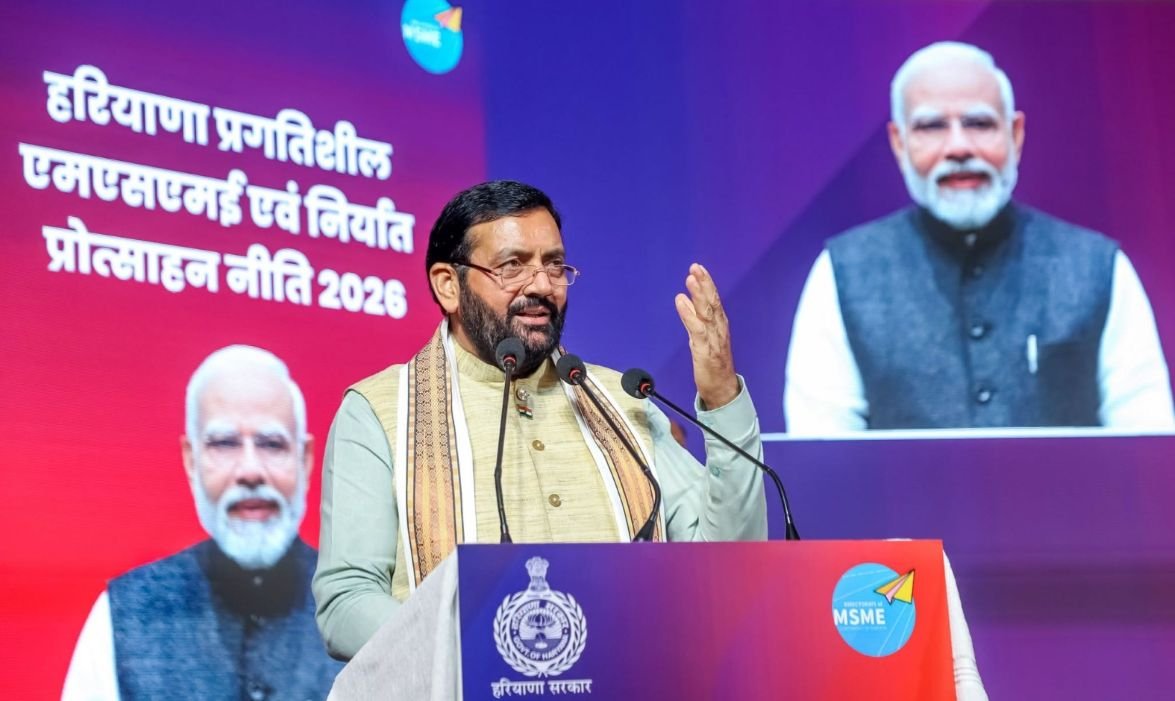
Haryana is seeking to reposition itself for the next phase of industrial growth, with Chief Minister Nayab Singh Saini unveiling a new policy framework aimed at expanding the state’s manufacturing base, strengthening small businesses and creating a more geographically distributed industrial economy.
The Haryana Progressive MSME and Export Promotion Policy-2026, launched in Karnal as part of programmes marking six decades of Haryana’s formation and development, places micro, small and medium enterprises at the centre of the state’s next industrial strategy.
The policy comes at a time when Haryana is attempting to build on its established reputation as a major manufacturing and industrial state while creating opportunities beyond its traditional economic centres. The government’s stated objective is to ensure that industrialisation is not concentrated only around the state’s larger cities, but reaches districts and smaller economic centres as well.
Saini described entrepreneurs as the foundation of any strong economy, arguing that businesses convert ideas into production, investment into economic activity and individual ambition into employment. The government, he said, wants to create an environment in which entrepreneurs can establish, expand and sustain businesses with greater confidence.
The policy’s emphasis on MSMEs is significant because smaller enterprises form an important part of the employment and manufacturing ecosystem. For Haryana, strengthening this segment could help widen the industrial base while creating opportunities for young people who may otherwise migrate in search of work.
The Chief Minister said the government’s broader ambition was to make Haryana not merely an investment destination but a centre for innovation, employment and entrepreneurial confidence.
The geographical dimension of the strategy is particularly important. Haryana’s industrial growth has historically been strongly associated with areas such as Gurugram, Faridabad, Panipat and other established industrial clusters. The new policy seeks to encourage a wider spread of industrial activity, allowing local skills, resources and entrepreneurial potential in other districts to become part of the state’s economic expansion.
The government also sees the policy as part of the wider ‘Make in India’ framework, with ‘Make in Haryana’ emerging as a complementary objective. The focus is expected to extend across finance, industrial infrastructure, technology, skills, exports and access to markets.
A dedicated Directorate of MSME has been established to strengthen institutional support for the sector. The move is intended to create a more focused administrative mechanism for dealing with the requirements of smaller enterprises and prospective entrepreneurs.
The state is also attempting to align industrial expansion with environmental responsibility. A Green Investment Fund has been incorporated into the policy framework to encourage environmentally sustainable investment and the adoption of cleaner technologies.
This focus reflects an increasingly important challenge for industrial states: how to expand production and employment without placing unsustainable pressure on natural resources. The government has indicated that environmental considerations will therefore form part of Haryana’s industrial growth strategy.
Haryana Assembly Speaker Harvindra Kalyan said the state had considerable potential for industry and entrepreneurship, pointing to its infrastructure, connectivity and proximity to Delhi as major advantages for investors.
Industry and Commerce Minister Rao Narbir Singh also stressed the importance of MSMEs alongside large industries, arguing that the smaller enterprise sector would remain essential to sustaining economic growth.
He urged businesses to concentrate on quality and innovation so that products manufactured in Haryana could strengthen their presence in both domestic and international markets.
The state’s economic ambitions are therefore increasingly being framed around a combination of manufacturing, entrepreneurship, exports, technology and employment. The challenge will be to convert the policy announcements into measurable investment, new enterprises and sustainable jobs across districts.
For the Saini government, the new policy represents an attempt to move Haryana into a broader industrial phase — one in which the state seeks not simply to attract investment but to develop its own ecosystem of entrepreneurs, manufacturers, exporters and skilled workers.
If effectively implemented, the policy could help determine whether Haryana’s next six decades of economic development are concentrated in established industrial corridors or distributed more widely across the state.
The government’s stated vision is clear: Haryana should be a place where young people can find opportunity without having to leave the state, while local entrepreneurs have the infrastructure, finance, technology and markets required to compete beyond the state’s borders.
The real test, however, will lie in implementation — particularly in ensuring that the benefits of the new industrial strategy reach smaller towns and emerging entrepreneurs rather than remaining concentrated in established business centres.