
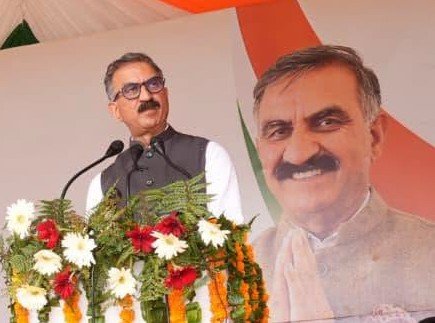
The Sukhvinder Singh Sukhu government is preparing to expand its welfare agenda with a targeted programme aimed at some of Himachal Pradesh’s most economically vulnerable households, marking an important shift in the state’s approach to social protection. The proposed “Apna Parivar, Sukhi Parivar” initiative is expected to focus on around 1.8 lakh families identified through a government survey, with the administration seeking to connect each household with the welfare support most relevant to its circumstances.
The programme is expected to be formally launched on October 2. Its political significance lies not merely in the number of beneficiaries but in the government’s attempt to move towards a more targeted model of welfare delivery. Instead of treating poverty as a single category, the administration intends to identify the particular difficulties faced by individual families and then link them with appropriate government schemes.
For Chief Minister Sukhu, the initiative provides an opportunity to strengthen the social dimension of his government’s governance agenda at a time when the Congress administration is simultaneously under pressure over Himachal Pradesh’s difficult financial position.
The government has said that a large-scale survey covering nearly 19 lakh families was undertaken to identify households requiring additional support. Around 1.8 lakh families were subsequently identified as particularly vulnerable. The administration’s stated objective is to ensure that such families are not left outside the social-security network simply because they do not fall within conventional poverty categories.
That distinction is important in Himachal Pradesh.
The state’s rural economy is built around agriculture, horticulture, livestock, small businesses, seasonal employment and government services. A household may own land or have a modest income and still face serious financial difficulties because of medical expenses, inadequate housing, unemployment, rising household costs or the loss of livelihood following a natural disaster.
The proposed programme seeks to address precisely this grey area of vulnerability.
District administrations have been asked to assess the requirements of identified families and determine which government schemes can provide assistance. The concept is therefore not limited to distributing financial aid. It is intended to create a mechanism through which a family can be connected with multiple forms of government support depending on its needs.
One household may require housing assistance. Another may need employment support. A third could benefit from electricity relief, social security or livelihood assistance.
For the Sukhu government, this represents a potentially significant change in how welfare administration is organised.
Instead of expecting citizens to navigate multiple departments and schemes on their own, the administration wants the government machinery to identify eligible families and guide them towards available benefits.
That approach also has a clear political dimension.
The Congress government has been attempting to build a narrative around “vyavastha parivartan” — changing the way government functions. A targeted welfare programme allows Sukhu to extend that narrative into the social sector by arguing that government should become more responsive to individual household needs.
It also enables the Chief Minister to defend welfare expenditure at a time when his government is simultaneously pursuing fiscal restraint.
Himachal Pradesh faces significant financial pressures. The state must finance salaries, pensions, healthcare, education, infrastructure and disaster recovery while continuing to meet welfare commitments. Repeated monsoon-related disasters have added further pressure on the public exchequer.
In such circumstances, the government cannot easily pursue unlimited universal subsidies.
A targeted approach allows Sukhu to argue that limited resources should be concentrated on those who require them most.
This is likely to become an important part of the political debate.
The BJP, which is increasingly challenging the Congress government on corruption, development and public services, will examine whether the new programme can be implemented effectively and whether the state has the financial capacity to sustain its promised benefits.
The Opposition may also question the process through which vulnerable families are identified and whether political considerations could influence the selection of beneficiaries.
For the government, transparency will therefore be crucial.
The credibility of the programme will ultimately depend on whether eligible families are identified through objective criteria and whether benefits reach them without unnecessary administrative delays.
The welfare initiative also connects with commitments already made by the Sukhu government.
The state’s budget has included targeted assistance for poorer families, including support related to electricity, housing and financial assistance for eligible women. The latest programme brings these ideas together within a more household-focused framework.
The government has also been developing a wider social-support agenda covering nutrition and maternal and child welfare.
The proposed “Indira Gandhi Matri Shishu Sankalp Yojana”, for example, is intended to strengthen nutritional support for mothers, women and young children. The government has indicated that the programme will initially be implemented in selected Integrated Child Development Services blocks before being expanded.
Taken together, these initiatives suggest that the Sukhu government is trying to build a broader welfare architecture rather than relying on individual schemes operating in isolation.
The political timing is significant.
Congress came to power in Himachal Pradesh in 2022 promising a range of welfare and development measures. Since taking office, Sukhu has had to balance those commitments against the state’s difficult fiscal situation. His administration has increasingly emphasised revenue generation, expenditure control and administrative reform.
The latest welfare push allows the government to make a different political argument: financial discipline does not necessarily mean retreating from welfare.
Instead, the government can claim that better targeting can make social spending more effective.
That will be particularly important as the administration moves towards the second half of its tenure.
For voters, however, the success of the programme will not be determined by government announcements or political speeches. It will be determined at the household level.
If a vulnerable family receives electricity relief, obtains assistance to construct a house, gains access to employment support or gets help with an existing welfare entitlement, the programme will have tangible meaning.
If families face delays, unclear eligibility criteria or difficulties dealing with departments, the political narrative could quickly change.
This is why implementation at the district, block, panchayat and village levels will be crucial.
Himachal Pradesh’s social structure also gives the programme a wider significance. In many rural areas, government institutions remain central to economic security. Families affected by illness, crop losses, natural disasters or unemployment can quickly become dependent on public assistance.
A welfare system capable of identifying vulnerability before a household falls into deeper poverty could therefore become an important instrument of social resilience.
For Sukhu, the programme offers a chance to combine that social objective with his broader political message of administrative reform.
The Chief Minister can present the initiative as evidence that his government is attempting to make welfare more precise, responsive and accountable.
The BJP, meanwhile, will likely continue testing the government on whether these promises translate into actual delivery.
That contest is likely to intensify as Himachal’s political conversation gradually moves towards the next Assembly election.
The state’s future political battle will not be decided solely by Assembly protests or competing allegations. It will also be shaped by how people experience government in their homes and villages — whether public services work, whether welfare reaches them and whether young people see economic opportunities in the state.
“Apna Parivar, Sukhi Parivar” therefore carries significance beyond another welfare announcement.
It represents an attempt by the Sukhu government to place the household at the centre of its social-policy approach while navigating one of the state’s most difficult political contradictions: how to expand social protection without further worsening public finances.
If implemented effectively, the programme could strengthen the government’s claim that its welfare policies are becoming more targeted and responsive. If delivery falls short, the Opposition will have a ready-made political issue.
For now, Sukhu is betting that a government that knows precisely which families need help — and what kind of help they need — can build a stronger connection between administration and society.
That connection could become increasingly important as Himachal Pradesh enters the next phase of its political cycle.