



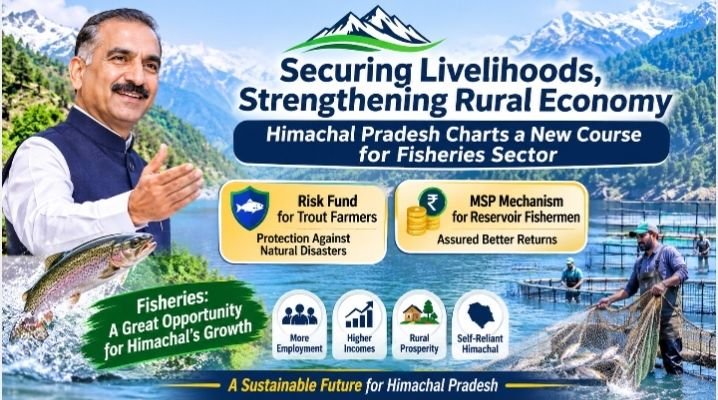
Risk protection for trout farmers and assured returns for reservoir fishermen signal a broader effort to make fisheries a sustainable source of income, employment and rural prosperity
Himachal Pradesh is looking towards its fisheries sector as an important pillar of rural economic growth, with a renewed emphasis on protecting traditional livelihoods, reducing financial vulnerability and creating more dependable income opportunities for people engaged in fishing and fish farming. In a state where geography offers both high-altitude streams and extensive reservoir resources, fisheries has the potential to contribute far more significantly to the rural economy than its conventional role as a livelihood activity.
Recognising this potential, the state government is focusing on two critical concerns confronting the sector: the financial uncertainty faced by trout farmers and the need to secure better prices for fishermen operating in reservoirs. The proposed Risk Fund for trout farmers and the Minimum Support Price (MSP) mechanism for reservoir fishermen represent important interventions in this direction.
For trout farmers, particularly those operating in high-altitude areas, fish cultivation is not merely a commercial activity but a livelihood built around considerable investment, technical knowledge and the availability of suitable natural conditions. However, natural disasters and unforeseen environmental disruptions can cause substantial losses, sometimes wiping out the earnings of an entire production cycle. Such setbacks can place small and medium-scale farmers under severe financial pressure, making it difficult for them to sustain operations or invest in future production.
The proposed Risk Fund seeks to address this vulnerability by providing a financial cushion against losses arising from natural disasters. Its significance lies in the possibility of giving trout farmers greater confidence to continue their activities without facing the full burden of unexpected setbacks. Financial protection can also encourage investment, improve continuity in production and make fish farming a more reliable livelihood option in the state’s mountainous regions.
Equally important is the government’s focus on reservoir fishermen, for whom market uncertainty and fluctuating prices often determine whether fishing remains economically viable. The MSP mechanism is intended to provide better price assurance and protect fishermen from unfavourable market conditions. By strengthening the returns available to those engaged in reservoir fishing, the initiative seeks to improve household incomes and make the occupation more sustainable.
These measures reflect a broader understanding that the development of fisheries cannot be measured merely through increased production. The real test lies in whether people working at the grassroots level receive stable earnings, adequate protection and opportunities to expand their economic activities.
Fisheries: An Emerging Opportunity for Himachal’s Rural Economy
Himachal Pradesh possesses considerable natural advantages for developing fisheries. Its reservoirs, rivers, streams and high-altitude water bodies provide opportunities for different forms of fish production, including trout cultivation and reservoir-based fishing. With appropriate infrastructure, scientific practices, market access and financial support, these resources can become a stronger source of employment and income.
The sector is particularly relevant for rural communities where employment opportunities may be limited and traditional economic activities remain central to household survival. Fisheries can generate income not only through fish cultivation and harvesting but also through associated activities such as transportation, processing, marketing, equipment supply and other local services.
Trout farming, in particular, offers opportunities in suitable high-altitude locations, while reservoir fisheries can support communities living around major water bodies. Strengthening both segments can help diversify the rural economy and reduce dependence on a limited number of livelihood sources.
From Traditional Occupation to Sustainable Enterprise
One of the major challenges facing the fisheries sector is the transition from traditional, small-scale activity towards a more organised and economically sustainable enterprise. This requires more than financial assistance. Farmers and fishermen also need access to technical guidance, improved production practices, quality inputs, modern infrastructure and reliable marketing channels.
Risk protection and price support can provide an important foundation for this transition. When producers have greater confidence that unforeseen losses will not completely undermine their livelihoods and that their produce can fetch more dependable returns, they are better positioned to plan production and make long-term decisions.
The Chief Minister has emphasised that strengthening traditional economic activities is central to the government’s approach towards making Himachal Pradesh self-reliant. He said the fisheries sector has considerable potential to generate employment, improve rural incomes and create new economic opportunities, especially in reservoir and high-altitude areas.
He also reiterated that the government would continue introducing initiatives focused on the welfare of farmers and fishermen, with the objective of making the sector stronger and ensuring that the benefits of development reach communities across the state.
The Larger Goal: Inclusive Growth and Economic Security
The proposed interventions carry significance beyond the immediate financial assistance they are expected to provide. They represent an effort to make rural livelihoods less vulnerable to natural and market-related uncertainties while creating a more supportive environment for local enterprise.
For Himachal Pradesh, self-reliance will depend not only on expanding large industries or attracting investment but also on strengthening the economic foundations of villages and smaller communities. Activities such as agriculture, horticulture, animal husbandry and fisheries can collectively create a more resilient rural economy when supported by effective policies and accessible institutional assistance.
The long-term success of the fisheries initiatives will depend on transparent implementation, timely financial support, effective assessment of losses, fair procurement arrangements and the creation of stronger market linkages. Equally essential will be ensuring that small fishermen and trout farmers can access the benefits without procedural difficulties.
If these measures translate into meaningful financial security and better market opportunities, fisheries could emerge as a stronger engine of rural prosperity in Himachal Pradesh. The larger vision is to transform a traditional livelihood into a sustainable economic opportunity—one that supports families, generates local employment and contributes to the state’s journey towards self-reliance.