

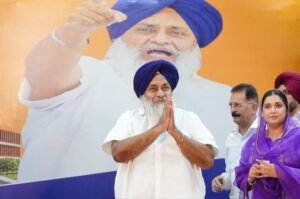
Calling for the return of a regional government, the Akali Dal chief targets AAP and Congress while putting affordable power, sand prices, industrial revival and law and order at the heart of his campaign
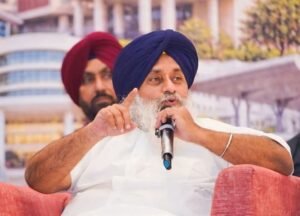
TARN TARAN | As Punjab gradually moves towards the 2027 Assembly elections, Shiromani Akali Dal (SAD) president Sukhbir Singh Badal is sharpening his party’s political pitch around a familiar but increasingly central theme: the need for a strong regional leadership to safeguard Punjab’s interests. His interaction with traders, industrialists and representatives of non-governmental organisations in Tarn Taran on November 23 was part of an expanding outreach campaign through which the Akali Dal is seeking to rebuild its connection with different sections of the electorate.
The meeting, organised by constituency in-charge Kanchanpreet Kaur, was less a conventional political address than an attempt to take the party’s emerging economic and administrative agenda directly to local business communities. From the rising cost of construction material and industrial electricity tariffs to GST-related concerns, infrastructure deficiencies and law and order, Badal used the issues raised by participants to outline a series of promises should the SAD return to power in 2027.
His central political argument was that Punjab needed a government rooted in the state’s own political and regional interests. He urged voters to choose the Shiromani Akali Dal, alleging that the Congress and the Aam Aadmi Party had failed to protect Punjab’s interests and were more concerned with political power than the state’s welfare. These were political charges levelled by the SAD president, but they reflected the direction in which the party is attempting to frame the coming electoral contest.
A regional party seeks to reclaim political space
For Sukhbir Badal, the 2027 election is an important test of the Akali Dal’s political revival. Once a dominant force in Punjab politics, the party has faced a difficult period following its defeat in the 2022 Assembly elections. Its challenge now is to persuade voters that it can re-establish itself as a credible alternative while addressing concerns about its own record in government.
Badal’s appeal to elect a regional party is therefore central to the SAD’s campaign narrative. The argument is that Punjab’s agricultural, economic, cultural and federal concerns require leadership that understands the state’s specific circumstances and can negotiate with the Centre from a regional perspective.
The party has been stepping up its public engagement ahead of the elections through constituency-level meetings, door-to-door outreach and a statewide campaign led by Badal. It has also been gathering suggestions from different sections of society for its election agenda. The Tarn Taran interaction fits into this broader effort to move beyond general political criticism and place specific commitments before traders, industry representatives and local communities.
Affordable power and the promise of industrial revival
One of the most prominent announcements at the meeting concerned electricity tariffs. Responding to the demand for affordable power from shopkeepers and industrial units, Badal promised that an SAD government would provide electricity to shops and industries at ₹5 per unit.
He also claimed that Punjab could be made a power-surplus state within the first 18 months of an Akali Dal government. The promise is intended to address concerns among businesses over operating costs and the reliability of electricity supply. However, achieving such a target would require a detailed assessment of generation capacity, procurement costs, distribution infrastructure and the state’s financial commitments.
The industrial infrastructure question was raised by Harbhajan Singh of the Industry Union, who drew attention to the lack of basic facilities in the Focal Point and frequent power cuts. Badal recalled that industrial focal points across Punjab had been developed during earlier Akali governments and promised that these would be repaired and rebuilt if the party returned to office.
The commitment is significant for industrial centres such as Tarn Taran, where local businesses depend on functioning roads, drainage, electricity and other essential services. For the SAD, the wider message is that industrial revival cannot be achieved merely through investment announcements; existing industrial infrastructure must also be made functional and competitive.
Badal argued that the state should focus on attracting large industries rather than relying on raids on shops and small businesses to increase revenue. He said fresh investment would expand economic activity and generate tax revenue, while also creating employment opportunities.
Sand prices and the politics of mining
The sharp rise in sand prices was another major issue raised during the interaction. Gursharanjit Singh, head of the Building Material Traders Union, said that prices had increased from around ₹2,400 to more than ₹10,000 over a decade, putting pressure on construction-related businesses and consumers.
Badal promised that an SAD government would ensure the availability of sand at reasonable rates. He alleged that illegal or excessive collections linked to sand mining had benefited politically connected individuals and said that money allegedly collected by Arvind Kejriwal through mining would be recovered.
The allegation was part of Badal’s attack on the AAP government and should be viewed as a political claim rather than an established finding. Nevertheless, the underlying concern over the cost and availability of construction material has a direct bearing on the construction sector, traders and ordinary households.
The issue also presents a policy challenge for any incoming government: ensuring transparent mining operations, preventing illegal extraction, regulating supply and making construction material available at prices that do not place an unreasonable burden on consumers.
Rahat scheme and an end to inspector harassment
For small traders, the promise to revive the Rahat scheme was among the more consequential announcements. Adesh Agnihotri raised concerns about GST-related harassment and the deteriorating law and order situation, prompting Badal to outline a proposed system under which shopkeepers would pay a nominal lump-sum tax.
Under the model he described, once the prescribed payment was made, inspectors would not be permitted to routinely visit their premises. The proposal is intended to reduce compliance pressure on small businesses and restore what the SAD describes as a relationship of trust between traders and the government.
The practical details, including the applicable tax categories, eligibility and coordination with existing GST regulations, would need to be clarified. GST is a national tax framework, and any state-level relief mechanism would have to operate within the law. Even so, the announcement reflects the party’s attempt to address a long-standing demand among small traders for simpler compliance and less intrusive inspections.
Badal also assured brick kiln owners that their problems would receive a permanent solution, although he did not spell out the proposed measures in detail.
Law and order enters the campaign agenda
The law and order situation was another prominent concern at the meeting. Badal promised firm action against gangsters and said an Akali Dal government would work to restore public confidence in the police and administration.
The issue is likely to remain a major part of the 2027 political debate. Concerns over organised crime, extortion, gang networks and drug trafficking have repeatedly featured in Punjab’s political discourse. For the SAD, raising these issues allows it to challenge the AAP government on one of the most sensitive responsibilities of any state administration.
However, the test for any party making such promises will be the ability to strengthen policing, improve investigation and prosecution, dismantle criminal networks and ensure that ordinary citizens feel secure. A tougher political message alone cannot substitute for measurable improvements in public safety.
Tarn Taran meeting becomes part of the manifesto exercise
The meeting also provided a platform for local business representatives to place their demands before the SAD leadership. Harinder Aggarwal, Surjit Ahuja, Parminderjit Singh and Subhash Kumar shared their views and suggestions, which Badal said would be considered for inclusion in the party’s election agenda.
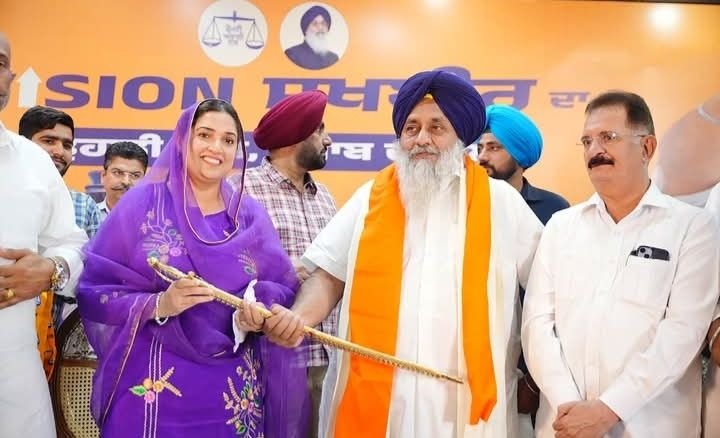
He appealed to those present to support Kanchanpreet Kaur, the party’s constituency in-charge and candidate, praising her for continuing to raise public issues despite what he described as harassment by the civil and police administration. Punjab Beopar Mandal president Amit Kapoor also urged the gathering to support the Akali Dal.
The interaction reflects the party’s attempt to make its campaign more issue-based by engaging with traders, industrialists and local organisations rather than relying exclusively on public rallies and political speeches.
The road to 2027
Sukhbir Badal’s Tarn Taran outreach comes at a time when political parties in Punjab are beginning to position themselves for the next Assembly election. The Akali Dal is seeking to turn economic concerns, regional identity, administrative accountability and law and order into the principal pillars of its campaign.
For the party, the challenge is twofold: it must persuade voters that its proposed policies can address Punjab’s current problems, while also convincing them that it has drawn lessons from its own periods in government. Its promises of ₹5-per-unit electricity, affordable sand, a revived Rahat scheme and a power-surplus Punjab will require clear financial and implementation plans before voters can assess their feasibility.
The Tarn Taran meeting has given Badal another opportunity to put those commitments on the table. Whether they translate into wider public support will depend not only on the strength of the Akali Dal’s campaign but also on how convincingly it answers questions about its past governance and its plans for Punjab’s future.
As the 2027 election approaches, the contest will increasingly be about competing claims of performance, credibility and the capacity to deliver. Badal’s message in Tarn Taran was clear: the SAD wants the election to be fought around the argument that Punjab needs its own regional political voice. The electorate, however, will make its judgement on the basis of both promises and the record behind them.