

CM calls for greater financial autonomy to local bodies, announces phased transfer of key civic services and matching grants to boost grassroots development
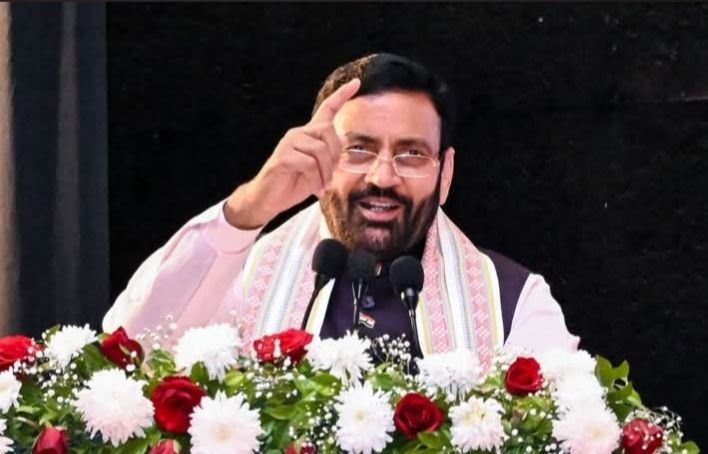
Gurugram : Haryana Chief Minister Nayab Singh Saini has called for transforming Panchayats and Municipalities into strong, financially independent and accountable institutions, asserting that empowered local governments are essential for achieving the vision of a developed Haryana.
Addressing the concluding session of a two-day national conference on empowering Panchayats and Municipalities in Gurugram on Tuesday, the Chief Minister said the state government was committed to equipping local bodies with greater administrative authority, institutional capacity and adequate financial resources. He emphasised that Panchayats and Municipalities should function as effective institutions of local self-government rather than remain confined to routine administrative responsibilities.
Development and Panchayats Minister Krishan Lal Panwar and Industries and Commerce Minister Rao Narbir Singh were also present at the conference, which brought together public representatives, policymakers and experts from different parts of the country to deliberate on strengthening grassroots democracy.
Saini said the discussions during the two-day event had provided an opportunity to exchange experiences, innovative practices and successful models of local governance. The deliberations, he added, had helped evolve a practical roadmap for improving the functioning and financial sustainability of local institutions.
Highlighting the importance of grassroots democracy, the Chief Minister said the real strength of democratic governance was reflected in village streets, community spaces and urban neighbourhoods rather than being limited to government offices and administrative files.
Recalling Mahatma Gandhi’s vision of Gram Swaraj, Saini said the concept of self-reliant villages remained central to India’s democratic philosophy. He linked this vision with Prime Minister Narendra Modi’s goal of making India a developed nation by 2047, observing that the journey towards this national ambition must begin with empowered village Panchayats and urban wards.
Local Assets to Become Revenue-Generating Resources
The Chief Minister stressed that Panchayats must make better use of their common lands, village ponds and community properties by developing them as sustainable sources of income. Such assets, if managed efficiently, could strengthen the financial position of village institutions and reduce their dependence on government grants.
He also outlined the government’s approach to encouraging local bodies to mobilise additional financial resources. Under the proposed arrangement, the state government will provide matching grants against the additional resources generated by Panchayats and other local institutions. The initiative is intended to reward efforts towards revenue generation and encourage greater financial discipline and self-reliance at the grassroots level.
Saini said the government wanted local institutions to have both the authority and the resources necessary to address people’s everyday requirements. Financial empowerment, he indicated, would be accompanied by improved administrative capabilities and greater accountability in the delivery of civic services.
Key Civic Services to Be Transferred in Phases
In another significant announcement, the Chief Minister said responsibilities relating to public health engineering, drinking water supply and fire services would be transferred to local bodies in a phased manner.
The proposed devolution is expected to expand the role of Panchayats and Municipalities in managing essential public services and bring decision-making closer to citizens. A phased approach would allow local institutions to develop the necessary administrative and operational capacity before assuming additional responsibilities.
The Chief Minister said the government was working towards a governance framework in which local bodies would have greater ownership of development priorities and would be better equipped to respond to the specific needs of their communities.
Referring to the Centre’s development agenda, Saini also cited the Prime Minister’s poverty alleviation initiatives, claiming that welfare programmes over the past 12 years had helped lift 500 million people out of poverty. He described this as a major achievement and said inclusive development required effective institutions at every level of governance.
The conference concluded with a renewed emphasis on strengthening decentralised governance, improving the financial position of local institutions and ensuring that development decisions increasingly reflect the needs and aspirations of people at the village and municipal levels.
The Haryana government’s approach, as outlined by the Chief Minister, places Panchayats and Municipalities at the centre of its development strategy, with financial autonomy, better management of local assets and the phased transfer of public services emerging as key components of the proposed governance reforms.