
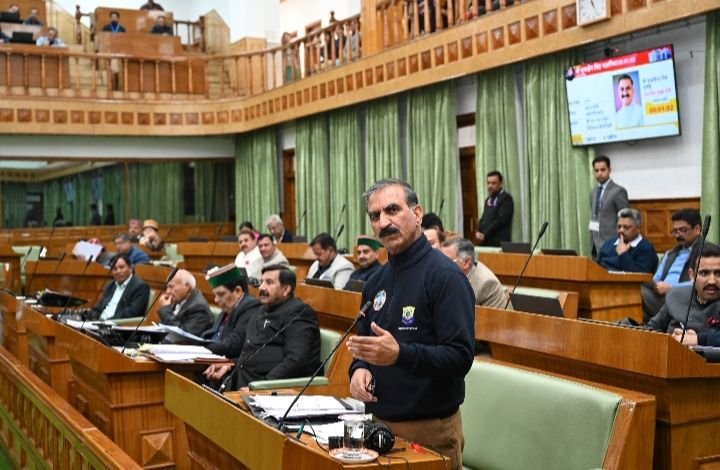
The final day of the Himachal Pradesh Assembly’s winter session in Tapovan, Dharamshala turned into a theatre of sharp political confrontation, heated exchanges and procedural interruptions. Friday, which marked the eighth and concluding day of the session, witnessed an intense face-off between senior Congress minister Jagat Singh Negi and Leader of Opposition and former Chief Minister Jai Ram Thakur, with BJP MLAs joining the fray and pushing the House into repeated bouts of uproar.
What was expected to be a routine concluding sitting unfolded into a full-blown political tussle—highlighting how both Congress and BJP appear determined to corner each other rather than seek consensus on pressing issues before the state.
A Session Dominated by Conflict
The day began with Question Hour, where the Leader of Opposition raised queries about the closure and denotification of various government institutions under the current Congress government. The government responded that data was still being compiled, which immediately triggered a reaction from Jai Ram Thakur, who accused the Treasury benches of deliberately concealing information.
Chief Minister Sukhvinder Singh Sukhu intervened, assuring that complete details would be shared in the next session. But the back-and-forth only intensified the charged atmosphere already simmering in the House.
The “Nonsense” Controversy and Special Privilege Notice
The most significant flashpoint of the day stemmed from Minister Jagat Singh Negi’s special privilege notice against Jai Ram Thakur. Negi alleged that the Opposition leader used inappropriate terms against him the previous day. The minister maintained that he was subjected to remarks like “nonsense” and accused of misbehavior.
Negi, a five-time elected MLA and a prominent tribal leader, stated on the floor of the House that he was “called names and threatened”, stressing that speaking the truth should not be labelled as misconduct. He reiterated that he never interrupts any member and participates only when his turn comes.
Jai Ram Thakur countered with equal emphasis, insisting that he never used any unparliamentary word and that the official record would prove his claim. The former Chief Minister underlined that unnecessary friction benefits no one and urged that public interest issues must receive priority.
Speaker Kuldeep Singh Pathania informed the House that the notice had been forwarded to the Assembly Secretary for examination and that further action would be communicated after scrutiny. He also assured that all unparliamentary expressions would be removed from the record, and appealed for cooperation—especially after the House had to be adjourned for ten minutes due to constant shouting.
BJP’s Charges: Social Media, RTI and Government Image Management
The Leader of Opposition also raised concerns regarding RTI responses suggesting that information withheld in the Assembly was available through other channels. He accused the government of hiring agencies to tarnish the Opposition’s image through social media pages allegedly funded with public money.
The Chief Minister dismissed these allegations, claiming that such tactics are characteristic of the BJP’s IT culture, not the Congress. Sukhu said the government would investigate the matter and maintained that Congress does not indulge in such practices.
The “Radhe Radhe” Issue
During the ongoing clash, the Chief Minister also addressed a recent social media controversy wherein his remarks to schoolchildren about the phrase “Radhe Radhe” were clipped and circulated in a misleading manner.
Sukhu clarified that he had merely asked children whether they knew the meaning and cultural context of the greeting which is commonly used in Vrindavan. The edited video, he claimed, was shared in a distorted manner to generate outrage.
Rising Volume, Deepening Divide
As Jagat Singh Negi and BJP MLA Vipin Parmar locked into a separate argument, the House again descended into loud protests. The exchanges illustrated the widening gap between the ruling and opposition benches—fuelled by months of political pressure, defections, and internal challenges within the state’s political landscape.
The Chief Minister later remarked that the dignity of ministers must be respected inside the House. While backing Negi as an honest and straightforward leader, he also reminded the Opposition that appointing or removing ministers remains the prerogative of the government.
A Contentious End to a Critical Session
The winter session’s final day mirrored the state’s current political mood—confrontational, volatile and deeply polarized. While both sides claim to defend public interest, much of the assembly’s time was consumed by personal allegations, procedural disputes and attempts to undercut each other.
As the House concluded, it left behind not just pending discussions but also a trail of unresolved tensions. The sharp exchanges between Jagat Singh Negi and Jai Ram Thakur, the debate over social media manipulation, the controversy over cultural remarks, and the ongoing privilege issue—all indicate that the political temperature in Himachal Pradesh is likely to stay elevated well beyond the session’s closure.