
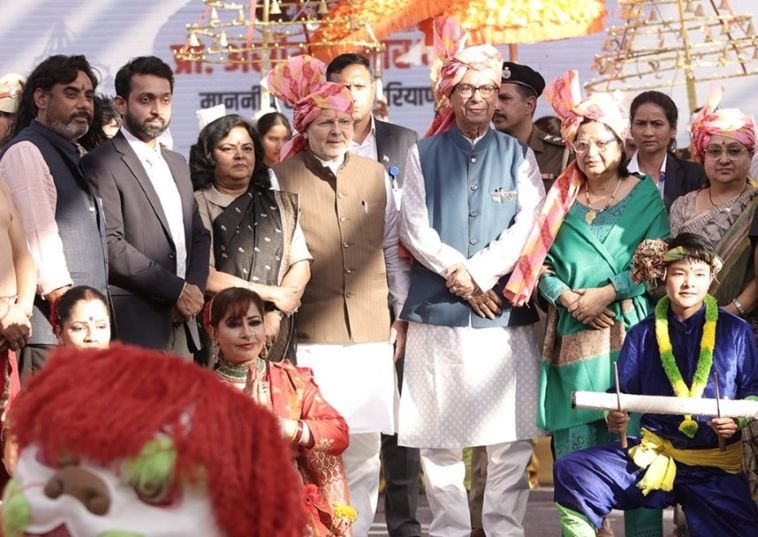
The 39th Surajkund International Crafts Mela concluded on a magnificent note, reaffirming Haryana’s position as a vibrant cultural gateway of India and a global meeting ground of tradition, innovation and artistic enterprise. Organized annually by the Haryana Government, the fair has grown far beyond a regional exhibition of crafts into one of the world’s most recognized cultural gatherings, drawing artisans, performers and visitors from across continents. This year’s edition marked yet another milestone in the state’s cultural journey, blending heritage with modern outreach under the broader developmental vision of Chief Minister Nayab Singh Saini.
The closing ceremony was graced by Haryana Governor Professor Aseem Ghosh, who presented awards to distinguished artisans and lauded the event as a living testament to India’s civilizational depth and creative diversity. In his address, the Governor observed that the mela has evolved into a platform where tradition and innovation walk hand in hand. He described it as a celebration of the skill, resilience and imagination of artisans, weavers and folk performers from India and abroad, reinforcing the spirit of unity in diversity.
The ceremony was attended by Cabinet Minister Vipul Goyal, Mayor Praveen Joshi, and was presided over by Tourism Minister Dr. Arvind Kumar Sharma, whose department played a pivotal role in curating and executing the event at an international scale. The combined efforts of the Tourism Department and the Public Relations Department ensured that the fair reached audiences across social, economic and geographical segments, making it not merely an exhibition but a global cultural narrative.
The Surajkund Mela, hosted annually in Faridabad district, has steadily transformed into a major soft-power platform for Haryana. Under the leadership of Chief Minister Nayab Singh Saini, the state government has emphasized cultural infrastructure and global engagement as integral components of development. The mela stands as a reflection of that broader vision—one that positions Haryana not only as an industrial and agricultural powerhouse but also as a custodian of India’s intangible heritage.
At the awards ceremony, master artisans from across India were honoured in multiple categories, recognizing excellence in traditional and contemporary crafts. In the Traditional Category, Telangana’s Gaddam Bala was awarded for outstanding Ikat craftsmanship, receiving a cash prize of ₹11,000. In the Kala Ratna category, Odisha’s Damodar Fateh Singh was recognized for his exceptional contribution to Pattachitra art, also receiving ₹11,000.
The Kala Mani category saw eight artisans being honoured for diverse traditional crafts: Salauddin from Uttar Pradesh for Chikankari, Karupathi Rajavari Kumar from Andhra Pradesh for Kalamkari, Irfan Ali from Uttar Pradesh for marble inlay, Lakshmi Lal Kumhar from Rajasthan for Molela art, Om Prakash Malhotra from Himachal Pradesh for Kullu shawls, Urmila Devi from Bihar for Madhubani painting, Shakuntala from Andhra Pradesh for wood carving, and Mohammad Kaleem from Uttar Pradesh for Banarasi saree craftsmanship. Each awardee received ₹11,000 in recognition of their artistic excellence.
In the Kala Nidhi category, artisans such as Ehmonkhongwir and Relivent from Meghalaya for cane-bamboo craft and Eri silk respectively, K. Ramu from Telangana for Kalamkari, Santosh Kumar from Andhra Pradesh for wooden toys, Chanda Devi from Rajasthan for leather footwear, and Asit Baran Jana from West Bengal for Madurkathi craft were honoured with ₹5,100 each.
The Kala Shri awards recognized emerging excellence, honouring Shipra Sharma from Uttar Pradesh for Lippan art, Rita Sarkar from West Bengal for jute craft, and Charu Arora from Delhi for origami and paper craft, each receiving ₹2,100.
The mela’s international character was reflected in the Best Foreign Awards, presented to artisans from Egypt, Sri Lanka and Algeria. Gehan Khalifa from Egypt was honoured for embroidery, Iresha from Sri Lanka for batik craft, Hosin Nezzar from Algeria for hand weaving, and M.D. Empapi from Egypt for brass and metal plate craftsmanship. Their participation underscored the mela’s global resonance and Haryana’s growing cultural diplomacy footprint.
Beyond the awards, what distinguished this edition was its scale, outreach and administrative coordination. The Haryana Tourism Department ensured world-class infrastructure, curated thematic pavilions, facilitated artisan participation, and maintained logistical excellence throughout the fortnight-long celebration. Meanwhile, the Public Relations Department sustained a dynamic media campaign, amplifying daily highlights, cultural performances and artisan stories across traditional and digital platforms. This strategic communication effort significantly broadened the mela’s visibility among youth, urban audiences and international observers.
The economic impact of the fair has also been notable. Thousands of artisans reported strong sales and new business connections, strengthening the narrative of “Atmanirbhar” or self-reliant crafts. The mela has emerged as a sustainable livelihood platform, bridging rural artistry with global markets. This aligns with the state government’s emphasis on empowering grassroots talent and integrating heritage industries into modern economic frameworks.
Under Chief Minister Nayab Singh Saini’s governance, Haryana has increasingly positioned culture as a driver of both identity and development. The Surajkund Mela embodies this dual objective. It celebrates India’s artistic traditions while projecting Haryana as a progressive state capable of organizing a world-class cultural festival with administrative precision and inclusive outreach.
As the curtains fall on the 39th edition, the Surajkund International Crafts Mela leaves behind not only vibrant memories of colour, music and craftsmanship but also a strengthened global image for Haryana. With sustained institutional support, visionary leadership and dedicated execution by the Tourism and Public Relations departments, the mela continues to evolve as one of India’s most significant cultural landmarks—an annual affirmation that heritage, when nurtured thoughtfully, can become a powerful instrument of unity, economic vitality and international engagement.