

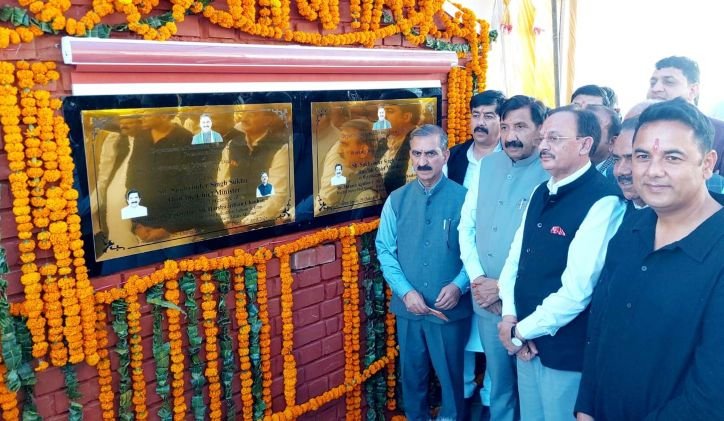
In a significant move blending industrial ambition with political messaging, Sukhvinder Singh Sukhu on Sunday laid the foundation stone for key infrastructure works under the Bulk Drug Park project at Polian Beet in Una district, marking a renewed push to position Himachal Pradesh as a critical player in India’s pharmaceutical manufacturing ecosystem. The project, estimated at ₹250 crore for initial infrastructure works, is part of a much larger ₹2,000 crore industrial vision that the state government hopes will redefine the region’s economic trajectory.
The Chief Minister also inaugurated the foundation for a working women’s hostel at Panjuana, signaling a parallel focus on social infrastructure to support the anticipated workforce influx. Together, these announcements reflect a broader governance strategy aimed at combining industrial growth with social inclusivity—an approach that carries strong political undertones as Himachal gradually moves towards its next electoral cycle.
Describing the Bulk Drug Park as a “project of national importance,” Sukhu emphasized that its timely execution would not only generate large-scale employment for local youth but also transform the Haroli region into a modern industrial hub. He directed officials to ensure visible progress within the next six to eight months, underlining the urgency often associated with flagship projects in politically competitive environments.
The Bulk Drug Park is one of only three such projects being developed across India, making its location in Himachal Pradesh strategically significant. With equal financial participation from the Centre and the state government—₹1,000 crore each—the project aims to reduce India’s dependence on imported Active Pharmaceutical Ingredients (APIs), a vulnerability that became particularly evident during global supply chain disruptions in recent years. By strengthening domestic manufacturing capabilities, the project aligns with India’s broader push for self-reliance in critical sectors.
However, Sukhu used the occasion not only to highlight development but also to sharpen his political critique. Taking a direct swipe at the previous Bharatiya Janata Party government, he alleged that despite receiving significantly higher central funds during its tenure, the funds were not effectively utilized for public welfare. He contrasted this with his administration’s focus on targeted reforms and measurable outcomes, particularly in education and social welfare.
The Chief Minister also accused the Centre of neglecting Himachal’s financial needs by discontinuing the Revenue Deficit Grant and curtailing allocations under schemes like MGNREGA, arguing that such decisions have placed additional pressure on the state’s resources. This narrative of fiscal constraint versus developmental ambition is likely to become a central theme in upcoming political debates, especially as opposition parties counter the government’s claims.
Beyond industry, Sukhu highlighted reforms in the education sector, stating that the adoption of the CBSE curriculum in government schools has already begun yielding results, with Himachal rising significantly in national education rankings. He also pointed to the launch of the Dr. Y.S. Parmar Vidyarthi Rin Yojana, which offers higher education loans at a minimal one percent interest rate, as evidence of the government’s commitment to inclusive growth.
Deputy Chief Minister Mukesh Agnihotri reinforced the industrial narrative by describing Haroli as an emerging node on India’s industrial map. He detailed complementary infrastructure projects, including water supply schemes worth ₹66 crore and a proposed ₹3,400 crore rail link to integrate the Bulk Drug Park with the national logistics network. These developments, he said, would not only enhance industrial activity but also improve the quality of life for local residents.
Industries Minister Harshwardhan Chauhan echoed similar sentiments, calling the project a “milestone” for Himachal’s economic future and a catalyst for investment and employment generation. The presence of multiple senior नेताओं and officials at the event underscored the political importance attached to the project.
The broader implications of the Bulk Drug Park extend beyond immediate economic gains. By positioning Himachal as a pharmaceutical manufacturing hub, the government is attempting to diversify the state’s traditionally tourism- and agriculture-driven economy. At the same time, the project serves as a tangible symbol of governance, one that can be showcased in electoral narratives as evidence of development-oriented leadership.
Yet, as with many large-scale infrastructure projects, execution will be key. Timelines, environmental considerations, and actual job creation will determine whether the project lives up to its promise or becomes another contested political talking point. With elections on the horizon, both the ruling government and the opposition are likely to frame the Bulk Drug Park as either a transformative success or an overambitious claim.
For now, the foundation stones laid at Polian Beet represent more than just concrete beginnings—they signal the intersection of policy, politics, and public expectation in a state where development is increasingly becoming the central battleground.