
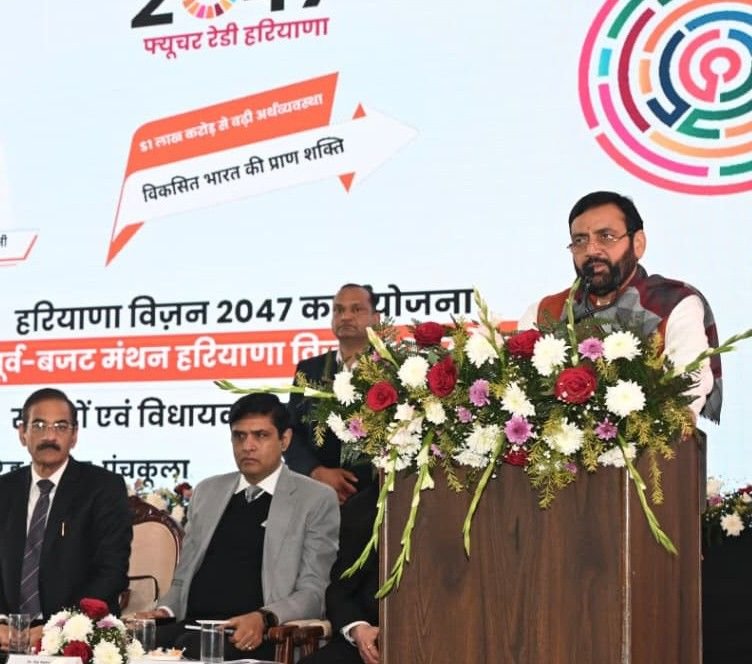
Haryana Chief Minister Nayab Singh Saini on Tuesday said that the upcoming state budget for 2026–27 will be shaped not merely by financial figures but by the hopes, expectations and aspirations of the people of Haryana, asserting that the exercise is aimed at ensuring that every citizen feels a renewed sense of trust and optimism. Addressing a high-level pre-budget consultation meeting in Panchkula with ministers, Members of Parliament and MLAs, the Chief Minister said the budget would reflect the collective voice of the state and serve as a bridge between present needs and long-term developmental goals.
The meeting was held as part of the Haryana Vision 2047 action plan, which aligns the state’s development roadmap with the national goal of achieving a developed India by 2047. The Chief Minister said the budget process this year is being strengthened through the extensive use of information technology and artificial intelligence. He informed that since the launch of an AI-based app on January 6, more than 9,000 suggestions have already been received from citizens and stakeholders. These inputs, he said, are being carefully evaluated, and constructive and practical ideas will be incorporated into the final budget document, following the model adopted last year.
Saini said citizens can continue to submit their suggestions through the online portal until January 31, underlining the government’s commitment to participatory governance. He noted that the pre-budget consultation process, which began in Gurugram on January 6, has now concluded with the Panchkula meeting. In total, 12 consultation sessions were held across the state, during which discussions were conducted with nearly 1,600 stakeholders and more than 1,500 suggestions were formally recorded. These interactions covered a wide range of sectors, including industry, education, women’s groups, healthcare, farmers, sarpanches and councillors, youth representatives and various social and professional organisations.
The Chief Minister emphasised that the upcoming budget belongs to Haryana’s 2.8 crore citizens and not to any single government or political entity. He said the budget would be a document of aspirations rather than just a statement of numbers, designed to support inclusive growth and long-term transformation. According to him, the focus will be on increasing farmers’ income, promoting sustainable and profitable agriculture, strengthening water conservation and encouraging natural farming practices. He also highlighted the government’s intent to create an enabling environment for youth by expanding employment opportunities and aligning skill development with future economic needs.
Women’s empowerment, Saini said, will remain a central pillar of governance, with policies aimed at strengthening their participation in economic and social life. He added that special attention will be given to ensuring that welfare schemes reach the poorest, most deprived and marginalised sections of society with full transparency. Referring to the past decade, the Chief Minister said that the state has made significant progress in strengthening governance through e-governance, direct benefit transfer mechanisms and technology-driven monitoring systems, which have enhanced transparency and accountability.
Addressing political criticism over the state’s financial position, Saini said that the government’s fiscal management is based on data, reforms and outcomes, and that the people of Haryana are aware of the ground realities. He also noted that invitations for the consultation meeting were sent to all MPs and MLAs, including those from the opposition, but some opposition leaders chose not to attend. He said wider participation would have strengthened the consultative process further.
Highlighting continuity in citizen-driven budgeting, the Chief Minister pointed out that in the previous year’s pre-budget exercise, over 1,500 suggestions were received, of which more than 700 were incorporated into the final budget. This, he said, demonstrates the government’s seriousness in translating public feedback into actionable policy decisions.
On sector-specific initiatives, Saini said the government is working to upgrade healthcare infrastructure across all 23 districts by establishing fully equipped hospitals with modern facilities such as MRI, CT scan, digital X-ray and private wards. He added that in several districts, significant progress has already been made, with substantial utilisation of Ayushman Bharat funds to strengthen hospital services.
To promote natural farming, the Chief Minister announced that the state plans to develop smart zones across 1,000 acres, where farmers will be encouraged to adopt chemical-free and pesticide-free agricultural practices. These zones will serve as model clusters to demonstrate sustainable farming techniques and improve soil health and long-term farm productivity. He also referred to the PM Surya Ghar initiative, under which a separate allocation of Rs 100 crore has been made to support the installation of solar plants of up to 3 kilowatts, reducing the financial burden on beneficiaries and promoting clean energy adoption.
Concluding his address, Saini said that Haryana’s Vision 2047 document has been prepared in line with the Prime Minister’s national vision for a developed India, and that the state budget will act as a key instrument in translating this vision into tangible outcomes. He said the government is committed to ensuring that the upcoming budget becomes a catalyst for inclusive growth, innovation, sustainability and social empowerment, bringing visible change on the ground and reinforcing public confidence in governance.