
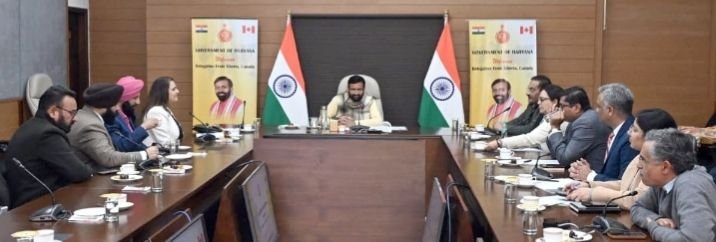
Haryana is steadily emerging as a preferred destination for global partnerships in education, innovation, and economic development, with Chief Minister Nayab Singh Saini playing a central role in positioning the state on the international map. This vision was clearly reflected during a high-level meeting between a delegation from Alberta, Canada, led by Minister of Indigenous Relations Rajan Sawhney, and the Chief Minister at his official residence, Sant Kabir Kutir, in Chandigarh late Wednesday evening.
The meeting marked a significant step towards strengthening bilateral ties between Haryana and the Canadian province, with in-depth discussions held on investment, innovation, higher education, skill development, and long-term economic cooperation. The engagement underlined Haryana’s growing stature as an epicentre for foreign collaboration, driven by progressive policies, a skilled workforce, and robust institutional support.
Welcoming the Alberta delegation, Chief Minister Nayab Singh Saini reiterated that Haryana remains open and proactive in forging global partnerships that contribute to skills enhancement, innovation-led growth, and sustainable economic development. He emphasized that international cooperation is a key pillar of the state’s development strategy, especially at a time when Haryana is rapidly transforming into a hub for industry, education, and technology-driven enterprises.
Highlighting the strong people-to-people connect between Haryana and Canada, the Chief Minister noted that a large number of students from the state are currently pursuing higher education in Canadian institutions. This, he said, makes educational cooperation not only a strategic priority but also a natural area of mutual interest. He assured the delegation that the Haryana Government would extend full institutional and policy support to initiatives that promote educational exchange, academic collaboration, and research-driven partnerships.
A major focus of the discussions was higher education, particularly the possibility of establishing a Canadian university campus in Haryana. Such an initiative, if materialized, would significantly enhance the state’s higher education ecosystem, provide global exposure to local students, and reduce the need for outbound migration for quality education. The proposal was seen as a transformative step that could position Haryana as an international education destination in North India.
Chief Minister Saini underlined that the Department of Foreign Cooperation of Haryana is actively working to strengthen international relations, attract foreign investment, and facilitate innovation-led partnerships. The department acts as a single-window institutional mechanism to engage with foreign governments, universities, and global enterprises, ensuring that international collaborations translate into tangible outcomes on the ground.
During the meeting, Alberta’s Indigenous Relations Minister Rajan Sawhney appreciated Haryana’s forward-looking policies related to industrial development, innovation, and human resource development. She acknowledged the state’s efforts in creating an enabling environment for investors and institutions through transparent governance, infrastructure expansion, and skill-focused initiatives.
The Alberta delegation also shared insights into the province’s advanced skill development framework and education-to-employment models. Detailed discussions were held on collaboration in skill training, vocational education, and industry-oriented programs, with a shared objective of significantly enhancing employment opportunities for Haryana’s youth. Both sides explored the potential for joint programs that align education with industry needs, ensuring that skill development leads directly to meaningful employment.
Beyond education and skills, the meeting covered a wide spectrum of economic sectors. Possibilities of cooperation in energy, food processing, agriculture, logistics, and free trade were discussed at length. Chief Minister Saini laid special emphasis on technology exchange and investment, citing Haryana’s expanding capabilities in renewable energy, agro-based industries, and modern supply chain infrastructure. He pointed out that the state’s strategic location, proximity to the national capital, and strong industrial base make it an attractive destination for global investors.
The Chief Minister reiterated that Haryana’s development model is rooted not only in economic growth but also in social progress, knowledge exchange, and global integration. By strengthening ties with regions like Alberta, the state aims to create a balanced ecosystem where innovation, education, industry, and employment reinforce each other.
Senior officials present during the meeting included Chief Principal Secretary to the Chief Minister Rajesh Khullar, Principal Secretary of the Department of Foreign Cooperation Amneet P. Kumar, Director General of the Department of Information, Public Relations, Language and Culture K. Makarand Pandurang, Advisor to the Department of Foreign Cooperation Pawan Chaudhary, along with other senior officers. Their presence underscored the institutional importance Haryana attaches to international engagement and foreign cooperation.
The meeting with the Alberta delegation reflects Haryana’s growing confidence as a globally connected state under the leadership of Chief Minister Nayab Singh Saini. As the state deepens its engagement with foreign governments and institutions, Haryana is steadily shaping its identity as a dynamic hub for international collaboration on both economic and social fronts.