
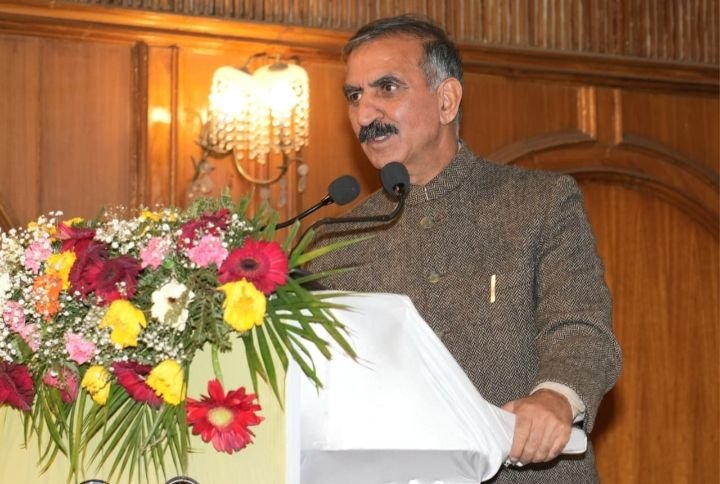
Himachal Pradesh took a significant step forward in its urban transformation journey with Chief Minister Thakur Sukhvinder Singh Sukhu inaugurating the second phase of the ‘Citizen Connect Programme’ at Peterhoff, Shimla, under the state’s flagship vision of ‘Clean City, Prosperous City’. The initiative reflects the government’s broader commitment to building self-reliant, inclusive and sustainable cities amid rising population pressures and rapid urbanisation.
Addressing the gathering, the Chief Minister said Himachal Pradesh is undergoing a phase of continuous and positive change, with urban development being driven by transparency, technology and direct citizen engagement. He underlined that the government’s focus is not merely on infrastructure creation, but on improving quality of life, strengthening livelihoods and ensuring that urban growth remains people-centric.
During the event, Chief Minister Sukhu unveiled a series of major schemes and projects aimed at empowering citizens, strengthening urban local bodies and modernising service delivery. Among the key launches was the Rajiv Gandhi Laghu Dukaandaar Sukh Kalyan Yojna, designed to provide much-needed financial relief and security to small shopkeepers. Alongside this, 15 Municipal Shared Services Centres, nine new online citizen services and the Chief Minister Urban Digital Identity Scheme were inaugurated, marking a decisive push towards digital governance.
The Chief Minister also launched an awards scheme under the Swachhata Survey to promote cleanliness and healthy competition among urban local bodies. Central Business Districts in Hamirpur and Shimla, along with hydraulic parking facilities of the Urban Development Department, were also dedicated, signalling a shift towards organised commercial spaces and improved urban mobility.
In a gesture reflecting the government’s emphasis on livelihoods and grassroots empowerment, settlement letters were distributed to small traders, while Self-Help Groups were honoured under the Amrit Mitra Scheme. Urban local bodies demonstrating exemplary performance were recognised, and the Urban Development Department signed four Memorandums of Understanding with industrial houses, indicating growing public-private collaboration in urban infrastructure development.
Highlighting the role of digital platforms, the Chief Minister praised the Him Seva Facility Portal, describing it as a nationally distinctive initiative that integrates multiple citizen services on a single platform. He noted that such digital interventions are reducing bureaucratic hurdles, enhancing transparency and making governance more accessible to ordinary citizens.
Chief Minister Sukhu outlined a series of major urban infrastructure projects currently underway or in the pipeline. These include a ₹400 crore shopping complex in Mandi, ₹150 crore worth of city beautification works in Hamirpur, and a new shopping complex at the site of the old bus stand in Hamirpur. He announced that urban development projects worth ₹707 crore will be implemented in the near future, with additional facilities amounting to ₹500 crore planned for Shimla. Utility ducts, following the Shimla model, will be established across municipal corporations to streamline services and reduce repeated excavation.
Looking ahead, the Chief Minister spoke of ambitious plans to develop a world-class ‘Him-Chandigarh’ city near Baddi, envisaged as a modern urban hub. He stressed that strengthening governance, enhancing citizen participation and ensuring transparency in urban local bodies remain central to the government’s strategy. He pointed out that the number of strengthened urban local bodies in the state has increased to 75, up from 60 in November 2024, reflecting sustained institutional growth.
Citizen welfare remained a core theme of the address. The Chief Minister highlighted the Chief Minister Urban Livelihood Guarantee Scheme, which assures 120 days of employment annually to the urban poor. He also noted the use of GIS technology for urban planning, revenue enhancement, tax transparency and property verification, with detailed mapping currently underway in 36 urban local bodies.
Significant financial relief measures were announced for small traders. Under the new policy, shopkeepers with outstanding bank loans of up to ₹1 lakh that have turned non-performing will be eligible for a one-time settlement facility of up to ₹1 lakh. Those with loans between ₹1 lakh and ₹2 lakh will also receive one-time assistance of up to ₹1 lakh. The Chief Minister described this as a crucial decision aimed at protecting small businesses and sustaining urban livelihoods.
Digital expansion continues to be a cornerstone of the programme. With over 2.5 lakh citizens already registered in the first phase, nine additional online services have been added, while 15 integrated, cluster-based citizen service centres are being established at a cost of ₹47.37 crore. Each urban household will also be provided a unique digital identity through digital door plates, strengthening service delivery and data accuracy.
In line with sustainable development goals, the Chief Minister announced plans to establish biogas plants with capacities ranging from 5 to 20 tonnes per day to promote renewable energy, organic fertiliser production and circular economy practices. Urban local bodies securing positions within the top 100 of the national cleanliness rankings will be rewarded to encourage competitiveness and innovation.
Urban Development Minister Vikramaditya Singh and Principal Secretary Devesh Kumar also addressed the gathering, emphasising the integration of modern technology in urban governance. They highlighted that infrastructure development is being aligned with population growth and that effective implementation of schemes on the ground will be key to ensuring lasting impact. Both underscored that urban local bodies in Himachal Pradesh are witnessing a visible transformation, driven by focused, inclusive and technology-enabled governance.
The second phase of the Citizen Connect Programme thus marks a comprehensive push by the Himachal Pradesh government to redefine urban living—combining infrastructure, digital innovation, livelihood support and sustainability into a unified vision for the state’s cities.