
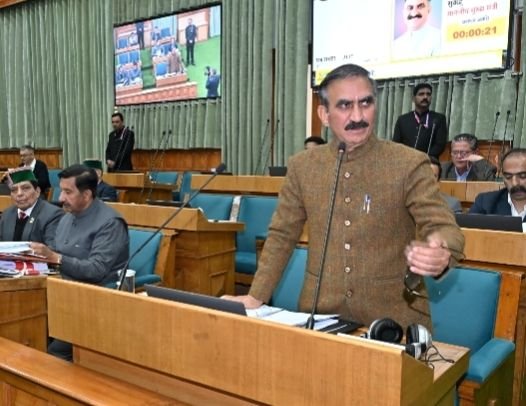
In a politically charged session of the Himachal Pradesh Assembly, the government led by Sukhvinder Singh Sukhu on March 23 secured the passage of a key amendment bill proposing the imposition of a special welfare cess on petrol and diesel. The decision, taken against the backdrop of a fragile economic environment and global uncertainties including tensions in the Middle East, has triggered sharp reactions from the opposition and raised concerns about a potential rise in fuel prices across the state.
The legislation introduces an “Orphan and Widow Welfare Cess” to be levied at the point of first sale of petrol and high-speed diesel within the state. The government has been empowered to notify the rate of this cess through executive orders. While the exact rate is yet to be officially announced, indications suggest that fuel prices could rise by up to ₹5 per litre once the provision comes into effect. If implemented at the upper range, petrol prices in the hill state could cross the ₹100 mark, while diesel may exceed ₹90 per litre.
Following its passage in the Assembly, the bill will now be sent to the Governor for assent. Once approved, the revised pricing structure is expected to be notified shortly thereafter.
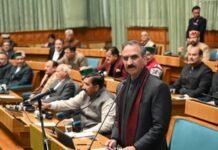
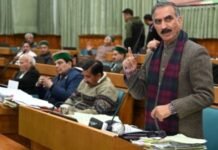
The proposal sparked intense debate inside the विधानसभा, with opposition members strongly criticizing the move as anti-people. Leaders from the opposition benches argued that the additional burden would come at a time when residents are already grappling with inflationary pressures. They warned that higher fuel prices would have a cascading effect on transportation costs, essential commodities, and overall cost of living, particularly in a geographically challenging state like Himachal Pradesh where logistics already remain expensive.
Opposition legislators also raised concerns over the state’s existing tax structure on fuel, noting that petrol currently attracts around 17 percent tax and diesel approximately 13.9 percent. They argued that any further increase would widen the price gap with neighboring states, potentially impacting trade, tourism, and the transport sector. Some members also objected to the nomenclature of the cess, questioning the appropriateness of linking taxation measures with vulnerable social groups.
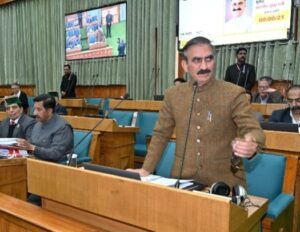
Responding to the criticism, Chief Minister Sukhu strongly defended the decision, describing it as a socially responsible and welfare-oriented कदम. He emphasized that the revenue generated through the cess would be exclusively utilized for the upliftment of economically weaker sections, particularly widows and orphaned children, who often remain outside the reach of conventional welfare frameworks.
The Chief Minister countered opposition claims by citing comparative data, stating that the Union government itself levies substantial cess components on fuel, amounting to nearly ₹27 per litre. He further argued that even after the proposed increase, fuel prices in Himachal Pradesh would remain broadly in line with, or in some cases lower than, those in neighboring states such as Punjab and Haryana.
In a political rebuttal, Sukhu accused the opposition of opposing welfare initiatives aimed at marginalized communities. He asserted that instead of resisting such measures, opposition parties should press the Centre for restoring financial support mechanisms like the Revenue Deficit Grant, which has been a key demand of the state government.
The passage of the bill comes as part of a broader fiscal strategy being pursued by the Sukhu government to navigate financial constraints while continuing to fund social sector schemes. In recent Assembly proceedings, the government has highlighted the pressure on state finances due to legacy liabilities, rising expenditure commitments, and limited revenue streams.
Alongside the fuel cess proposal, the ongoing budget session has also seen discussions on strengthening rural economy, enhancing healthcare infrastructure, and expanding welfare schemes. The government has reiterated its commitment to balancing fiscal discipline with inclusive growth, though opposition leaders remain unconvinced, accusing the administration of relying excessively on taxation measures.
The debate over the new cess reflects a larger political and economic tension in the state — between the need to mobilize resources for welfare and the challenge of minimizing the burden on citizens. As the bill moves towards final approval, its real impact will be closely watched, both in terms of fuel pricing and the effectiveness of targeted welfare delivery.