
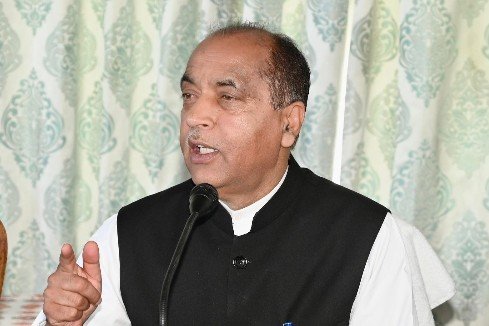
Leader of Opposition Jairam Thakur has launched a strong critique of the ruling Congress administration in Himachal Pradesh, alleging that the state is grappling with a deepening financial crisis driven by what he described as policy mismanagement and inconsistent governance. His remarks come at a politically sensitive time, as parties begin to shape narratives ahead of future electoral contests, including the Vidhan Sabha elections.
Addressing the media after a two-day state executive meeting of the Bharatiya Janata Party in Mandi, Thakur painted a grim picture of the state’s fiscal health under Chief Minister Sukhvinder Singh Sukhu. He argued that within a relatively short span of governance, the economic condition of the hill state has deteriorated significantly, raising concerns about sustainability and long-term development.
One of the key points raised by the BJP leader was the contraction of the state budget. According to Thakur, the current budget reflects a reduction of approximately ₹3,500 crore compared to the previous year, leaving a very limited proportion of funds available for developmental activities. He claimed that less than five percent of the total expenditure is now being directed towards development, describing the situation as “alarming” for a state that relies heavily on public investment for growth.
Thakur also highlighted what he termed as an unsustainable rise in public debt. He stated that when the BJP demitted office, the state’s debt stood at around ₹69,600 crore. In contrast, he alleged that the current government has added over ₹40,000 crore in a span of three and a half years, pushing the total liability beyond ₹1.1 lakh crore. He further pointed to an increase in borrowing rates, claiming that the pace of debt accumulation has more than doubled under the present administration.
In a sharp rhetorical comparison, Thakur likened Himachal Pradesh’s financial trajectory to that of a struggling economy, suggesting that the state is increasingly dependent on fresh loans not only for development but also to service existing debt obligations. He warned that such a cycle could lead to a serious fiscal imbalance if corrective measures are not introduced promptly.
The former Chief Minister also questioned what he described as contradictions in the government’s policy statements. He noted that while the current leadership has publicly acknowledged the challenges in achieving a revenue-surplus status, it has simultaneously set ambitious targets of making Himachal self-reliant by 2027 and one of the most prosperous states by 2032. According to Thakur, such claims lack coherence in the absence of a clear fiscal roadmap.
Beyond macroeconomic concerns, Thakur raised issues related to governance and welfare delivery. He alleged that financial strain could compel the government to reconsider subsidies on essential services such as electricity, water, and food distribution. He also expressed apprehension over potential delays in salary disbursements, dearness allowance payments, and other welfare benefits.
The BJP leader further accused the state government of undermining welfare schemes introduced during the previous administration, citing concerns over the implementation of health and social security initiatives. Additionally, he pointed to administrative inconsistencies, including conflicting decisions on re-employment policies and delays in conducting Panchayati Raj elections, which he argued reflect a lack of policy clarity.
Positioning the BJP as a proactive opposition, Thakur announced plans to take these issues to the public through a व्यापक outreach campaign. He emphasized the need for immediate corrective steps, including improved revenue generation and strict expenditure control, to stabilize the state’s finances.
As Himachal Pradesh moves closer to its next electoral cycle, the debate over fiscal management is likely to become a central theme. Thakur’s remarks indicate that the BJP intends to frame the upcoming political contest around economic governance and accountability, seeking to challenge the Congress government’s record on financial stewardship.
With both sides expected to intensify their narratives in the coming months, the state’s economic trajectory may well emerge as a निर्णायक factor influencing voter sentiment in the run-up to the Vidhan Sabha elections.