
RAJPURA — Punjab Chief Minister Bhagwant Singh Mann has defended his government’s welfare and development agenda, saying the Aam Aadmi Party administration would continue to use public resources for the benefit of ordinary citizens despite criticism from opposition parties.
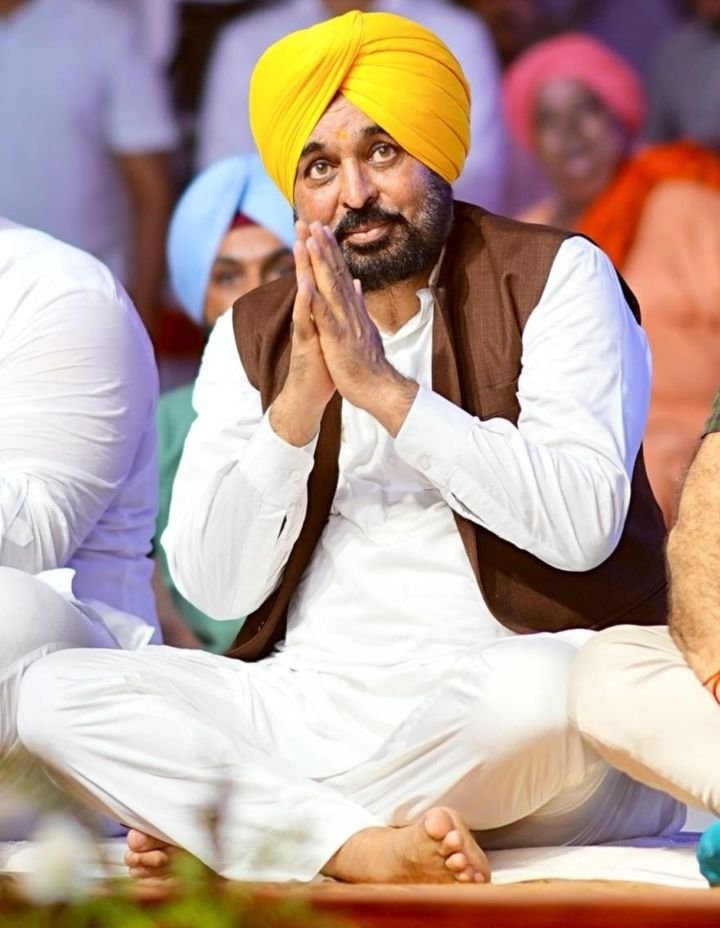
Addressing a gathering at the “Ek Sham Bhagwan Shiv Ke Naam” programme in Rajpura, Patiala, Mann said his government’s priority was to create employment opportunities, expand access to healthcare and improve education, while continuing financial assistance schemes aimed at women and other sections of society.
He said the government’s approach was based on the principle that public money should ultimately be returned to the people through services, welfare programmes and development.
“My responsibility is to ensure employment for every household, treatment for every elderly person and quality education for every child,” Mann said, outlining what he described as the government’s central responsibilities.
His remarks come as the Punjab government seeks to highlight its welfare record while facing sustained political criticism from opposition parties over governance, finances and the implementation of various schemes.
Mann stresses Punjab’s tradition of communal harmony
The Chief Minister used the Rajpura event, which was organised around a religious programme dedicated to Lord Shiva, to emphasise Punjab’s tradition of social and religious harmony.
He said people in the state had historically celebrated each other’s religious festivals and argued that this shared culture should be protected.
Describing Punjab as a land where different communities coexist, Mann said the state’s social fabric was built on brotherhood and mutual respect. He referred to celebrations associated with different faiths, including Ram Navami, Gurpurab and Eid, as examples of Punjab’s tradition of participating in one another’s festivals.
His message was also political: at a time when communal and social divisions frequently become part of electoral discourse, the Chief Minister sought to position Punjab’s shared cultural traditions as an important part of the state’s identity.
He said hatred should have no place in Punjab and that the state’s strength lay in its unity.
Pilgrimage scheme expanded
Mann also highlighted the government’s Mukh Mantri Tirath Yatra Yojana, under which residents are provided assistance to visit important religious destinations.
According to the Chief Minister, the scheme initially focused on prominent religious sites in Punjab, including Sri Harmandir Sahib and Sri Anandpur Sahib, but has now been expanded to include destinations such as Haridwar, Rishikesh, Salasar Dham and Khatu Shyam Ji.
The government provides transport as well as boarding and lodging facilities under the programme, Mann said.
The scheme is intended to make religious travel accessible to people who might otherwise find the cost of long-distance journeys difficult to afford.
The Chief Minister presented the initiative as part of the government’s broader welfare philosophy, arguing that financial circumstances should not prevent people from visiting places of religious significance.
Women’s financial assistance remains a major political message
Mann also drew attention to the Mukh Mantri Mawan Dheeyan Satkar Yojana, under which the government says women began receiving monthly financial assistance from July 1.
Under the scheme, eligible women are to receive ₹1,000 a month, while eligible women belonging to Scheduled Castes are entitled to ₹1,500 a month, according to the Chief Minister.
Mann said approximately 75 lakh women had already started receiving the assistance.
He also appealed to women who had not yet received the payment to complete the required formality so that they could become eligible for payments from July.
The scheme is likely to remain politically significant because of its scale and its direct connection with household finances. Direct financial transfers can have a particularly visible impact on beneficiaries, making their implementation and coverage important issues for both the government and the Opposition.
The administration will also face the challenge of ensuring that eligible women who have not yet received payments are able to complete the registration process without unnecessary administrative difficulties.
Mann targets Opposition over welfare schemes
The Chief Minister also sharpened his political attack on the Opposition, warning voters that rival parties could discontinue schemes introduced by the AAP government if they returned to power.
He argued that his administration would continue working in the public interest regardless of political criticism.
Mann cited several initiatives to support his claim that his government had prioritised ordinary citizens.
Among them, he mentioned the closure of 19 toll plazas, which he said had resulted in savings of around ₹70 lakh a day for commuters.
He also claimed that more than 70,000 government jobs had been provided to young people through a transparent recruitment process.
The Chief Minister said around 90% of households were receiving free electricity and that farmers were being supplied power during the daytime.
He further highlighted road construction, claiming that approximately 44,000 kilometres of roads were being developed across Punjab.
These figures form a central part of the government’s argument that its policies have delivered tangible benefits to households. However, the political Opposition is likely to continue examining the government’s spending, implementation and financial sustainability.
Healthcare becomes another key pillar
Healthcare was another major component of Mann’s address.
He referred to the Mukh Mantri Sehat Yojna, which the government describes as a universal cashless healthcare programme providing treatment coverage of up to ₹10 lakh per resident family in Punjab.
Mann described the initiative as a landmark scheme and said Punjab had become the first state in India to offer such comprehensive coverage.
The government says the programme is designed to reduce the financial burden of serious illness on families and provide access to treatment without requiring patients to make large upfront payments.
Mann said lakhs of residents had already benefited from free treatment under the scheme.
The success of the healthcare programme, however, will ultimately depend not only on the size of the financial cover but also on the availability and quality of participating hospitals, timely approvals, treatment accessibility and the government’s ability to ensure that beneficiaries understand how to use the scheme.
For Punjab’s healthcare system, expanding financial protection is only one part of the challenge. Strengthening public hospitals, ensuring specialist availability and reducing waiting times will remain equally important.
Welfare politics ahead of the next electoral test
Mann’s Rajpura address brought together several themes that have become central to the AAP government’s political messaging: direct welfare transfers, free or subsidised services, employment, healthcare, infrastructure and religious tourism.
The Chief Minister’s repeated emphasis on “public money returning to the people” reflects an attempt to present welfare expenditure as an investment in citizens rather than simply as government spending.
But welfare promises also create expectations. The government will need to demonstrate that schemes are financially sustainable and that benefits reach the intended recipients without delays or administrative barriers.
For the Opposition, the task will be to challenge the government’s claims and question whether welfare measures are being matched by improvements in employment, public services and Punjab’s financial position.
For Mann, the message from Rajpura was clear: political criticism will not change the direction of his government.
He said the AAP administration would continue pursuing its welfare agenda and urged people to judge the government by the benefits reaching their households.
As Punjab moves deeper into another politically charged period, welfare delivery, jobs, healthcare, electricity and the state’s finances are likely to remain among the issues that shape public debate.