
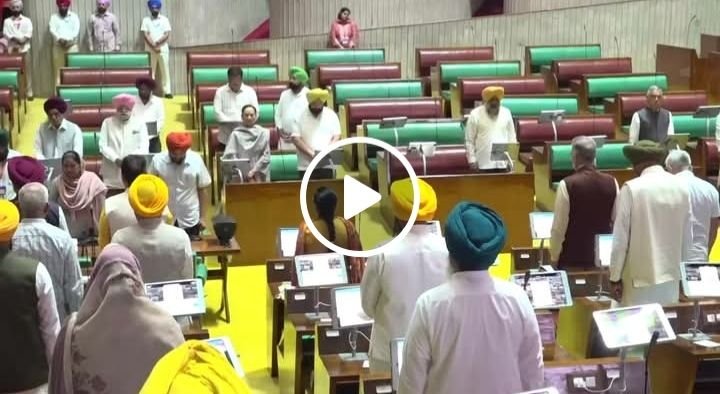
Chandigarh: The 13th session of the 16th Punjab Vidhan Sabha opened on Thursday with obituary references honouring former public representatives, social figures and victims of a road accident, including anti-drug activist Parvinder Singh Jhota, whose killing has brought the state’s campaign against narcotics and the government’s response to the issue into sharp political focus.
The session, scheduled to continue until October 27, is expected to become a major platform for the Aam Aadmi Party (AAP) government to present its record on governance, the anti-drug campaign, farmers’ concerns and Punjab’s rights over river waters, while countering an Opposition offensive over law and order and corruption allegations. The official Assembly programme lists obituary references and non-official business for the opening day, with further legislative business scheduled during the session.
Assembly pays tribute to leaders and accident victims
During the obituary references, the House paid tributes to Chunni Lal Bhagat, former Deputy Speaker and minister; Varinder Singh Bajwa, former Rajya Sabha member; Ranjit Singh, former MLA; Padam Shri Dr Ratan Lal Mittal, former Director of Medical Education and Research; and Parvinder Singh Jhota, known for his activism against drugs.
Members also remembered eight MGNREGA workers who lost their lives in a road accident in Sangrur. The tributes brought a solemn beginning to a session expected to witness intense political exchanges over several issues affecting Punjab.
Jhota’s name carries particular significance amid the continuing debate over the state’s drug problem. His killing has reignited public concern about the alleged illegal sale of habit-forming substances and the safety of those who challenge suspected drug networks.
Jhota case puts anti-drug campaign under scrutiny
For the Bhagwant Mann-led government, the challenge will be to demonstrate that its stated commitment to eliminating drugs is being translated into sustained enforcement, accountability and protection for people who raise concerns about narcotics.
The government has been expected to highlight its flagship campaign, *Yudh Nashian Virudh*, and argue that action against drug networks must be assessed in the context of the scale and longstanding nature of the problem. The AAP leadership has also maintained that earlier governments must answer questions about the growth of the drug trade during their respective tenures, while the role of central agencies in controlling cross-border and port-based trafficking requires scrutiny.
The Opposition, however, is preparing to make Jhota’s death a central issue, questioning whether the state has done enough to protect anti-drug campaigners and dismantle the networks allegedly operating in Punjab. Congress leaders have indicated that they will press the government on law and order, with Leader of the Opposition Partap Singh Bajwa saying his party would not allow the issue to be avoided during the session.
An important development ahead of the Assembly debate has been the transfer of the murder investigation to the Central Bureau of Investigation. The CBI registered a case on October 21 and began taking over the investigation, with a post-mortem examination planned at PGIMER, Chandigarh, by a team of experts. The development followed the Punjab government’s announcement that the case would be handed over to the central agency in response to the family’s demand.
The government can point to the decision to involve the CBI as a step towards an independent investigation, but the wider political debate is unlikely to end with the transfer. The coming proceedings are expected to focus on whether the investigation establishes accountability and whether enforcement against the illegal sale of intoxicating substances is sufficiently effective.
AAP prepares to counter Opposition attack
The Assembly session is set to test the government’s ability to defend its governance record against criticism from the Congress and other Opposition parties. Alongside the drug issue, the Opposition is expected to raise concerns about law and order, alleged corruption and a CBI case involving government functionaries.
Congress leaders are also expected to demand Chief Minister Bhagwant Mann’s resignation, holding him politically responsible for the state’s law-and-order situation. The AAP government, meanwhile, is preparing to defend its record and challenge the Opposition over the legacy of previous administrations, particularly their handling of the drug problem.
The government’s argument is likely to be that Punjab’s drug crisis cannot be separated from the supply chains operating beyond the state’s borders and that effective action requires coordination between state and central agencies. The Opposition’s counterargument is that the state government must be held accountable for policing, prevention and the protection of citizens within Punjab.
The Assembly debate will therefore be significant not only for the claims made by political parties but also for the specific measures, evidence and commitments placed before the House.
Farmers’ rights and river waters on the agenda
The government is also expected to use the session to address issues raised by farmer organisations. Resolutions concerning Punjab’s riparian rights over river waters and the demand for reconsideration of measures affecting those rights are expected to figure in the proceedings. The government is also expected to seek repeal of the Dam Safety Act, reflecting concerns about the implications of central legislation for the state’s interests.
These issues are politically important for AAP because the government had committed to bringing farmers’ concerns before the Assembly following their agitation. The treasury benches are expected to highlight the government’s account of crop procurement, irrigation-related measures and efforts to address farmer distress, including its claim of a decline in farmer suicides.
For the government, the session offers an opportunity to present these matters as questions of Punjab’s economic interests, agricultural security and federal rights rather than allowing the proceedings to be dominated exclusively by the Opposition’s criticism.
Resolution against Chief Election Commissioner among expected moves
Another issue expected to attract attention is a proposed resolution seeking the resignation of Chief Election Commissioner Gyanesh Kumar. The move would bring electoral institutions and questions of accountability into the Assembly’s political debate. The government is also expected to announce further relief for women, although details and the formal status of any measure would need to be established through official announcements during the session.
With the Assembly’s opening day beginning with tributes, the focus now shifts to the substantive business and political exchanges scheduled over the coming days. For AAP, the session will be an opportunity to defend its anti-drug campaign, place farmers’ concerns and river-water rights on the legislative agenda, and challenge the record of its political opponents.
For the Opposition, the priority will be to demand answers over Jhota’s killing, law and order and allegations of corruption. The outcome of the debate will depend on whether the parties move beyond accusations to concrete proposals, verifiable evidence and decisions that address the concerns of Punjab’s people.