

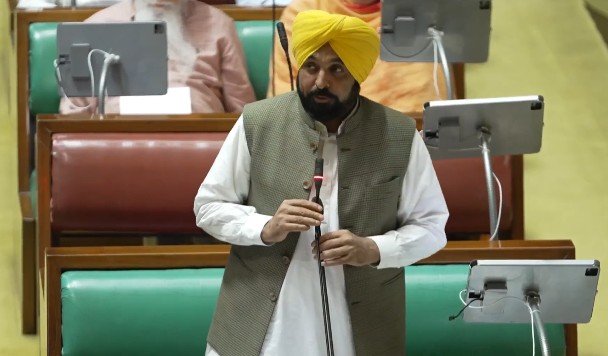
In a decisive and politically charged move that reflects years of public anger and unresolved religious sensitivities, the Punjab Assembly has unanimously passed the Jaagat Jot Sri Guru Granth Sahib Satkar (Amendment) Bill, 2026, marking one of the most stringent legislative responses to sacrilege in the state’s history under the leadership of Bhagwant Singh Mann.
The Bill, cleared in the presence of members of the Sant Samaj and representatives of various deras, proposes a significantly tougher punitive framework for acts of sacrilege. It prescribes imprisonment ranging from 10 to 25 years, substantial financial penalties between ₹5 lakh and ₹25 lakh, and provisions for confiscation of property belonging to those found guilty. The legislation reflects a calibrated attempt by the Aam Aadmi Party government to respond to a deeply emotional and politically sensitive issue that has shaped Punjab’s socio-political discourse for over a decade.
The demand for stricter laws has its roots in a series of sacrilege incidents, particularly those involving the desecration of the Guru Granth Sahib, which triggered widespread protests, civil unrest, and allegations of political interference in investigations. These incidents not only shook public confidence but also became a recurring flashpoint in electoral politics, with successive governments accused of failing to deliver justice.
During the Assembly debate, the legislation became a platform for revisiting past controversies and holding previous regimes accountable. Congress MLA Sukhpal Singh Khaira invoked the findings of the Justice Ranjit Singh Commission Report, which had examined incidents of sacrilege and related police action. He argued that the report had, for the first time, pointed toward the alleged involvement of influential political figures, including members of the Badal family, and questioned why meaningful action had not followed even after more than a decade.
Khaira also raised concerns about the lack of action against Gurmeet Ram Rahim Singh, whose name had surfaced in connection with the broader controversy, further intensifying the political dimension of the debate. His remarks underscored a key opposition narrative—that while legislation is necessary, accountability for past incidents remains incomplete.
Leader of Opposition Partap Singh Bajwa added a constitutional perspective, questioning whether the Bill would require Presidential assent given its legal scope and potential overlap with central laws. This raised procedural questions even as the House moved toward unanimous passage.
Responding to these concerns, Chief Minister Bhagwant Mann clarified that the Bill would require only the Governor’s approval, asserting that it had been carefully structured within the constitutional framework. He emphasized that the primary objective of the legislation is preventive as much as punitive—deterring future acts of sacrilege while ensuring swift and uncompromising action against offenders.
Mann framed the Bill as a moral obligation of his government, stating that protecting the sanctity of the Guru Granth Sahib is not merely a legal issue but a matter of collective faith and identity for millions. By pushing for a law that eliminates ambiguity and strengthens enforcement mechanisms, the government aims to restore public trust that had been eroded by years of perceived inaction.
Importantly, the Chief Minister also indicated that this legislative step is part of a broader roadmap. He announced that a select committee, headed by Inderbir Singh Nijjar, will soon present its report examining similar protections for other religious texts. The committee is also expected to revisit historical incidents such as the Nakodar firing incident 1986, suggesting that the government intends to address unresolved grievances alongside future safeguards.
The presence of religious leaders during the Assembly proceedings added symbolic weight to the legislation, reinforcing its social legitimacy. It also signaled an attempt by the government to align political action with religious sentiment, a delicate balance in a state where faith and politics are deeply intertwined.
From a governance standpoint, the Bill introduces stricter procedural clarity, potentially ensuring that investigations are conducted more efficiently and that cases do not linger indefinitely. The inclusion of financial penalties and property confiscation provisions is seen as a deterrent designed to raise the cost of committing such offences, both legally and economically.
However, the political implications of the Bill are equally significant. By securing unanimous support in the Assembly, the Mann government has positioned itself as responsive to a long-standing public demand, while also placing pressure on opposition parties that have historically been associated with earlier phases of the controversy. At the same time, the debate has reopened questions about accountability, institutional credibility, and the pace of justice delivery in past cases.
As Punjab moves forward, the effectiveness of this law will depend not only on its provisions but on its implementation. For a state that has witnessed repeated cycles of outrage and political contestation over sacrilege, this legislation represents both an opportunity and a test—an opportunity to deliver justice and closure, and a test of whether strong laws can translate into tangible outcomes on the ground.
In the broader context, the passage of this Bill marks a defining moment in Punjab’s legislative and political landscape, where faith, law, and governance intersect. Whether it succeeds in preventing future incidents and rebuilding public confidence will ultimately determine its legacy in the years to come.