

Saptrishi :
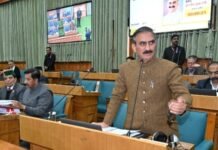
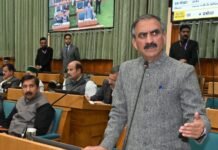
The Himachal Pradesh Cabinet, chaired by Chief Minister Thakur Sukhvinder Singh Sukhu, on Tuesday approved a wide-ranging set of decisions aimed at strengthening the health sector, boosting employment, supporting farmers and pastoral communities, and accelerating infrastructure and institutional reforms across the state.
In a significant move to reinforce healthcare services, the Cabinet approved the filling of 53 posts of Assistant Professors and 121 teaching and non-teaching posts, including paramedical staff, across all government medical colleges. Additionally, 600 posts of Assistant Staff Nurses will be created through the HP Rajya Chayan Aayog, Hamirpur, under the Assistant Staff Nursing Policy. To encourage higher specialization, faculty doctors holding DM and MCh qualifications will receive an incentive of 20 percent of their basic pay.
The Cabinet also cleared recruitment to address vacancies in key departments. This includes filling 40 vacant posts of Junior Engineer (Civil) as Job Trainees in the Jal Shakti Vibhag and 10 posts of Block Development Officer in the Rural Development Department through direct recruitment. Employment on compassionate grounds was also approved for 28 incumbents in the Education Department.
In the education sector, the government approved the creation of a dedicated sub-cadre for CBSE schools, with clearly defined norms for recruitment, training, tenure and performance evaluation, covering 100 identified schools in the state. Further, approval was accorded for setting up the University of Multidisciplinary Institute of Innovation, Skill, Technology, Entrepreneurship and Research (MIISTER) at Ghumarwin in Bilaspur district under the Public-Private Partnership mode, aimed at nurturing a digitally skilled and entrepreneurial workforce.
Strengthening social security, the Cabinet expanded the ambit of the Mukhya Mantri Sukh Aashray Yojna to include children studying in Tong-Len School, Dharamshala, children of parents with 70 percent or more disability, and children who have been abandoned after the death of one parent. Relaxation was also granted for under-construction Lok Bhawans under the Mukhya Mantri Lok Bhawan Yojna.
On the economic and rural development front, the Cabinet approved an ambitious project titled *Pastoralists Employment in Himalayan Ecosystems for Livelihoods (PEHEL)*, focusing on resilient livelihoods for shepherds, modernization of pastoral practices, conservation of indigenous breeds, and strengthening market linkages. A new Act will be introduced to ensure smooth movement of pastoral communities, with forest lands and meadows opened for Gaddi livestock.
To boost the dairy sector, the government approved the setting up of milk processing plants at Nahan, Nalagarh, Mohal and Rohru, along with milk chilling and cooling infrastructure in Hamirpur, Una, Karsog and Pangi, in collaboration with MILKFED and the National Dairy Development Board. A cash credit limit of ₹60 crore was sanctioned to HP MILKFED to meet increased working capital needs, along with the opening of a separate milk cess account to ensure timely payments to farmers.
Major infrastructure decisions included approval to build a world-class township at Shitalpur on the Himachal-Chandigarh border, modern commercial complexes in Bilaspur district, and shifting the headquarters of the Himachal Pradesh State Commission for Backward Classes from Shimla to Dharamshala. The Cabinet also approved the establishment of a drug de-addiction centre at Malot in Kangra district.
In policy reforms, amendments were approved to the Himachal Pradesh Real Estate Rules, 2017, to enhance transparency and speed up dispute resolution. The Swaran Jayanti Energy Policy-2021 was amended to extend concessions on free power royalty to certain hydro projects up to 25 MW, while equity power share in key SJVNL projects will be re-allocated to the state for sale through the Directorate of Energy.
Environmental and disaster preparedness measures included approval to amend the Himachal Pradesh Land Preservation Act, 1978, to regulate the felling of dried chir trees, and clearance of the Himachal Pradesh Disaster Risk Reduction and Preparedness Project with French Development Agency support, involving an outlay of ₹892 crore over five years.
Other notable decisions included subsidy approval for 18–42 seater buses under the Rajiv Gandhi Swarojgar Start Up Yojna, revision of the Rajiv Gandhi Laghu Dukandar Sukh Kalyan Yojna–Shahri to provide one-time settlement assistance to small shopkeepers with NPAs, and adoption of a Functional Equivalence Model for faculty posts in government engineering colleges.
Collectively, the decisions reflect the Sukhu government’s focus on inclusive growth, institutional strengthening, social welfare and long-term economic resilience in Himachal Pradesh.