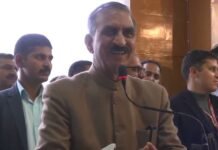


Himachal Pradesh Chief Minister Sukhvinder Singh Sukhu has firmly rejected the allegations that the state government revived the Old Pension Scheme (OPS) to gain political advantage. Speaking during the Assembly proceedings, he clarified that the decision was taken purely in the interest of employees who had been demanding the restoration of OPS for nearly two decades. According to the figures shared by the Chief Minister, more than 5,356 retired employees are currently receiving their pensions under the revived OPS framework, which highlights the government’s commitment to fulfilling a long-standing assurance.
Sukhu stated that employees were forced to serve for years without the security of a defined pension, and the previous pension structure had made their post-retirement life uncertain. He said the state government could not ignore the genuine concerns of thousands of workers who had contributed to public service throughout their careers. The Chief Minister also mentioned that OPS was not a political maneuver, but a moral responsibility that his government had chosen to honor. He reminded the House that similar demands were raised across the country, but Himachal Pradesh chose to act decisively for its employees instead of waiting for political opportunities.
During the Assembly session, several opposition leaders questioned the financial implications of OPS on the state’s already strained fiscal condition. In response, Sukhu explained that while the financial load was considerable, the government was prepared to manage it through long-term planning and resource mobilization. He criticized the opposition for what he termed as “selective concern,” stating that the same leaders had earlier ignored employee grievances when they were in power. The Chief Minister reiterated that the government had already devised a system to channel resources efficiently so that pensions could be disbursed without affecting development work.
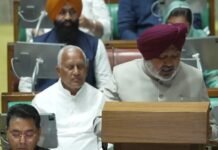
The session also witnessed heated exchanges over the use of police force on ABVP protestors earlier in the week. Members of the Bharatiya Janata Party raised strong objections to the police action taken against student activists. They argued that protestors were only voicing their concerns and did not deserve such treatment. Replying to the criticism, Parliamentary Affairs Minister Harshwardhan Chauhan said the police acted only after some demonstrators attempted to breach security arrangements near the Assembly complex. He stressed that while peaceful protests are welcome in a democracy, law enforcement agencies must intervene when public safety or the dignity of the Assembly premises is threatened.
Meanwhile, two other important bills were passed during the session. One pertained to municipal amendments aimed at improving urban administration, while the second bill focused on updates in the Panchayati Raj framework. Both bills were cleared after brief discussions and will now move to the next stage of procedural approval.
Overall, the Assembly witnessed a blend of policy-driven discussion and political confrontation. The revival of OPS remained the center of debate, with the Chief Minister standing firm on his government’s decision. Sukhu reaffirmed that the commitment to employees was more important than political narratives, and the government would continue working towards employees’ welfare while balancing the state’s financial challenges.