

Six-Decade Struggle Reaches a Turning Point: Himachal High Court Clears Legal Roadblock to ST Status for Sirmaur’s Hatti Community
Saptrishi Soni
69-page landmark judgment dismisses challenges to constitutional recognition, directs authorities to issue certificates to eligible members; verdict brings fresh hope to over three lakh people across Trans-Giri, while questions of implementation and existing reservation safeguards remain important
SHIMLA: For a community that spent nearly six decades seeking constitutional recognition, the Himachal Pradesh High Court’s November 28 verdict represents a defining moment in its long journey. By dismissing petitions challenging the inclusion of the Hatti community of Sirmaur district’s Trans-Giri region in the Scheduled Tribe (ST) list and directing the authorities to take consequential steps, including issuing certificates to eligible members, the court has removed a major legal obstacle that had kept the benefits of the 2023 legislation in uncertainty.
The judgment, delivered by a Division Bench comprising Justice Vivek Singh Thakur and Justice Bhupesh Sharma, is significant not merely because it upholds the statutory position of the Hatti community but also because it clarifies the constitutional limits of judicial intervention in the inclusion or exclusion of communities from the Scheduled Tribes list.
The 69-page judgment decided 18 connected petitions. Three petitions challenging the inclusion of the Hatti community were dismissed as not maintainable, while 15 petitions seeking directions for the issuance of ST certificates were allowed. The authorities have been directed to take consequential action in accordance with Entry No. 11 in Part V (Himachal Pradesh) of the Constitution (Scheduled Tribes) Order, 1950.
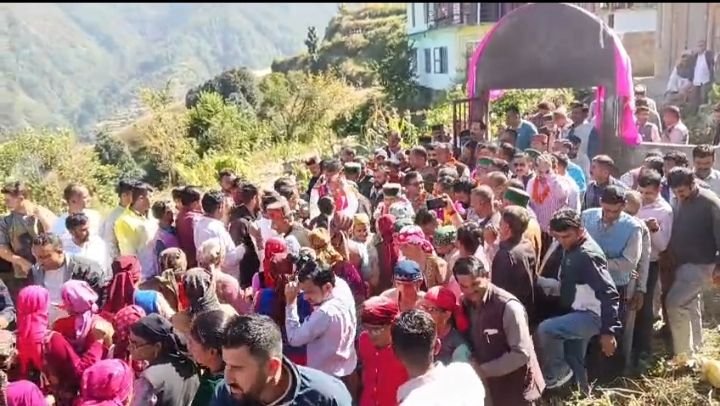
For residents of Giripar, the ruling has brought relief after years of political representations, administrative uncertainty and prolonged litigation. Celebrations were reported across the Trans-Giri region, particularly in the areas of Shillai, Renuka, Pachhad and Paonta Sahib, where the community has a substantial presence.
A geographical divide that became a question of constitutional equality
The roots of the Hatti demand lie in the geographical and historical relationship between the Trans-Giri region of Himachal Pradesh and Jaunsar-Bawar in neighbouring Uttarakhand.
The Hatti community is concentrated in the Trans-Giri, also known as Giripar, region of Sirmaur district. Across the Tons river lies Jaunsar-Bawar, whose population shares several historical, cultural and social connections with the Hattis.
The two regions were historically associated with the erstwhile Sirmaur princely state. Political and administrative changes during the British period eventually separated their administrative destinies. The Tons river subsequently became an important geographical boundary between the two regions.
The Hattis argue that despite sharing cultural traditions, customary practices, social institutions, food habits and traditional attire with their counterparts in Jaunsar-Bawar, the people living on the Himachal side remained outside the Scheduled Tribe framework.
The situation changed for Jaunsar-Bawar in 1967, when the region received Scheduled Tribe recognition. For the Hattis of Trans-Giri, however, the wait continued.
This difference became the central argument behind their demand: communities with comparable historical and cultural backgrounds were receiving different levels of constitutional protection and development opportunities because of an administrative boundary.
The demand gradually evolved into a sustained community movement, with successive generations of leaders raising the issue before state and central governments.
Who are the Hattis? Understanding their distinct identity
The Hattis are a close-knit community whose traditional identity is closely associated with agriculture, livestock rearing, local trade and customary social institutions.
The name Hatti is derived from the traditional village markets known as ‘haats’, where people brought locally produced agricultural and livestock products for exchange and trade.
Historically, these markets served as important economic and social meeting points. People traded ghee, wool, ginger, walnuts, turmeric, vegetables and other local produce in exchange for essential commodities such as salt, iron and fabric.
The community developed its own social customs, family structures, marriage traditions, religious practices and mechanisms for resolving disputes.
One of its important traditional institutions is the Khumbli, a community council that has historically played a significant role in resolving social disputes and taking collective decisions. Its influence reflects the importance of customary institutions in the region’s social organisation.
Ethnographic research has also documented similarities between the Hatti and Jaunsari communities, particularly in their traditional institutions, kinship practices and religious organisation.
A research paper published in the journal Sociological Bulletin in 2024, based on fieldwork in seven villages of Trans-Giri, examined the community’s cultural traditions, family relationships, marriage systems, political organisation and religious practices. It also documented the close cultural relationship between the Hattis and the recognised tribal population of Jaunsar-Bawar.
The community is spread across approximately 150-154 panchayat areas, with estimates of its population exceeding three lakh. Its geographical concentration covers the Shillai, Renuka, Paonta Sahib and Pachhad Assembly constituencies.
However, the Hatti identity also encompasses different caste and social groups. This internal diversity later became one of the major points of contention in the legal challenge to its inclusion in the ST list.
Six decades of representations, political promises and administrative hurdles
The demand for Scheduled Tribe recognition gained momentum after Jaunsar-Bawar received tribal status in 1967.
Over the following decades, community representatives approached successive governments, arguing that the Trans-Giri population faced geographical disadvantages and socio-economic challenges similar to those experienced by the neighbouring tribal region.
The movement developed organised leadership and became an important regional issue. The Central Hatti Committee emerged as a platform for pursuing the demand, while traditional Khumblis and community organisations continued to mobilise public support.
The demand also acquired political importance. The BJP incorporated the issue in its 2009 Assembly election manifesto and subsequently reiterated its commitment. In 2014, then BJP national president Rajnath Singh publicly promised ST recognition during a rally in Nahan.
The Congress government led by Virbhadra Singh also pursued the matter with the Centre. In 2016, the state government forwarded proposals seeking tribal recognition for the Trans-Giri region, supported by a study conducted through the Tribal Research Institute.
However, the Centre initially expressed reservations over the adequacy of the ethnographic material and the definition of the Hatti community. On different occasions, the proposal faced objections relating to the identification of the community and the need to establish its distinct tribal characteristics.
The demand therefore remained unresolved despite repeated political assurances and administrative exercises.
A major breakthrough came in 2022, when the Union Cabinet approved the proposal to include the Hattis of Trans-Giri in Himachal Pradesh’s Scheduled Tribes list.
Parliament subsequently moved the constitutional amendment process forward.
From Parliament to the President: How the legal recognition was granted
The Constitution (Scheduled Tribes) Order (Third Amendment) Bill, 2022, was introduced to include the Hatti community of the Trans-Giri region of Sirmaur district in the Scheduled Tribes list of Himachal Pradesh.
The Bill was passed by the Lok Sabha in December 2022 and by the Rajya Sabha in July 2023.
Following the President’s assent on August 4, 2023, the Constitution (Scheduled Tribes) Order (Second Amendment) Act, 2023, became law and was published in the Extraordinary Gazette of India.
The amendment inserted Entry No. 11 in Part V of the Schedule relating to Himachal Pradesh, specifically recognising:
“Hattee of Trans Giri area of Sirmour District.”
This geographical specification is important. The recognition relates to the Hatti community of the identified Trans-Giri region of Sirmaur, not to every person carrying the Hatti surname or to all residents of the district.
The amendment provided the constitutional foundation for eligible members of the community to seek Scheduled Tribe certificates and access benefits available under the relevant reservation and welfare provisions.
However, the legislative achievement soon encountered a legal challenge.
Why was the 2023 decision challenged?
The inclusion of the Hatti community generated concerns among certain organisations representing existing Scheduled Caste and Scheduled Tribe interests.
Three principal organisations approached the High Court:
- Giripar Anusuchit Jaati Adhikari Sanrakshan Samiti.
- Gujjar Samaj Kalyan Parishad.
- Kinnaur Students Welfare Association.
Their objections centred on the social composition of the Hatti community and the possible implications of bringing diverse caste groups under a common Scheduled Tribe entry.
The petitioners questioned whether the community could be treated as a single homogeneous tribal group, given its internal social divisions and the different constitutional categories to which some constituent groups had previously belonged.
They also raised concerns about the implications for existing Scheduled Caste reservation entitlements and opportunities.
The challenge brought into focus a sensitive question: how could the benefits granted to a newly recognised community be implemented without undermining the constitutional safeguards already available to other historically disadvantaged groups?
The dispute was therefore not simply about the recognition of one community. It also involved questions of social classification, reservation policy, constitutional protection and the distribution of opportunities.
The January 2024 stay: Why the community had to wait again
Although the 2023 amendment had received presidential assent, its implementation faced an immediate legal hurdle.
The Himachal Pradesh High Court initially issued notices on the petitions and, on January 4, 2024, stayed the implementation of the decision.
The interim order created uncertainty for Hatti families seeking ST certificates and benefits in education and employment.
In the meantime, the state government had issued a notification on January 1, 2024, concerning implementation of the recognition. The administration had also sought clarification from the Union Ministry of Tribal Affairs regarding the identification of the Hatti community and the position of members who were already covered by Scheduled Caste reservation.
The ministry’s clarification in November 2023 was followed by the state notification.
The subsequent judicial stay, however, prevented the recognition from translating into an uninterrupted process of issuing certificates and extending benefits.
The issue remained before the High Court for nearly three years, during which several petitions seeking ST certificates were also filed by individual applicants.
Eventually, on October 26, 2026, the court reserved its judgment after hearing the parties.
The final decision came on November 28.
What exactly did the High Court decide?
The most important aspect of the November 28 judgment is its reliance on the constitutional framework governing the identification and inclusion of Scheduled Tribes.
The Division Bench examined whether the petitions challenging the inclusion of the Hatti community could be entertained by the High Court under its writ jurisdiction.
The court relied particularly on the Supreme Court’s landmark judgment in State of Maharashtra vs. Milind and Others (2001), along with other authoritative decisions, including State of Orissa vs. Dasarathi Meher (2018).
The constitutional framework under Article 342 provides for the specification of Scheduled Tribes in relation to individual states. While the initial Presidential Order is issued after consultation with the Governor, any subsequent inclusion or exclusion from the notified list requires legislation by Parliament.
The High Court held that courts and tribunals cannot undertake an inquiry into the correctness of an inclusion or exclusion by collecting evidence, examining social classifications or reassessing the merits of a community’s entry in the constitutional list.
The Bench observed that the Supreme Court’s established legal position left no scope for entertaining the petitions challenging Entry No. 11.
Consequently, the petitions filed by the three organisations were dismissed as not maintainable.
It is important to understand the precise legal significance of this ruling. The High Court did not independently conduct a fresh ethnographic assessment of the Hatti community or decide the sociological merits of its tribal identity. Its central finding was that the inclusion made through the constitutional amendment could not be challenged in the manner attempted before it, in view of the binding Supreme Court precedents.
The court also rejected the argument that an earlier interim order staying implementation prevented it from examining the maintainability of the petitions at the final stage.
This distinction is important in understanding the judgment correctly: the court upheld the legal effect of Parliament’s amendment by dismissing the challenges as not maintainable, rather than undertaking a fresh exercise to determine tribal eligibility.
Relief for eligible applicants: The practical importance of the judgment
Perhaps the most immediate consequence of the ruling is its direction concerning the issuance of Scheduled Tribe certificates.
The High Court allowed 15 connected petitions seeking directions to the authorities to issue ST certificates to eligible members of the Hatti community.
It directed the respondent authorities to take consequential steps, including issuing certificates in accordance with the existing entries in the Constitution (Scheduled Tribes) Order, 1950.
This is a significant development because the uncertainty surrounding the 2023 amendment had affected applicants seeking formal recognition of their status.
The judgment now provides a clear judicial direction to the administration to act in accordance with the constitutional entry.
For young people preparing for competitive examinations, students seeking admission to educational institutions, job aspirants and families looking for access to applicable welfare programmes, the effective implementation of the decision will be particularly important.
Nevertheless, the benefits will have to be extended in accordance with the prescribed eligibility, identification and certification procedures. The judgment does not mean that every resident of Trans-Giri automatically receives an ST certificate without verification.
The larger question: Balancing new recognition with existing safeguards
While the Hatti community has welcomed the verdict, the larger reservation debate in Himachal Pradesh cannot be ignored.
The petitioners had raised concerns regarding the position of Scheduled Caste communities and the possibility of existing reservation entitlements being affected by the inclusion of diverse social groups under the Hatti entry.
This concern is especially relevant because the Hatti social structure includes different groups with distinct historical identities and previous constitutional classifications.
The state government and the Union authorities will therefore have an important responsibility to ensure that the implementation of the judgment follows the constitutional framework and applicable government clarifications.
The recognition of the Hatti community must operate within the existing legal safeguards governing Scheduled Castes and Scheduled Tribes. The exact eligibility of applicants, particularly where previous reservation classifications are involved, will need to be determined according to the applicable orders and rules.
The High Court’s judgment settles the immediate legal obstacle to the inclusion and certificate process, but the administrative responsibility of ensuring a fair and legally consistent implementation remains.
A development opportunity for the Trans-Giri region
Beyond reservation, the recognition carries wider development implications for a region that has long highlighted its geographical disadvantages.
The Trans-Giri belt includes remote and hilly settlements where access to higher education, specialised healthcare, employment opportunities, infrastructure and government services has historically been a challenge.
The community has argued that despite its cultural links with Jaunsar-Bawar, its development trajectory remained different after the neighbouring region received tribal recognition in 1967.
Scheduled Tribe status can open access to applicable educational and employment reservations, scholarships, hostels, welfare programmes and targeted development interventions.
It can also strengthen the institutional focus on the region’s infrastructure and socio-economic requirements.
However, constitutional recognition alone cannot resolve the region’s development challenges. Its real value will depend on how effectively the government translates the new status into educational opportunities, employment access, healthcare facilities, connectivity and livelihood support.
The coming years will therefore test the ability of the administration to convert legal recognition into measurable improvements in people’s lives.
Political significance ahead of the 2027 Himachal Assembly elections
The judgment also has a political dimension, particularly with the next Himachal Pradesh Assembly elections approaching in 2027.
The Hatti population has a significant presence in four Assembly constituencies: Shillai, Sri Renuka Ji and Paonta Sahib in Sirmaur district, and Pachhad in neighbouring Shimla district.
The demand for ST status had remained an important political issue for successive governments, with both the BJP and Congress having engaged with the community’s representatives over the years.
The BJP can point to the Union government’s approval of the proposal and the passage of the constitutional amendment in 2023 as a major step in fulfilling a long-standing demand.
The Congress government, meanwhile, will face the responsibility of implementing the legal recognition and ensuring that eligible families receive certificates and access the promised benefits.
Industries Minister Harshwardhan Chauhan, who represents Shillai, described the verdict as a historic development for the people of Trans-Giri. Former Chief Minister and Leader of the Opposition Jai Ram Thakur also welcomed the decision, recalling the efforts made during his tenure to secure tribal recognition for the community.
The political contest over credit is likely to continue, but for the people of the region, the immediate priority is the effective implementation of the judgment.
Beyond a legal victory: The real test begins now
The High Court’s verdict marks the end of a major chapter in the Hatti community’s six-decade struggle, but it also begins a new phase of responsibility for the state administration.
The immediate task is to ensure that eligible applicants receive their certificates without unnecessary delays, that the applicable reservation provisions are implemented correctly and that existing constitutional protections are respected.
Equally important is the need to ensure that the recognition benefits the economically and educationally disadvantaged sections of the region through meaningful development interventions.
For generations, the Hattis of Trans-Giri have argued that geographical separation should not result in unequal access to opportunities when their historical and cultural connections with neighbouring Jaunsar-Bawar are so strong.
The November 28 judgment has removed a significant legal barrier to their constitutional recognition. Its wider significance will ultimately be measured not only by the number of certificates issued but by whether young people from remote villages gain better access to education, government employment and economic opportunities.
After nearly six decades of waiting, the community has reached an important constitutional milestone. The challenge now is to ensure that this recognition becomes a lasting instrument of social advancement, equal opportunity and development for the people of Trans-Giri.