
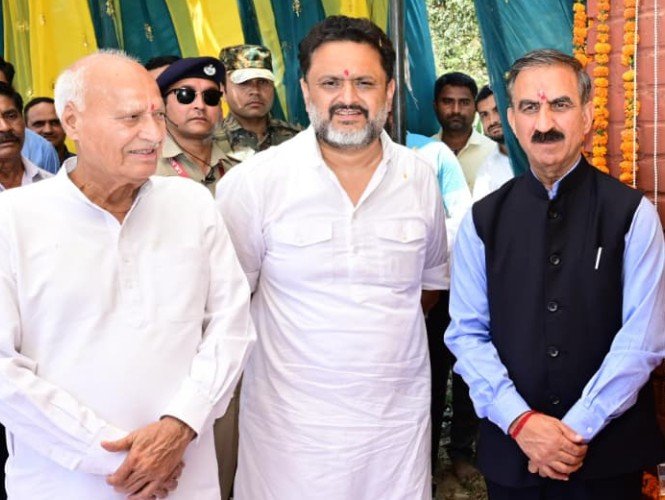
Himachal Pradesh Chief Minister Sukhvinder Singh Sukhu has announced a sweeping set of development, governance and welfare measures during a major public address in Fatehpur Vidhan Sabha segment of Kangra district, positioning his government’s agenda around education reform, healthcare expansion, rural income support and administrative accountability.
Addressing a large gathering in Jakhbar, the Chief Minister confirmed that all schools recently brought under the Central Board of Secondary Education framework would have full teaching staff in place by June 30. The state government has already initiated recruitment through a centralized selection process, with examinations underway to ensure timely appointments. Sukhu described the move as a cornerstone of his government’s effort to bridge educational inequality, particularly in rural areas, and to improve long-term learning outcomes.
In a parallel administrative decision, Sukhu announced the restoration of the Shah Canal project’s Chief Engineer office back to Fatehpur, reversing its earlier relocation to Mandi. The decision is expected to strengthen regional administrative access and improve coordination for irrigation-related works in the area.
The Chief Minister also approved ₹10 crore for the development of an industrial area in the constituency, alongside targeted financial assistance for community institutions. Mahila Mandal will receive ₹20,000 each, while ₹50 lakh has been sanctioned for the renovation of Wazir Ram Singh Stadium. These initiatives, he said, reflect a broader strategy to combine infrastructure growth with grassroots empowerment.
However, the address was not limited to development announcements. Sukhu launched a pointed critique of the previous government led by the Bharatiya Janata Party, alleging financial mismanagement and structural inefficiencies. He claimed that the earlier administration had access to significantly higher central funds, including revenue deficit grants and tax compensation, but failed to translate these resources into sustainable development outcomes. According to him, large sums were spent on infrastructure that remains underutilized, raising concerns over planning and execution.
One of the most serious allegations concerned the Himcare health insurance scheme, where Sukhu cited reported irregularities and announced a formal investigation. He suggested that discrepancies in medical claims pointed to systemic lapses, reinforcing the need for stricter oversight in public welfare programmes.
The Chief Minister emphasized that his administration is focused on transparency and reform, particularly in education and healthcare. He noted that Himachal Pradesh has improved its national standing in education quality after reforms such as introducing English-medium instruction from early grades and aligning 151 schools with a national curriculum pattern. These measures, he said, are aimed at preparing students for competitive opportunities while ensuring that financial barriers do not create inequality.
In healthcare, Sukhu highlighted the establishment of model health institutions across constituencies, including Fatehpur, where specialist doctors and modern diagnostic equipment are now available. He stated that the goal is to reduce dependency on distant medical facilities by strengthening services at the local level.
The Chief Minister also outlined a comprehensive rural economic strategy. The government has fixed procurement prices for naturally grown turmeric at ₹150 per kilogram and increased milk procurement rates to ensure direct income support for farmers. A ₹200 crore milk processing plant in Kangra district is under development, expected to significantly enhance dairy sector productivity. Additional measures include minimum support pricing for fisheries and financial assistance for fishing communities during seasonal restrictions.
Social welfare formed another key pillar of the address. Sukhu reiterated commitments to vulnerable groups, including widows, single women and orphaned children. Under a targeted welfare scheme, eligible women will receive monthly financial assistance along with subsidized electricity, while an ongoing survey is identifying the most economically disadvantaged households to ensure inclusive policy delivery.
The Chief Minister also addressed long-standing concerns of displaced families from the Pong Dam project, stating that land rights are being facilitated through lease arrangements. Infrastructure initiatives such as bridge construction and administrative buildings were highlighted as catalysts for regional connectivity and economic growth.
The event reflected a dual narrative—development-driven governance combined with political positioning. By announcing concrete projects while questioning the legacy of the opposition, Sukhu sought to reinforce his administration’s credibility ahead of future political challenges.
With a focus on institutional reform, welfare expansion and rural economic resilience, the Chief Minister’s address signals an attempt to recalibrate governance priorities in Himachal Pradesh while maintaining a strong political message against past administrations.