
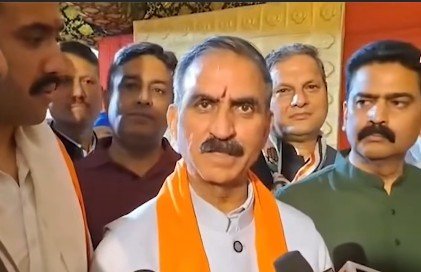
Himachal Pradesh Chief Minister Sukhvinder Singh Sukhu used a public rally in Palampur to sharpen his government’s political messaging ahead of municipal elections, presenting a governance model centred on welfare delivery, education reform and fiscal discipline, while mounting a sustained critique of the previous Bharatiya Janata Party (BJP) administration.
Addressing the gathering, Sukhu framed his administration as one that inherited severe financial strain but chose structural reform over short-term populism. He stated that when the Congress government assumed office, it faced a debt burden exceeding ₹76,000 crore along with significant unpaid dues to employees. Despite what he described as constrained fiscal space, Sukhu argued that his government had prioritised transparency, curbed wasteful expenditure and redirected resources towards public welfare.
A key plank of his address was the emphasis on systemic change. Sukhu said his administration had moved to close avenues of alleged corruption and rationalise spending patterns, presenting these steps as essential to restoring financial stability. He contrasted this with what he characterised as the previous government’s approach, alleging that large sums received through central assistance and GST compensation had not translated into sustainable fiscal management.
The Chief Minister placed particular emphasis on education, projecting it as a flagship area of reform. He highlighted the introduction of English-medium instruction from the earliest grades and the consolidation of administrative structures within the education department as measures aimed at improving learning outcomes. According to Sukhu, these interventions have contributed to a marked improvement in the state’s education ranking within a relatively short span, positioning Himachal Pradesh among the better-performing states.
Expanding on this agenda, Sukhu outlined the government’s efforts to widen access to quality education through the establishment of government-run CBSE-affiliated schools and the rollout of Rajiv Gandhi Day Boarding Schools. He announced that a substantial recruitment drive would be completed by the end of June to ensure these institutions are adequately staffed, including provisions for specialised subjects such as yoga and music. The initiative, he suggested, reflects an attempt to bridge the gap between public and private schooling standards, particularly for students from economically weaker backgrounds.
Disaster response and social welfare also featured prominently in his address. Referring to the devastating floods and landslides that affected parts of the state in recent years, Sukhu said his government had extended financial assistance significantly beyond standard relief norms to support affected families. He portrayed this as evidence of a people-centric approach, where the state steps in decisively during crises despite limited resources.
Looking ahead to urban governance, the Chief Minister announced that each ward in Palampur would receive dedicated development funding if the Congress secures victory in the municipal corporation elections. He argued that empowered local bodies are critical to sustaining urban growth and improving civic infrastructure, positioning the proposed funding as a means to accelerate grassroots development.
Throughout his speech, Sukhu sought to balance political critique with a forward-looking narrative, presenting welfare-driven governance as both a policy priority and an electoral proposition. As Himachal Pradesh moves closer to local body polls, his remarks signal a campaign strategy that leans heavily on delivery, institutional reform and targeted social investment, even as the political contest with the opposition intensifies.