
Talwara (Hoshiarpur)
In what is being projected as one of the Punjab government’s most ambitious attempts to combine social welfare with cultural outreach, Chief Minister Bhagwant Singh Mann and Aam Aadmi Party National Convenor Arvind Kejriwal on Sunday announced a major expansion of the state’s free pilgrimage programme while outlining a broader package of welfare initiatives ranging from financial assistance for women to healthcare and infrastructure development.
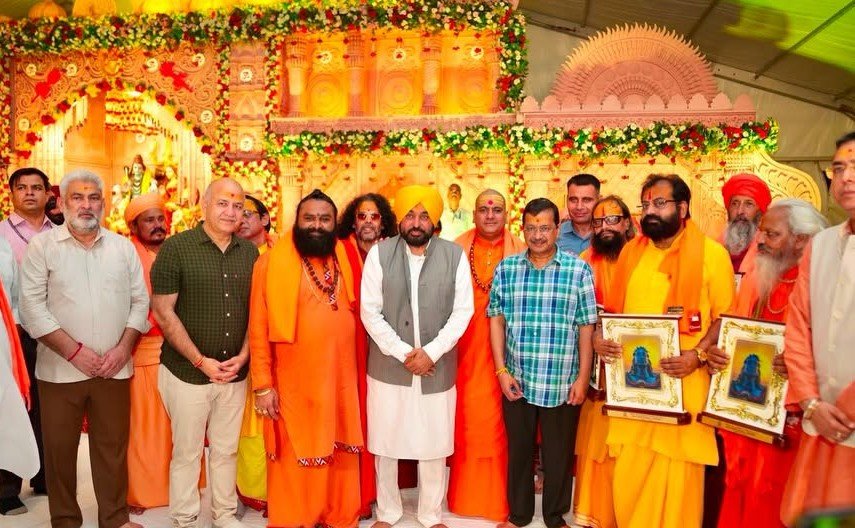
Addressing a large gathering during the ‘Ek Shaam Bhagwan Shiv Ke Naam’ Bhajan Sandhya in Talwara, the two leaders presented the government’s latest initiatives as part of what they described as a governance model centred on transparency, public welfare and inclusive development.
The most significant announcement was the expansion of Punjab’s Free Teerath Yatra Scheme, under which the government will begin operating pilgrim services to Khatu Shyam Ji-Salasar, Haridwar-Rishikesh and Mathura-Vrindavan from August. Registration for all three routes is expected to open next month, with the government estimating that nearly 1.5 lakh devotees will benefit from the expanded programme.
The scheme, which currently facilitates free pilgrimages to Sri Darbar Sahib and Sri Anandpur Sahib, covers transportation, accommodation, meals and other travel-related expenses, all funded by the state government. Officials said the addition of new destinations reflects growing public demand while also broadening the religious and cultural reach of the initiative.
Arvind Kejriwal said the expansion was aimed at ensuring that economic constraints do not prevent people from undertaking journeys to places of faith. According to him, the government has made arrangements to provide pilgrims with comfortable travel through air-conditioned buses along with accommodation and other facilities without any financial burden on the beneficiaries.
Alongside the pilgrimage announcement, Kejriwal highlighted the government’s social welfare programmes, particularly the financial assistance scheme for women. He said women whose registrations have already been completed but who are yet to receive payments will receive accumulated benefits on August 1. Eligible beneficiaries will receive arrears covering multiple months, while women belonging to Scheduled Caste families will receive enhanced assistance under the programme.
He claimed that the initiative would soon cover more than 50 lakh women across Punjab, describing it as one of the state’s largest direct benefit programmes targeted at women.
Linking these welfare initiatives to the government’s fiscal management, Kejriwal argued that transparent administration had enabled Punjab to expand social spending without compromising public finances. He asserted that the government’s emphasis on eliminating corruption had created additional financial resources that were now being invested in public welfare schemes, including free electricity, healthcare and financial support for vulnerable sections.
The AAP leader also used the occasion to contrast the present administration with previous governments, maintaining that public confidence in governance grows when citizens believe that public money is being utilised for welfare rather than personal enrichment. While making those political observations, he reiterated that the government’s focus remained on delivering tangible benefits to ordinary families.
Beyond welfare measures, the event also carried significant cultural and religious messaging.
Kejriwal announced that the state government has decided to develop a grand temple dedicated to Mata Sita and Luv Kush adjacent to the historic Bhagwan Valmiki Temple in Amritsar, a site closely associated with traditions surrounding the Ramayana. He described the proposed project as an effort to preserve and promote Punjab’s rich spiritual heritage while strengthening religious tourism within the state.
He further said that devotional programmes such as ‘Ek Shaam Bhagwan Shiv Ke Naam’ are being organised across all districts of Punjab as part of a broader initiative to promote social harmony through cultural and religious gatherings. He also referred to the ongoing redevelopment of Kali Mata Mandir in Patiala, where the government is investing in infrastructure improvements aimed at transforming the shrine into a major religious destination.
Chief Minister Bhagwant Singh Mann, addressing the gathering, placed greater emphasis on Punjab’s long-standing tradition of communal harmony and social unity.
Describing Punjab as a land where diversity has historically flourished, Mann said the state’s greatest strength lies in its ability to bring people of different faiths together. He observed that public participation in the Bhajan Sandhya reflected Punjab’s shared cultural traditions, where religious events often transcend community boundaries and become collective celebrations.
The Chief Minister said preserving this spirit of harmony remains central to his government’s vision for the state. He maintained that divisive politics has never found lasting acceptance in Punjab and expressed confidence that the values of peace, fraternity and mutual respect would continue to define the state’s social fabric.
Alongside these broader themes, Mann highlighted what he described as key achievements of his administration over the past four years.
He said the closure of 19 toll plazas had reduced financial burden on commuters while generating daily savings for the public. He also pointed to the recruitment of more than 68,000 young people into government service through what he termed a transparent and merit-based process.
The Chief Minister further claimed that nearly 90 per cent of Punjab households are now receiving free electricity, while farmers are benefiting from daytime power supply and strengthened canal irrigation systems. He added that extensive road construction projects are underway across the state as part of efforts to improve rural and urban connectivity.
On women’s welfare, Mann said the Maavan Dheeyan Satkar Yojana has begun direct transfers into beneficiaries’ bank accounts from July 1. Under the scheme, eligible women receive monthly financial assistance, with enhanced support for women belonging to Scheduled Caste communities. He said the programme has been backed by a substantial budgetary allocation and is expected to benefit the overwhelming majority of women in Punjab.
Healthcare also featured prominently during the event.
The Chief Minister announced that the BBMB Hospital would be comprehensively upgraded to provide advanced medical facilities comparable to those available at premier institutions. The proposed modernisation will include new diagnostic equipment, specialist doctors and expanded treatment facilities aimed at reducing the need for patients to travel outside the region for advanced healthcare.
According to Mann, strengthening public health infrastructure remains one of the government’s long-term priorities, particularly in semi-urban and rural areas where access to specialised medical services has traditionally remained limited.
The announcements made in Talwara collectively reflect the Punjab government’s attempt to combine welfare delivery, healthcare expansion, infrastructure development and cultural initiatives within a single governance narrative. As political parties gradually begin positioning themselves ahead of future electoral contests, programmes centred on social security, religious tourism, public services and community outreach are expected to remain central to Punjab’s evolving political discourse.
Sunday’s event, therefore, was not merely a devotional gathering. It also served as a platform for the state government to showcase its governance priorities, reinforce its welfare agenda and underline its message that development, cultural heritage and social harmony can advance together under a transparent and people-centric administration.