

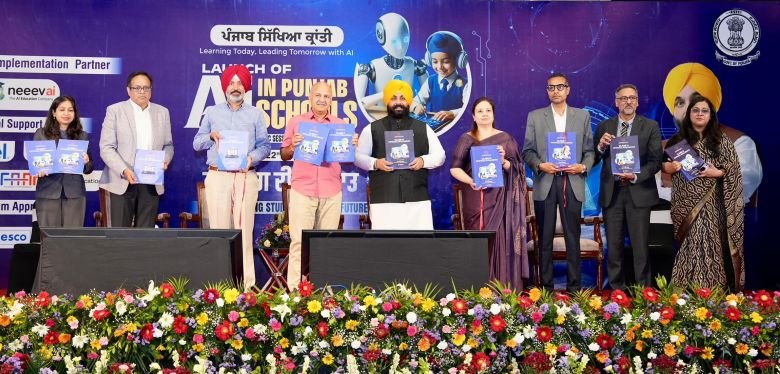
In a landmark reform that could redefine the future of school education in India, Punjab has become the first state to introduce Artificial Intelligence (AI) as a mainstream subject for students from Class I to Class XII. The initiative, launched under the ambitious ‘Sarbat.AI’ project, seeks to integrate AI education into the state’s school curriculum on an unprecedented scale, positioning Punjab at the forefront of technology-driven learning and preparing an entire generation for the rapidly evolving digital economy.
The programme was formally launched by Punjab School Education Minister Harjot Singh Bains in the presence of former Delhi Deputy Chief Minister and Education Minister Manish Sisodia, senior officials, education experts and representatives from leading global technology companies.
Describing the initiative as a defining moment in Punjab’s educational journey, Harjot Singh Bains said the state is now moving beyond its historic leadership in the Green Revolution to becoming a pioneer in what he termed the “Artificial Intelligence Revolution.” He said the objective is to ensure that every child, irrespective of whether they study in an urban or rural school, receives access to future-ready technological education.
According to the minister, Artificial Intelligence will become a core component of the Punjab School Education Board (PSEB) curriculum and will be introduced in phases to ensure effective implementation. The first phase will cover students from Classes VIII to XII by integrating AI into the existing Computer Science curriculum across government and affiliated private schools. The second phase will extend age-appropriate AI education to students from Classes I to VII, ensuring exposure to emerging technologies from the foundational years of schooling.
Officials said the curriculum has been developed after studying international education models followed in countries including Singapore, Finland, the United Arab Emirates and the United States. The framework has also been aligned with UNESCO’s Ethical Artificial Intelligence guidelines to ensure students learn not only technological skills but also the responsible, ethical and safe use of AI.
The Sarbat.AI initiative is expected to become one of India’s largest school-level Artificial Intelligence education programmes. Once fully implemented, it will cover 25,172 schools and benefit nearly 3.15 million students across Punjab. During the initial rollout, more than 12,400 Computer Science teachers will lead classroom implementation, while over two lakh teachers from different academic disciplines will gradually receive specialised training to integrate AI into teaching, learning and assessment practices.
The state government said the curriculum has been designed to move beyond conventional computer education by encouraging students to understand, create and innovate using Artificial Intelligence. Students will have access to live online classes, recorded lectures, project-based learning modules, continuous assessments and a dedicated Learning Management System aimed at promoting practical and experiential learning.
The programme builds upon the success of Punjab’s earlier AI pilot initiative, conducted in partnership with FA-AI, which concluded with a statewide Artificial Intelligence Hackathon. According to officials, several student-developed innovations showcased during the pilot phase demonstrated the potential of young learners to solve real-world problems through technology and inspired the decision to expand AI education across the state.
Implementation of the project will be supported by Neeev AI, while strategic collaborations with leading technology companies, including Google, Intel, Canva and FA-AI, are expected to strengthen AI literacy, teacher capacity building, curriculum innovation and workforce preparedness. The government believes these partnerships will expose students to globally relevant technological practices while maintaining high academic standards.
Speaking at the launch, Manish Sisodia described the initiative as a historic milestone that establishes Punjab as a national benchmark in Artificial Intelligence education. He said the programme is designed not merely to teach students how to use AI tools but to equip them with the ability to innovate, create solutions and emerge as leaders in the technology-driven economy of the future. He added that preparing children for tomorrow’s workforce requires integrating emerging technologies into mainstream education rather than treating them as optional skills.
Punjab School Education Board Chairman Dr. Amarpal Singh said Artificial Intelligence has now become an integral component of the state’s compulsory Computer Science curriculum, and students’ learning outcomes in AI will be reflected in their academic records. He noted that the challenge before educators is no longer whether Artificial Intelligence will transform education, but how educational institutions can shape that transformation responsibly and effectively.
A panel discussion held alongside the launch brought together experts from Google, Intel, Amazon Web Services, Canva, Neeev AI and FA-AI, who discussed strategies for strengthening AI education, improving digital learning ecosystems and leveraging technology to enhance examination integrity and educational governance.
The introduction of Artificial Intelligence as a mainstream subject marks one of the most ambitious curriculum reforms undertaken by any Indian state in recent years. By embedding AI education across every stage of schooling, Punjab aims to nurture a generation equipped with technological competence, critical thinking, ethical awareness and innovation skills that are increasingly becoming essential in the global knowledge economy.
If implemented effectively, the Sarbat.AI initiative could serve as a model for education systems across the country, demonstrating how emerging technologies can be integrated into mainstream classrooms to prepare students for the challenges and opportunities of the future.
Web Generated News Report.