
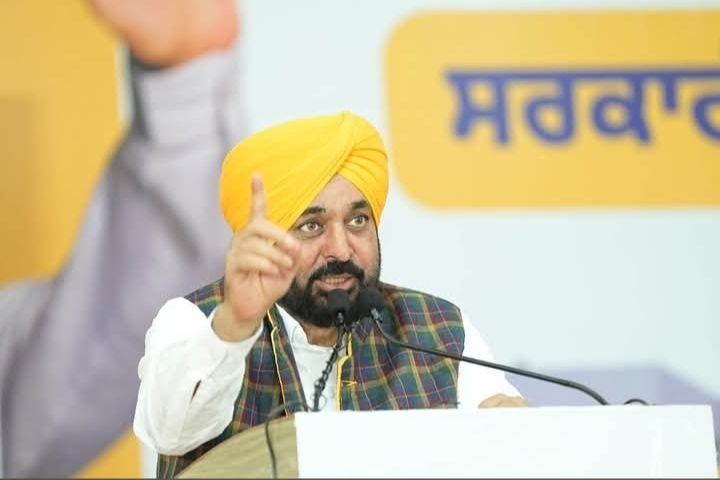
Punjab Chief Minister Bhagwant Singh Mann has inaugurated a new five-storey government school building for girls in Malerkotla, describing the facility as an Independence Day gift to the daughters of the historic city and surrounding villages.
The ₹6.34 crore building has been equipped with modern facilities including libraries, smart classrooms, common rooms and washrooms. According to the government, the project was originally approved at an estimated cost of ₹6.39 crore but was completed for ₹6.34 crore, resulting in a saving of ₹5.25 lakh.
Speaking at the inauguration, Mr Mann said the new building would enable girls from Malerkotla and nearby villages to access better educational facilities closer to their homes.
The chief minister said the building, spread over approximately 54,000 square feet, would provide students with an improved learning environment and modern infrastructure.
The project also carries a personal political significance for Mr Mann, who recalled the condition of the school from his days as a Member of Parliament. He said the school had previously operated in two shifts during winter and that its old building had become unsafe.
Mr Mann presented the new infrastructure as part of his government’s wider effort to transform government schools rather than simply improve their appearance.
He contrasted the current approach with previous governments, alleging that earlier administrations had sometimes equated the idea of “smart schools” with little more than painting and renovation of buildings.
The chief minister also highlighted the performance of government-school students in competitive examinations. According to figures cited by him, 882 students from government schools qualified for NEET in 2026, while 361 cleared the JEE examination.
Mr Mann said the number of government-school students clearing NEET had risen sharply from 80 in 2021 to 882 in 2026.
The government is also expanding its network of Schools of Eminence, with 118 such institutions being established for students, particularly those from families that may not be able to afford expensive private education.
Another component of the government’s education policy is transportation for girls. Mr Mann said more than 15,000 girls were currently being provided special school bus services so that distance and transport difficulties would not interrupt their education.
He also highlighted parent-teacher meetings across government schools, claiming that more than 24 lakh parents had participated.
The chief minister said his government’s objective was to ensure that a child’s educational ability, rather than the family’s financial background, determined the opportunities available to them.
The Malerkotla event was also used by Mr Mann to broaden the discussion beyond education. He referred to the city’s history of communal harmony and its importance in Punjab’s social and religious history.
He said Malerkotla represented Punjab’s tradition of fraternity and that developing the historic city was an important responsibility of the state government.
The chief minister also announced that a medical college named after Nawab Sher Khan was expected to come up in Malerkotla, arguing that it would strengthen healthcare facilities while creating employment opportunities for young people.
Mr Mann linked the school project to his government’s broader claims on healthcare, roads, employment and infrastructure. He said the government had established 1,090 Aam Aadmi Clinics and that more than five crore people had benefited from them.
He also claimed that more than 69,000 government jobs had been provided on merit without recommendations or corruption.
The government has increasingly made education and public-service delivery central themes of its political narrative in Punjab. With the 2027 Assembly election approaching, projects such as the Malerkotla school are likely to become an important part of AAP’s attempt to demonstrate that its governance model has produced visible changes at the grassroots.
For the government, the political significance of the project goes beyond a new building. It provides a tangible example that can be presented to parents and students as evidence of investment in public education.
For Punjab’s opposition parties, however, the government’s claims on education will remain an area of scrutiny, particularly over learning outcomes, teacher availability, recruitment and the long-term sustainability of new infrastructure.
For now, the Mann government is making education one of its strongest public-facing narratives—and Malerkotla’s new girls’ school fits directly into that strategy