
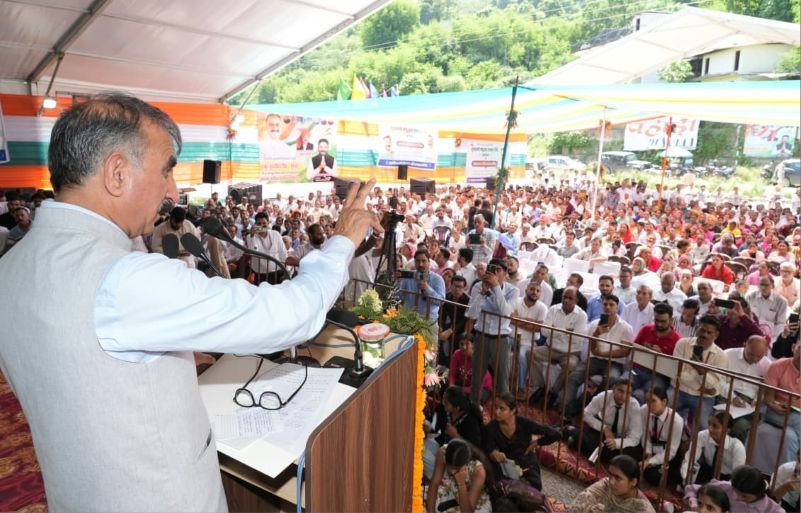
Bilaspur — The Himachal Pradesh government has announced a fresh package of financial and institutional support for the state’s fishing community, with Chief Minister Thakur Sukhvinder Singh Sukhu transferring Rs 52.50 lakh directly to 1,500 fishermen in Bilaspur under the Mukhya Mantri Machhuara Samman Nidhi Yojana.
The assistance, transferred through Direct Benefit Transfer (DBT), provides Rs 3,500 to each eligible fisherman. The announcement came during Sukhu’s visit to the Jhandutta Assembly constituency, where the government also unveiled a series of measures aimed at improving fishing infrastructure, reducing financial pressure on fishermen and strengthening their access to markets.
The measures are significant for a community whose livelihood is closely linked to Himachal’s reservoirs and rural economy. Along with the direct financial assistance, the government announced that the five-fold penalty imposed on fishermen societies would be waived. The subsidy for setting up cold-storage facilities has also been increased from 70 per cent to 80 per cent.
The Chief Minister further announced Rs 50 lakh for providing life jackets to fishermen across Himachal Pradesh and Rs 10 lakh for developing landing facilities. Ten link roads in the Jhandutta constituency will receive Rs 10 lakh each for completion, while Government Degree College Jhandutta is set to introduce BCA and BBA courses.
The announcements underline a broader attempt by the state government to treat fishing not merely as a traditional occupation but as a component of rural economic activity that requires infrastructure, market access and financial security.
Sukhu said the government’s approach was based on what he described as ‘Vyavastha Parivartan’—a governance model centred on listening to people’s concerns and shaping policies around them. He said his own background had helped him understand the difficulties faced by ordinary families and workers.
For fishermen, one of the most important policy changes concerns the royalty charged on fish caught from reservoirs. According to the Chief Minister, the rate was reduced from 15 per cent to 7.50 per cent during 2025-26 and has now been brought down further to one per cent.
The government is also providing a 70 per cent subsidy for the purchase of refrigerated vehicles, intended to help fishermen transport their produce to major markets, including Delhi and Chandigarh. Better cold-chain and transportation facilities could prove particularly important because access to distant markets can determine whether fishermen receive remunerative prices for their catch.
Sukhu said the government’s objective was to strengthen village economies so that people could generate sustainable livelihoods without being compelled to migrate elsewhere in search of income.
The Chief Minister linked the fishermen-focused measures with his government’s wider economic and social policy. He highlighted initiatives concerning milk prices, minimum support prices for natural farming produce and financial assistance to Mahila Mandals and Yuvak Mandals for plantation and increasing forest cover.
Education also featured prominently in his address. Sukhu claimed that Himachal Pradesh had improved its position in terms of quality education and said government initiatives had resulted in the opening of 150 CBSE schools, with enrolment increasing by around 24,000 students. He also said students pursuing higher education were being offered education loans at an interest rate of one per cent.
The Chief Minister used the occasion to defend his government’s broader governance record, including its decision to restore the Old Pension Scheme. He said the decision was taken in the first Cabinet meeting with the objective of providing greater financial security to government employees after retirement.
Healthcare and disaster assistance were also highlighted. Sukhu said the state was bringing advanced medical technology and expertise associated with AIIMS, New Delhi, to government medical colleges, including facilities for robotic surgery. He also referred to financial assistance of up to Rs 8 lakh being provided from state resources to families affected by disasters.
The political dimension of the Chief Minister’s speech was equally visible. He accused the previous BJP government of shortcomings in education and criticised what he described as attempts to destabilise the elected Congress government. He also defended the government’s position on the Kishau Dam project and said protecting Himachal’s interests could generate significant future revenue for the state.
Technical Education Minister Rajesh Dharmani described the announcements for fishermen as an important beginning in improving the economic security of the community. He said the government’s policies were intended to translate administrative decisions into tangible benefits for ordinary families.
Former minister Ram Lal Thakur said more than 6,000 fishermen in the state stood to benefit from the government’s initiatives. Former MLA Bumbar Thakur, Congress leaders and local representatives also used the gathering to highlight the government’s welfare measures and attack the BJP’s political claims.
The importance of the latest package, however, extends beyond the immediate financial transfer. Himachal’s fishing communities face challenges linked to transportation, storage, market connectivity, safety and access to modern infrastructure. The increase in cold-storage subsidy, reduction in royalty and investment in safety equipment indicate an attempt to address several of these concerns simultaneously.
For Bilaspur, where fishing livelihoods are closely connected with reservoir-based economic activity and the region’s history of displacement, the measures also carry a strong local significance. Support for fishermen can potentially strengthen household incomes while creating a more organised value chain around fish production and marketing.
The larger test will be implementation. Direct transfers can provide immediate relief, but sustained improvement in fishermen’s incomes will depend on whether infrastructure, market access, cold-chain facilities and safety measures reach beneficiaries efficiently.
For the Sukhu government, the latest announcements therefore represent both a welfare intervention and an effort to build a stronger rural livelihood economy. The challenge ahead will be to convert these financial and policy commitments into lasting improvements in the lives of Himachal’s fishing families.