
Punjab Chief Minister highlights daytime power for farmers, expanded canal irrigation, government jobs, healthcare and women’s welfare, while accusing rivals of attempting to damage his reputation
DHURI। Punjab Chief Minister Bhagwant Singh Mann on Sunday sought to reinforce his government’s governance narrative, asserting that the Aam Aadmi Party (AAP) had earned the trust of the people through four-and-a-half years of work, rather than the promises and political rhetoric he attributed to previous administrations.
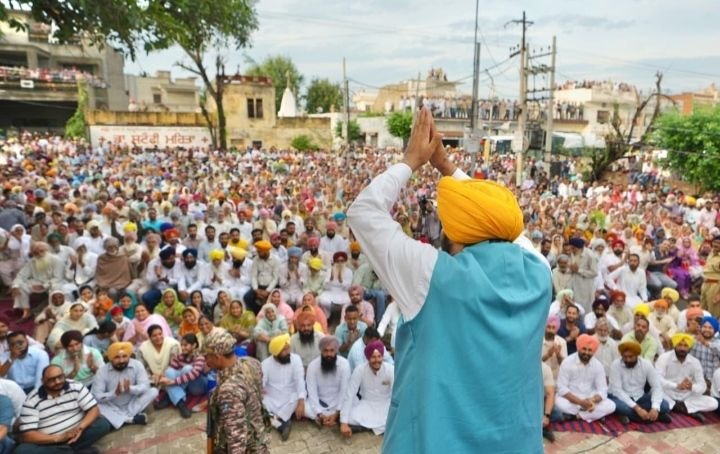
Addressing a Lok Milni programme at Mimsa village in the Dhuri Assembly constituency, Mann highlighted the government’s claims of improvements in agricultural irrigation, access to electricity, public healthcare, education, employment and household welfare. He also launched a sharp attack on political opponents, alleging that they were unable to challenge his record of work and were instead attempting to tarnish his personal image.
The Chief Minister said the government’s central objective was to ensure that public money was spent on public welfare, with the benefits reaching ordinary families through improved services and financial relief.
“Every penny of the state exchequer belongs to the people,” Mann said, adding that government spending was being directed towards development, schools, hospitals, roads and welfare initiatives. He maintained that the difference between his government and previous administrations lay in the delivery of tangible results.
Agriculture and irrigation at the centre of government’s claims
Agriculture formed a major part of Mann’s address, with the Chief Minister describing daytime electricity supply and the expansion of canal irrigation as significant changes for Punjab’s farming community.
He said farmers were receiving electricity during the day, reducing their dependence on night-time irrigation schedules. He also claimed that canal water had reached 1,587 villages that had previously not received supplies, following an investment of ₹7,200 crore in irrigation infrastructure.
According to the figures cited by Mann, the area receiving canal water has increased from 20.89 lakh acres in 2022 to 60.30 lakh acres at present. He said expanding irrigation facilities was essential to reducing the pressure on farmers, improving agricultural productivity and supporting the state’s rural economy.
The Chief Minister also promised that farmers would receive payment for their paddy directly into their bank accounts before returning home from the grain market. He said timely payments were crucial to protecting cultivators from financial uncertainty during the procurement season.
Mann presented these measures as part of a broader effort to reduce the financial burden on farmers and strengthen the agricultural economy. His government, he said, would continue to prioritise reliable irrigation, public services and village-level development.
Jobs, free electricity and household savings
Employment and household financial relief were other major themes of the programme. Mann said his government had provided more than 70,000 government jobs without corruption, presenting the appointments as evidence of a recruitment process based on merit rather than political influence.
He also claimed that more than 90 per cent of households were receiving free electricity and that government welfare measures were helping families reduce their monthly expenses.
Mann put the potential savings from various government schemes at around ₹15,000 per family per month. In a post on X, he cited a figure of ₹1.82 lakh in annual benefits for every family, linking the claimed relief to free electricity, healthcare, employment-related benefits and other welfare initiatives.
The Chief Minister also referred to the closure of toll plazas, saying the move had saved commuters approximately ₹70 lakh daily in charges. He said the government was investing in village development and sports stadiums to create better opportunities for young people.
The financial figures cited during the programme formed part of the government’s broader argument that welfare spending and public infrastructure were delivering direct benefits to residents. The overall savings, however, would depend on the schemes for which individual households qualify and the benefits they actually use.
Healthcare cover and women’s financial assistance
On healthcare, Mann highlighted the Mukh Mantri Sehat Yojna, under which the government says eligible families can access cashless treatment of up to ₹10 lakh. He said the initiative was intended to reduce the financial burden of medical emergencies and help families obtain treatment without worrying about hospital bills.
The Chief Minister also outlined the proposed benefits under the Mawan Dheeyan Satkar Yojna, under which eligible women aged 18 and above are to receive monthly financial assistance of ₹1,000, with ₹1,500 for eligible Scheduled Caste women, from July 1.
He said the assistance would be transferred directly into beneficiaries’ bank accounts and that women already receiving social security pensions would also be eligible. The government expects the scheme to benefit around 97 per cent of women in Punjab and has allocated ₹9,300 crore for it in the state budget, according to the figures cited by Mann.
Describing the initiative as a measure of recognition and dignity for women, he said direct financial support would help families manage household expenses and provide women with greater financial security.
The scheme, alongside free electricity and healthcare support, was presented as a key element of the government’s welfare approach.
Education pitched as a route out of poverty
Mann argued that welfare measures could provide immediate relief, but education remained the most effective long-term means of breaking the cycle of poverty.
He referred to teacher training, Schools of Eminence and efforts to improve government-school infrastructure as part of the state’s strategy to strengthen public education. The objective, he said, was to ensure that children from ordinary families could compete with students from better-resourced institutions.
Citing the number of government-school students qualifying for the National Eligibility-cum-Entrance Test (NEET), Mann said the figure had risen from 80 in 2021 to 882 in 2026. He described the increase as evidence of improvements in the government-school system and said his administration was determined to expand educational opportunities for students across Punjab.
The Chief Minister said better-quality education could improve living standards, widen career prospects and create opportunities for future generations. He maintained that strengthening public schools was essential to ensuring that a child’s future was not determined by the financial position of the family.
Mann accuses opponents of targeting his image
Turning to political criticism, Mann alleged that his opponents were attempting to malign him because they could not challenge his government’s performance or his personal integrity.
Unable to find fault with his work, he said, rival parties were resorting to personal attacks and political pressure. He asserted that the people of Punjab would judge the government on its record rather than on what he described as propaganda.
Referring to a raid by the Central Bureau of Investigation (CBI) at his office, Mann claimed that the BJP had sought to intimidate him but that the agency had returned empty-handed.
“The BJP thought that raids and pressure would intimidate me,” he said, reiterating that he would not compromise on the interests of Punjab and its people.
His remarks brought the political contest directly into a programme otherwise focused heavily on government schemes and public services. The CBI-related allegation and Mann’s interpretation of the raid were presented as part of his political response to his opponents.
Lok Milni as a message of accessibility
Mann also used the gathering to emphasise his claim that an elected representative must remain accessible to the public. He said his doors had always been open to the people of Punjab and would remain so, describing residents as members of his extended family.
According to the Chief Minister, the purpose of public office was to listen to grievances, understand local problems and work towards practical solutions rather than remain confined to official meetings and offices.
In his post on X, Mann described Mimsa as a revolutionary village and said the affection and support of its residents had helped make Dhuri a focal point of Punjab politics. He contrasted his government’s approach with what he characterised as the unfulfilled promises of previous administrations.
The programme also served to reinforce the AAP government’s broader political message: that its performance should be assessed through employment, public services, infrastructure and direct welfare benefits.
A governance pitch with political stakes
Mann’s address brought together the principal themes on which his government is seeking to build public confidence: agricultural relief, improved access to canal water, daytime electricity, government recruitment, healthcare cover, women’s financial assistance and stronger public education.
The claims offer a picture of the government’s priorities, while the scale of their impact will ultimately depend on implementation, eligibility, service quality and the benefits received by households across the state.
For Mann, however, the argument is also political. By contrasting his administration’s record with that of previous governments and accusing opponents of personal attacks, he sought to frame the debate around delivery and accountability rather than allegations against individual leaders.
The Chief Minister said his government would continue to work towards a prosperous and self-reliant Punjab, insisting that public service, transparency and accountability would remain its guiding principles.
As the state’s political contest continues, the durability of that message will depend not only on the schemes announced but also on whether farmers, women, young people and ordinary households experience the promised improvements in their daily lives.