

CM pitches rural economic revival as the foundation of Himachal’s development; unveils welfare initiatives and targets BJP over governance and political conduct
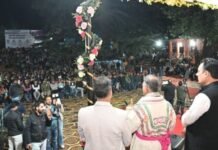
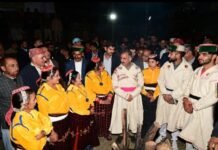
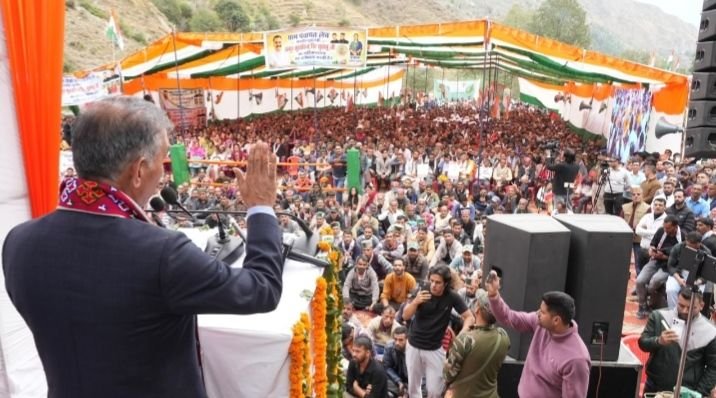
Shimla, November 5: Chief Minister Thakur Sukhvinder Singh Sukhu has announced an allocation of ₹18 crore for the construction of the Holi-Utrala road and the introduction of CBSE-affiliated education at five government schools in the Bharmour Assembly constituency of Chamba district. The announcements came during a public meeting at Lilh Kothi, where he outlined the state government’s development priorities, with particular emphasis on rural livelihoods, education, social welfare and improved connectivity in remote areas.
The five schools at Lilh, Mehla, Bharmour, Sunara and Holi will begin admissions under the CBSE curriculum from the next academic session. The Chief Minister said the process of recruiting teachers for these institutions had already been initiated. He said the move was intended to expand access to quality education in rural and geographically difficult regions, enabling children to receive an education comparable to that available in better-connected areas.
Sukhu said his government was pursuing a policy of Vyavastha Parivartan to bring structural changes in governance and ensure that development reached every region and section of society. He maintained that the government had introduced targeted schemes for orphan children, widows, single women, farmers, horticulturists and young people, while giving priority to strengthening the rural economy.
Addressing the gathering, he said that, for the first time in the state’s history, a government had adopted a focused strategy to improve rural incomes through agriculture, horticulture, animal husbandry, fisheries and self-employment. According to him, these sectors hold considerable potential to create sustainable livelihood opportunities and make villages economically stronger.
Disaster response and Centre’s assistance
Recounting the challenges faced by his government soon after taking office, Sukhu said Himachal Pradesh was struck by a devastating natural disaster barely six months after he became Chief Minister. He claimed that despite inadequate assistance from the Central Government, the state administration safely evacuated more than 75,000 stranded tourists and restored electricity and drinking water supplies within a remarkably short period.
He alleged that the Prime Minister had announced financial assistance of ₹1,500 crore for the disaster-hit state, but the amount had not been released so far. He also criticised BJP leaders in Himachal Pradesh, accusing them of failing to stand with the state during the crisis.
The Chief Minister said his government had arranged a special relief package from its own resources and substantially revised compensation norms for affected families. Financial assistance for rebuilding completely damaged houses, he pointed out, had been increased from ₹1.50 lakh to ₹8.50 lakh. He added that the state’s disaster management efforts had also received appreciation from the World Bank and NITI Aayog.
Political attack on BJP
Sukhu also referred to the political crisis faced by his government, accusing the BJP of attempting to destabilise an elected administration by allegedly luring Congress legislators and undermining the people’s mandate.
Taking aim at the BJP’s ongoing foot march, he questioned the party’s moral authority to lead a campaign on electoral issues, alleging that those accused by the Congress of engaging in vote theft could not claim the mantle of defending democracy. He said the Congress had played a historic role in securing democratic rights for citizens through the Constitution, including the right to vote.
Education reforms and rural schools
Highlighting the state’s performance in education, Sukhu said Himachal Pradesh had risen to fifth position nationally in terms of education quality. He contrasted this with the state’s reported 21st position during the previous BJP government and alleged that learning standards had deteriorated to such an extent at that time that some Class V students struggled to read textbooks prescribed for Class II.
He said the introduction of CBSE-affiliated schools in rural areas was part of a wider effort to improve educational standards and provide students with better academic opportunities. The five institutions announced for the Bharmour constituency, he said, would be equipped to implement the new curriculum from the coming academic session.
Welfare measures for vulnerable families
The Chief Minister said his own journey from a modest family background to the highest elected office in the state had given him an understanding of the difficulties faced by ordinary people. He said the government was therefore placing special emphasis on the welfare of economically and socially vulnerable sections.
Under the Mukhyamantri Sukh-Aashray Yojana, he said, comprehensive assistance was being provided to around 6,000 orphan children until they reach the age of 27. The support includes education, healthcare and pocket expenses, along with financial assistance for house construction and marriage.
He also referred to the Mukhyamantri Sukh Shiksha Yojana, under which the government bears the cost of professional education for children of widowed women.
Sukhu announced that the state government would soon introduce the Mukhyamantri Ka Apna Parivar Sukhi Parivar Yojana. The proposed scheme is intended to cover more than three lakh families with annual incomes below ₹75,000. Women aged between 21 and 59 years in eligible households would receive ₹1,500 per month. The proposed benefits would also include 300 units of free electricity and health insurance cover of ₹10 lakh.
State’s financial position and revenue initiatives
Responding to concerns over the state’s financial resources, Sukhu said the government was pursuing legal and administrative measures to protect Himachal Pradesh’s interests and strengthen its revenue base. He claimed that the state had secured favourable outcomes in several cases that could generate thousands of crores of rupees.
He said the government had saved approximately ₹3,000 crore by negotiating the Memorandum of Understanding for the Kishau Multipurpose Project on terms favourable to Himachal Pradesh. Once the project becomes operational, the state is expected to receive an estimated annual revenue of ₹1,500 crore from 2032, he said.
Referring to the Wildflower Hall case in Shimla, the Chief Minister said the Supreme Court had ruled in favour of the state government, resulting in revenue of ₹401 crore. He added that the state was also expected to earn another ₹1,200 crore over the next 30 years.
More announcements for Bharmour
Apart from the road and school-related announcements, Sukhu said a committee would be constituted to pursue with the Central Government the demand for granting Scheduled Tribe status to 27 gram panchayats in the Bharmour Assembly constituency.
He also assured residents that the government would examine proposals to upgrade schools at Churi, Chadi, Ananaihar, Grundhi and Kunaid. The possibility of constructing a helipad at an appropriate location in the constituency would also be explored, he added.
Chairman of APMC Chamba Lalit Thakur thanked the Chief Minister for the development initiatives and placed various demands concerning the region before him.
State Congress General Secretary Amit Bharmouri and Chamba District Congress President Surjit Chaudhary welcomed the Chief Minister. MLA Neeraj Nayyar, former minister Asha Kumari, Wool Federation Chairman Manoj Thakur, Scheduled Caste and Scheduled Tribe Development Corporation Chairman Lal Singh Kaushal, Zila Parishad Chairperson Rekha Thakur and other leaders and dignitaries were also present.
The announcements on road connectivity and CBSE education are particularly significant for Bharmour, where difficult terrain and limited access to infrastructure have long shaped the development needs of remote communities. The government’s stated emphasis on rural livelihoods, education and welfare now faces the task of translating these commitments into timely implementation on the ground.