


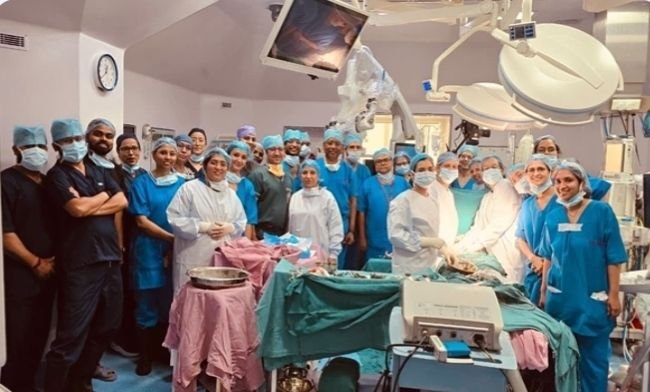
New Delhi: In a significant breakthrough in India’s advanced maternal and fetal healthcare, doctors at the All India Institute of Medical Sciences (AIIMS), New Delhi, have successfully performed the country’s first open fetal surgery to correct a severe spinal defect in an unborn baby at 25 weeks of pregnancy.
The complex, six-hour operation was carried out on November 12 at the Neurosciences Centre of AIIMS. The surgical team repaired a lumbosacral myelomeningocele, regarded as the most severe form of spina bifida, in which the spinal cord and its protective coverings protrude through an opening in the developing spine. The defect had resulted in leakage of cerebrospinal fluid, making early intervention particularly important.
Unlike conventional procedures performed after birth, fetal surgery allows doctors to address certain abnormalities while the baby is still inside the mother’s womb. In this case, the medical team undertook the repair in utero, with the objective of addressing the spinal defect before delivery and potentially reducing the severity of associated complications.
More than five weeks of preparation
The landmark procedure followed over five weeks of intensive preparation involving specialists from several medical disciplines. The planning process included detailed fetal imaging, extensive clinical assessment, non-directive counselling of the parents, anaesthetic preparation and operative simulation to anticipate the challenges of operating on an unborn child.
The surgery was performed with the assistance of high-end microscopy and continuous advanced ultrasonography, enabling the team to monitor the procedure and guide the delicate surgical intervention.
More than 30 doctors, specialists and nursing professionals participated in the operation. The multidisciplinary team included experts from obstetrics and gynaecology, maternal-fetal medicine, neurosurgery, obstetric and neuroanaesthesia, plastic surgery, radiodiagnosis and neonatology.
The scale of coordination reflects the complexity of fetal surgery, where the medical team must simultaneously consider the safety of the mother and the developing baby.
Why the surgery matters
Myelomeningocele is a serious congenital neural tube defect that develops during early pregnancy. In affected babies, an opening in the spine allows the spinal cord and surrounding tissues to protrude outside the normal protective structure.
Children born with this condition can face major lifelong health challenges, including paralysis or weakness of the lower limbs, hydrocephalus and other neurological disabilities. The extent of complications varies from case to case, depending on the location and severity of the defect.
By repairing the abnormality before birth, fetal surgery may help improve outcomes in carefully selected pregnancies. However, the procedure is not suitable for every patient and requires detailed evaluation, counselling and specialised medical facilities.
AIIMS has also underlined that fetal surgery should not be viewed as a replacement for preventive measures against neural tube defects. Prevention, early antenatal care and appropriate medical guidance remain important components of maternal and child healthcare.
Mother and baby to remain under close observation
Although the surgical intervention has been completed, the medical journey is not over. AIIMS has stated that both the mother and the fetus will remain under close multidisciplinary observation during the remaining period of pregnancy, delivery and the newborn stage.
The subsequent course of pregnancy and the baby’s condition after birth will be important in assessing the overall outcome of the intervention.
Another significant aspect of the achievement is that the entire procedure was provided free of cost to the family under the Government of India’s Janani Shishu Suraksha Karyakram (JSSK), which supports eligible maternal and newborn healthcare services.
The achievement marks an important advancement in India’s capacity to undertake highly specialised fetal interventions. It also demonstrates the role of multidisciplinary public healthcare institutions in bringing complex medical procedures within the reach of families who may otherwise find such treatment financially inaccessible.
This is a web-generated news report based on information released by AIIMS, New Delhi. The report has been independently rewritten and structured for digital news publication.