

From engaging rival political parties on electoral rolls to taking voter services to every polling booth and coordinating security agencies across state borders, Punjab’s Chief Electoral Officer is working to strengthen public faith in the electoral process well ahead of the Assembly elections
Chandigarh, Free and fair elections are not secured merely by deploying personnel on polling day or ensuring that electronic voting machines are in place. The credibility of an election is built much earlier — through accurate electoral rolls, accessible voter services, transparent procedures, confidence among political parties and a security environment in which every eligible citizen can exercise the right to vote without fear or pressure.
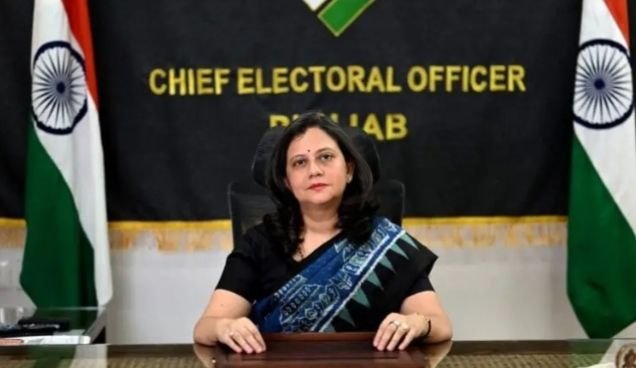
As Punjab moves towards its 2027 Legislative Assembly elections, Chief Electoral Officer Anindita Mitra is seeking to build these foundations through a series of administrative, voter-outreach and inter-agency initiatives. Her approach has increasingly placed emphasis on communication with political parties, wider participation by electors, timely resolution of grievances and coordination with law-enforcement agencies.
One of the most notable aspects of her tenure so far has been the response from representatives of rival political parties following the completion of the electoral-roll revision exercise in October. At a time when the Election Commission’s wider revision process has faced political criticism in different parts of the country, representatives of the Congress, Aam Aadmi Party, Bharatiya Janata Party and Shiromani Akali Dal acknowledged that their concerns had been heard and addressed during the exercise in Punjab.
That response has given Mitra’s efforts an important dimension: the challenge is not simply to conduct an administrative exercise correctly, but also to ensure that political stakeholders and ordinary voters have confidence in the process.
Political parties brought into the consultation process
The handling of the Special Intensive Revision (SIR) of electoral rolls emerged as an important test of the CEO’s ability to maintain communication with competing political interests.
According to representatives quoted in a report by *The Indian Express* on October 13, leaders from the four major political parties appreciated the way their queries had been addressed by the Punjab CEO. Shiromani Akali Dal spokesperson Arshdeep Singh Kler said the concerns raised at meetings had been heard and improvements made wherever necessary.
BJP legal cell chairman N.K. Verma described the exercise as having been completed in a peaceful atmosphere. AAP spokesperson Ferry Sofat said his party had received satisfactory responses to the issues it raised, while Congress spokesperson Hardeep Singh Kingra referred to the transparency of the process and the regular communication maintained with political representatives.
Kingra also highlighted the importance of ensuring that people felt the process was fair, not merely that it had been conducted according to procedure.
The appreciation, however, requires an important qualification. Congress and AAP representatives subsequently clarified that their comments related specifically to the handling of the process in Punjab and did not amount to an endorsement of the wider SIR exercise nationally. This distinction notwithstanding, the feedback indicated that regular engagement and accessible communication had helped maintain a working relationship between the CEO’s office and political parties in the state.
The participation of approximately 90,000 Booth Level Agents appointed by political parties was also cited as an important element of the exercise. Their involvement provided an additional channel for raising local concerns and checking electoral records.
For an election administration, such engagement is significant. Political parties are not merely participants in the electoral contest; their representatives also have a legitimate role in identifying discrepancies, bringing eligible voters’ concerns to the notice of officials and monitoring the preparation of electoral rolls.
A voter list that leaves no eligible citizen behind
The next major task is the Special Summary Revision (SSR) 2027, which covers all 117 Assembly constituencies in Punjab.
The draft electoral roll was published on November 12, 2026, initiating the claims and objections period. According to the schedule announced by the CEO’s office, applications and objections can be submitted until December 11, their disposal is scheduled to be completed by December 28, and the final electoral roll is due to be published on January 4, 2027.
Mitra has urged eligible citizens, particularly young people who will attain the age of 18 on or before January 1, 2027, to ensure that their names are included in the electoral rolls. Form 6 is available for new enrolment, while the prescribed forms also provide for deletion requests, enrolment of overseas electors and corrections or changes of residence.
The emphasis on accessibility is reflected in the decision to organise special camps at every polling booth across Punjab on November 22, from 10 am to 4 pm. These camps are intended to help citizens check their names and personal details in the draft rolls, apply for fresh enrolment and seek corrections.
The CEO’s office has also publicised the availability of help desks at District Election Officer and Electoral Registration Officer offices, the Voters’ Service Portal, the ECINET application and the facility to book a call with a Booth Level Officer. Citizens can also seek assistance through the Voter Helpline number 1950.
These arrangements are particularly important in a state with a large rural population, migrant families, young first-time voters and citizens who may find it difficult to visit election offices during working hours. Taking services closer to polling booths can help reduce the practical barriers that sometimes prevent eligible people from registering or correcting their details.
The underlying principle is straightforward: an election can only be inclusive if every eligible voter has a genuine opportunity to be on the electoral roll.
From electoral rolls to EVM preparedness
Alongside voter registration, preparations are also moving towards the technical and logistical aspects of the Assembly elections.
The Election Commission reviewed Punjab’s poll preparedness in October, with senior officials and representatives of enforcement agencies participating in the exercise. This was followed by a workshop on the first-level checking of Electronic Voting Machines and Voter Verifiable Paper Audit Trail units.
Mitra informed the meeting that the first-level checking process in districts would begin on November 12. The exercise is an important part of election preparation, as it involves technical verification and procedural checks before the machines are deployed for polling.
The purpose of such preparations is to ensure that the machinery of the election is ready well in advance, leaving adequate time for verification, training and the resolution of technical or administrative issues.
For voters, confidence in the electoral process depends not only on the accuracy of the voter list but also on trust in the systems through which votes are recorded and counted. Transparent procedures and clear communication about these arrangements are therefore essential.
Security planning moves beyond Punjab’s borders
The other major component of the CEO’s approach is the coordination of election-related security with neighbouring states and central agencies.
On November 20, Mitra joined Special Director General of Police (Law and Order) Praveen Kumar Sinha at a high-level Inter-State Coordination Meeting at Punjab Police Headquarters in Chandigarh. The meeting, chaired by Sinha on behalf of DGP Gaurav Yadav, brought together senior police officers and election nodal officers from Punjab, Rajasthan, Haryana, Jammu and Kashmir, Himachal Pradesh and Chandigarh.
Representatives of the Border Security Force, Central Reserve Police Force, Railway Protection Force, Intelligence Bureau, Narcotics Control Bureau, Punjab Anti-Narcotics Task Force and other enforcement departments also participated.
The discussions focused on inter-state trafficking of narcotics, illicit liquor, illegal arms, ammunition and explosives; monitoring of drone activity; border surveillance; tracking of wanted criminals and gangster networks; and the exchange of actionable intelligence.
The importance of this exercise lies in the fact that election-related security cannot be confined to the boundaries of individual districts or states. Criminal networks and illegal supply chains often operate across jurisdictions. Effective action therefore requires information to move quickly between agencies and coordinated operations wherever necessary.
The participation of the CEO alongside senior police officials also reflects the close relationship between election management and the maintenance of a peaceful electoral environment. The objective is to ensure that voters are not intimidated, unlawful activities do not disrupt campaigning and polling, and political parties can participate in the democratic process within the framework of the law.
The larger task: making people believe in the process
Punjab’s political landscape is competitive, with parties likely to scrutinise electoral arrangements closely as the 2027 Assembly contest approaches. In such an environment, the election administration faces a demanding responsibility: it must remain accessible to every stakeholder while demonstrating impartiality in every decision.
Mitra’s efforts to keep political representatives informed, provide channels for grievance redressal, encourage young voters to register and coordinate with security agencies are important elements of that responsibility.
Yet, public confidence cannot be established through official announcements alone. It will depend on how effectively applications are processed, how fairly objections are decided, whether eligible voters are protected from wrongful exclusion, and whether political parties receive consistent and impartial treatment.
The final electoral roll scheduled for January 4, 2027, will be an important milestone. The subsequent stages — EVM preparedness, staff training, enforcement coordination, campaign monitoring and polling-day arrangements — will provide further tests of the system.
There is also a wider democratic consideration. Voters must have confidence not only that their names appear on the list, but that their vote will be cast freely, recorded accurately and counted transparently. Political parties must have confidence that the rules are applied equally, while citizens must be able to approach the election machinery without apprehension.
A collective responsibility, not an individual achievement
The responsibility for delivering free and fair elections ultimately rests with the Election Commission of India, supported by the Chief Electoral Officer, district election machinery, police and other institutions. No single officer can guarantee the credibility of an entire election.
However, the CEO’s role is central to translating the Commission’s directions into effective arrangements at the state and constituency levels. Mitra’s continuing efforts to bring political parties, voters, district officials and security agencies into the same preparedness framework indicate an emphasis on consultation and institutional coordination.
As Punjab heads towards the 2027 Assembly elections, the real measure of this groundwork will be whether the state can deliver an electoral process in which every eligible citizen is included, every political party receives a fair opportunity and every voter can exercise the franchise without fear or interference.
The objective is larger than the successful completion of an election. It is to ensure that, irrespective of which party wins, the people of Punjab have confidence that their mandate has been respected.