

The Khadoor Sahib MP attended his grandmother’s cremation under heavy police security after more than three years away from his home state. With the 2027 Punjab Assembly elections approaching, his continued incarceration raises difficult questions about democratic representation, public order and the political consequences of prolonged detention.
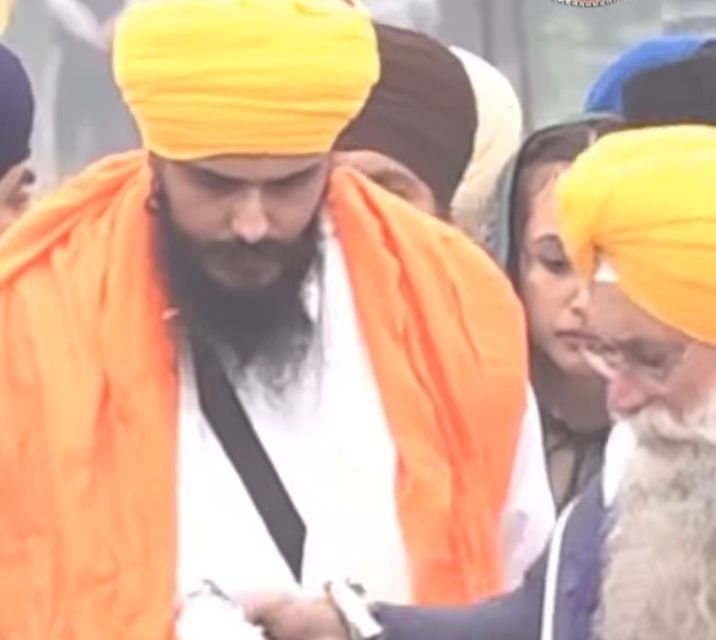
Jallupur Khera, For Khadoor Sahib MP Amritpal Singh, Saturday’s return to his native village was measured not in days or hours of freedom, but in a strictly controlled three-hour window. Brought from Assam under heavy security, the jailed parliamentarian attended the cremation of his 84-year-old grandmother, Charan Kaur, at Jallupur Khera in Amritsar district, paid his last respects and spent a brief period with members of his family before the custody arrangements resumed.
The emotional significance of the occasion was heightened by the fact that this was his first visit to Punjab since his arrest in April 2023. His grandmother had died on November 8 after a prolonged illness. The family had deferred her cremation in the hope that he would be able to attend the final rites.
Amritpal reached Punjab following an order by an Additional Sessions Judge in Amritsar granting him three hours of custodial parole, from noon to 3 pm on November 21. He was not released from custody during the visit. Police personnel accompanied him throughout, and the arrangements were designed to ensure that the ceremony could take place without any breach of the conditions imposed by the court.
The permission followed an earlier order for November 14 which could not be implemented because the authorities were unable to arrange suitable transport from Dibrugarh to Punjab at such short notice. The family subsequently postponed the cremation and moved the court again.
A tightly controlled journey
Amritpal’s journey from Dibrugarh Central Jail began on Friday, when a Punjab Police team took custody of him and escorted him to the airport. He was flown to Delhi before travelling onwards to Punjab on Saturday.
The security arrangements reflected the sensitivity surrounding his return. Around 800 police personnel were deployed in and around Jallupur Khera, with barricades, regulated access and separate routes planned to manage the movement of people. Senior police officers supervised the arrangements, while the administration appealed to residents and supporters to maintain peace and comply with the restrictions.
The state government had expressed concerns about the possibility of a law-and-order disturbance if Amritpal was allowed to remain in Punjab for an extended period. The court accepted the need for a tightly limited visit but made it clear that the state could remove him from the venue, or even take him out of Punjab, if there was a breach of law and order or a reasonable apprehension of an untoward incident.
The court also declined to permit his physical presence at the subsequent family ceremonies. He is to participate in the collection of his grandmother’s ashes on November 22 and the bhog ceremony on November 23 through video-conferencing.
His lawyer, according to reports, said he would be taken back to Dibrugarh Central Jail on November 22. The return journey is being handled under police escort and security arrangements.
From an electoral victory to continued incarceration
The circumstances of Amritpal’s detention have an unusual political dimension. He contested the 2024 Lok Sabha election from Khadoor Sahib as an independent candidate while in detention and won the seat by a substantial margin. His victory demonstrated that his political appeal in the constituency remained significant even though he was unable to campaign in the conventional manner.
He was subsequently taken to Delhi under temporary permission to take the oath as a Member of Parliament on July 5, 2024. Since then, however, his ability to perform his parliamentary and constituency responsibilities has remained severely restricted by his continued incarceration.
Amritpal was arrested on April 23, 2023, following a month-long police operation. His arrest came after the February 23 attack on Ajnala police station, when he and a group of supporters entered the premises while demanding the release of an associate. The confrontation involved clashes with police personnel, and some members of the group were carrying swords and firearms.
He was initially detained under the National Security Act (NSA) and lodged in Dibrugarh jail. His NSA detention ended on April 22, 2026, but he was arrested again the following day in connection with the Ajnala case and continues to remain in judicial custody.
That distinction matters. His present incarceration is linked to criminal proceedings and should not be portrayed as a continuation of the same NSA detention. Equally, the allegations and charges against him must be determined through the judicial process; detention itself is not a conviction.
The political question ahead of the 2027 elections
Amritpal’s brief return comes at a politically sensitive time. Punjab is moving towards the 2027 Assembly elections, and questions surrounding his political future, the representation of Khadoor Sahib and the continuing detention of a directly elected MP are likely to remain part of the state’s wider political conversation.
The issue is not simply whether Amritpal’s supporters regard him as a political figure. He holds an elected parliamentary mandate. His constituents have a legitimate interest in knowing how effectively their representative can discharge his responsibilities while remaining in custody, and what institutional arrangements are available to ensure that their concerns are heard.
There is a strong argument that prolonged incarceration of an elected representative, even when supported by ongoing legal proceedings, creates a democratic and political dilemma. The state has a responsibility to investigate alleged offences and maintain public order. At the same time, the criminal justice process must operate in a manner that does not unnecessarily undermine the representation of voters.
The approaching elections may make this debate more consequential. Keeping an elected MP away from his constituency for an extended period does not, by itself, resolve the political or social questions surrounding his influence. On the contrary, it may deepen the sense of grievance among sections of his supporters, particularly younger people who view his electoral victory as an expression of their political identity.
There is also a possibility that the continued detention could generate further sympathy for him among sections of Punjab’s youth. Such a response cannot be assumed to represent the views of the entire state, but it is a political factor that parties and the administration would be unwise to ignore. A tightly restricted family visit, followed by a return to a distant prison, may reinforce the emotional narrative surrounding his incarceration.
That does not mean that the legal process should be set aside or that public safety concerns should be dismissed. The Ajnala case remains a serious matter, and the courts must be allowed to determine the evidence and legal responsibility. The challenge for the authorities is to balance the requirements of law enforcement with the democratic principle that an elected representative’s mandate carries responsibilities towards the people who voted for him.
Security concerns and the cost of political alienation
The administration’s caution is not without context. Amritpal’s arrest followed a confrontation that raised serious concerns about policing, public order and the authority of the state. The court itself recognised the possibility of a law-and-order problem when it restricted his physical presence to a single three-hour period.
Yet, a security strategy cannot be judged only by the number of personnel deployed or the ability to move a detainee under escort. It must also be assessed by whether it reduces tensions, strengthens public confidence and prevents political alienation from becoming more entrenched.
Punjab has experienced prolonged periods of political and social turbulence, and the handling of sensitive cases involving religious identity, youth mobilisation and public order requires particular care. Any perception that legal processes are being used to marginalise a political constituency can become a source of resentment, even when the authorities maintain that their actions are based on security and judicial requirements.
The state government and law-enforcement agencies will therefore have to ensure that the case proceeds transparently, that court orders are implemented fairly and that the rights of the accused are protected. The political leadership, meanwhile, must address the larger question of how voters in Khadoor Sahib can be meaningfully represented while their elected MP remains in custody.
A brief homecoming, a larger unresolved debate
Saturday’s cremation was first and foremost a family occasion. It allowed Amritpal to pay his final respects to his grandmother after an absence of more than three years. But the extraordinary security surrounding a three-hour visit also brought into focus the unresolved questions surrounding his detention and political status.
As Punjab approaches another Assembly election, the issue is unlikely to disappear. The legal case must take its course, and the state cannot compromise on public safety. But neither can the democratic implications of keeping a sitting MP away from his constituency be brushed aside.
For now, Amritpal Singh is returning to Dibrugarh, while the political debate surrounding his incarceration is likely to continue in Punjab. The three hours he spent at Jallupur Khera may have brought a family chapter to a close, but they have reopened a much wider discussion about the balance between security, justice and democratic representation.