

Congress wins 3,701 Panchayat Samiti and 599 Zila Parishad seats against BJP’s 2,181 and 301 respectively; results revive debate over rural support and pre-SIR electoral rolls
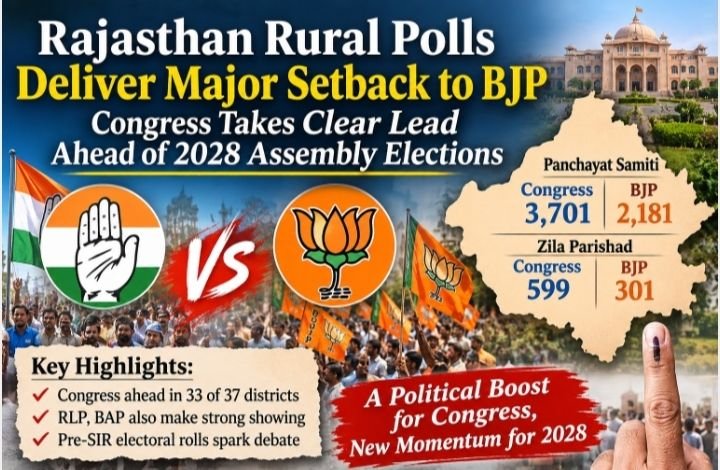
Rajasthan’s rural local body elections have delivered a significant political setback to the ruling Bharatiya Janata Party (BJP), with the Congress registering a substantial lead in both Panchayat Samiti and Zila Parishad contests. The outcome has given the opposition party fresh political momentum and brought the rural electorate back into focus as Rajasthan moves towards its next Assembly elections in 2028.
According to figures reported from the Rajasthan State Election Commission on November 20, the Congress secured 3,701 Panchayat Samiti seats, compared with 2,181 won by the BJP. The Congress also established a considerable lead in the Zila Parishad elections, winning 599 seats against the BJP’s 301.
The Congress outperformed the BJP in Panchayat Samiti seats in 33 of the 37 districts where counting took place, while the BJP managed to finish ahead in only four districts — Ajmer, Balotra, Salumber and Udaipur. The results indicate a broad geographical spread of the Congress’s performance across rural Rajasthan rather than gains being confined to a handful of districts.
However, the electoral exercise is not yet completely over. Counting in Kota, Baran, Karauli and Sri Ganganagar has been postponed until December 17. Consequently, the figures announced so far should be viewed as the results of the districts where counting has been completed, rather than a final statewide tally.
Congress Makes Gains Across Key Rural Regions
The Congress’s performance in several politically important districts has added to the significance of the results. In Jaipur, the party won 216 Panchayat Samiti seats against the BJP’s 87. In Jodhpur, Congress secured 195 seats while the BJP managed 81.
The opposition also maintained an advantage in Bhilwara, where it won 165 seats against the BJP’s 111. In Bikaner, the Congress secured 155 seats compared with 65 for the BJP. Its tally in Dausa stood at 135 against 59 for the ruling party, while in Sikar it won 179 seats against the BJP’s 87.
Another politically notable outcome emerged from Bharatpur, the home district of Chief Minister Bhajan Lal Sharma. Here, the Congress won 46 Panchayat Samiti seats against the BJP’s 32, while Independents secured 76 seats, highlighting the fragmented nature of the contest in the district.
The BJP, meanwhile, retained an advantage in Ajmer, Balotra, Salumber and Udaipur, demonstrating that the electoral picture was not uniform across the state.
Regional Parties and Independents Add to the Political Complexity
The results have also underlined the continuing influence of regional parties and independent candidates in Rajasthan’s rural political landscape.
The Rashtriya Loktantrik Party (RLP), led by Nagaur MP Hanuman Beniwal, secured 496 Panchayat Samiti seats. The Bharat Adivasi Party (BAP) won 276, while the Bahujan Samaj Party (BSP) secured 60 and the Communist Party of India (Marxist) won 50. The Aam Aadmi Party (AAP) managed to secure two seats. Independent candidates collectively won 627 Panchayat Samiti seats.
In the Zila Parishad elections, the RLP secured 37 seats, the BAP won 22, while the BSP and CPI(M) obtained six seats each. Independents won 10 seats.
The performance of the RLP and BAP is particularly relevant in regions where local political equations, community representation and candidate-level influence play an important role in determining electoral outcomes.
Pre-SIR Electoral Rolls Bring a Separate Dimension to the Verdict
One of the most significant aspects of these rural elections is the electoral roll controversy surrounding the Special Intensive Revision (SIR) conducted by the Election Commission of India.
The Panchayat and urban local body elections in Rajasthan were conducted using electoral rolls based on the pre-SIR voter list, rather than the final electoral rolls published following the SIR exercise in February 2026.
According to reports, the Rajasthan State Election Commission continued using the electoral roll last updated on January 1, 2025, as the basis for local body elections because preparations for these polls had begun earlier. State Election Commission Secretary Rajesh Verma confirmed the use of the pre-SIR list, while Chief Electoral Officer Naveen Mahajan also acknowledged this position.
The difference between the two electoral databases became a subject of considerable debate. Rajasthan’s final SIR electoral roll reduced the electorate from approximately 5.47 crore to 5.15 crore after 44.28 lakh names were deleted and 12.91 lakh new voters were added.
In contrast, the electoral rolls maintained for local body elections continued to carry approximately 5.45 crore names.
A separate analysis by civil rights activist Nikhil Dey reportedly found that 26.63 lakh voters removed during the SIR exercise continued to appear on the State Election Commission’s local body electoral rolls. The discrepancy raised questions about the maintenance and consistency of voter databases. The activist also questioned the continued use of the older list despite the availability of the revised electoral roll.
The State Election Commission’s explanation was that the local election preparations were already underway and the pre-SIR list was being used as the basis for the exercise.
The rural poll results therefore provide an important political development in the wider debate over electoral rolls, but they cannot independently establish the political impact of SIR or demonstrate how voters affected by the revision would have voted under a different electoral list.
A Political Test for the Bhajan Lal Sharma Government
For the BJP government led by Chief Minister Bhajan Lal Sharma, the results come at a politically important juncture. The government is approaching the completion of three years in office in December 2026, while the next Assembly elections are scheduled for 2028.
The outcome offers the Congress an opportunity to question the BJP’s rural support base and highlight issues concerning farmers, rural development, employment, public services and the implementation of government programmes.
The results are also significant because they follow the BJP’s strong performance in Rajasthan’s urban local body elections held in September 2026. The contrast between the two electoral exercises suggests that urban and rural voting patterns need not move in the same direction.
For the Congress, the immediate challenge will be to convert its local-level electoral gains into sustained organisational strength. Panchayat Samiti and Zila Parishad victories provide opportunities to strengthen grassroots networks, but translating these into Assembly constituencies requires wider political coordination, leadership cohesion and a sustained engagement with local issues.
For the BJP, the results underline the importance of reassessing its rural outreach and understanding the district-level factors behind the electoral outcome. Rajasthan BJP president Madan Rathore has acknowledged the people’s mandate and indicated that the party would review the results.
Why the 2026 Verdict Matters for 2028
Although Panchayat elections cannot be treated as a direct forecast of Assembly results, their political importance should not be underestimated. Local contests provide an opportunity for voters to express their views on governance, local leadership, development priorities and the performance of elected representatives.
The Rajasthan verdict has placed the Congress and BJP in a new political contest over the interpretation of rural public sentiment. The opposition will seek to use the outcome to build momentum, while the ruling party will have to address the message emerging from the districts where it lost ground.
With regional parties and Independents also maintaining a substantial presence, the state’s rural political landscape remains more complex than a straightforward Congress-BJP contest.
The December 17 counting in the four remaining districts will complete another important part of the electoral picture. Until then, the results already declared have given Rajasthan’s political discourse a significant new development, with both major parties facing the challenge of converting local electoral performance into a broader political strategy ahead of 2028.