


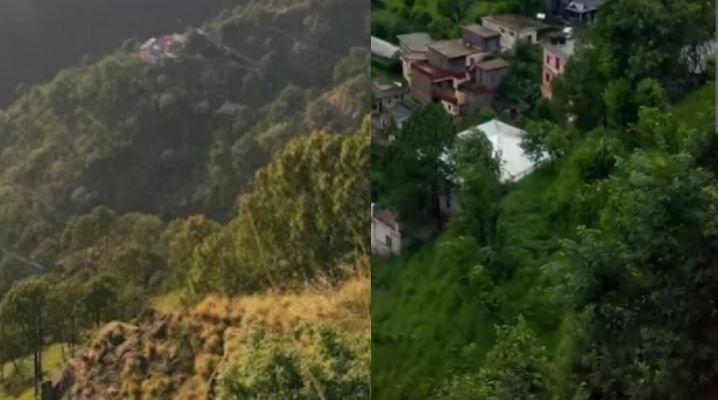
In a significant intervention to protect Himachal Pradesh’s fragile hill environment, the court questions the unchecked expansion of commercial construction, warns that repeated land-use permissions have weakened the safeguards under Section 118, and directs strict action against three builders accused of violating hill-cutting norms.
The Himachal Pradesh High Court has imposed an interim restraint on the state government from granting fresh permissions under Section 118 of the Himachal Pradesh Tenancy and Land Reforms Act, 1972, in Solan district without prior approval of the court and proper justification. The order marks a significant judicial intervention in the growing concerns over large-scale hill cutting, commercial construction and the changing character of ecologically sensitive areas, particularly Kasauli.
A Division Bench comprising Chief Justice Gurmeet Singh Sandhawalia and Justice Bipin Chandra Negi passed the directions while hearing a suo motu public interest litigation initiated by the court. The Bench expressed serious concern over the manner in which land permissions and commercial projects were contributing to construction pressure in the hill district, observing that the government had so far failed to effectively regulate the situation.
The interim order effectively places a judicial check on fresh Section 118 approvals across Solan district. Under the provision, certain categories of non-agriculturists require state government permission to acquire land in Himachal Pradesh. The restriction has particular significance in a state where land ownership, protection of agricultural interests and preservation of the fragile mountain environment have long been closely linked.
The court’s concern goes beyond an individual construction site. It has drawn attention to the larger pattern of commercial development, including the emergence of residential flats and other projects following repeated permissions under Section 118. The Bench observed that the scale of such approvals had contributed to the dilution of the stringent safeguards envisaged under the law. It also noted that the state had not placed before the court consolidated figures explaining the extent of permissions granted over the years.
Kasauli construction comes under judicial scrutiny
The immediate trigger for the court’s intervention was construction and excavation at a property named Woodvilla in Frezi village, Lower Mall, Kasauli, adjoining the house of a complainant. The court examined photographs and official reports relating to the site and found indications of extensive construction activity and hill cutting.
In its status report, the Sub-Divisional Magistrate, Kasauli, informed the court that a joint inspection had found excavation work underway. The digging had exposed the roots of some trees at the site, raising concerns about their safety and the possible environmental consequences of the ongoing work.
Following the inspection, directions were issued on October 16 to the project’s general manager and authorised representative to immediately stop the work, cover the exposed roots with soil and take steps to protect the existing trees. The court considered these developments while assessing the alleged violations at the property.
The Forest Department, in its report, stated that 35 trees had been counted at the location and that no tree had been found felled during patrolling. However, the absence of reported tree felling did not address the court’s wider concern about excavation, construction activity and compliance with the prescribed hill-cutting safeguards.
Another significant aspect emerging from the official record was that the Gram Panchayat Kasauli-Garkhal had not issued a No Objection Certificate for the property. This detail added to the questions surrounding the permissions and regulatory compliance associated with the project.
Three builders named, officials made respondents
After examining the photographs and material placed before it, the High Court observed that substantial construction and hill cutting were being undertaken by three entities: M/s Reviera Luxury Project Five LLP, M/s Sretan Luxury Project Four LLP and M/s Jambavati Project Reality Three LLP.
The Bench treated the activities as serious violations of the state’s 2025 policy guidelines governing hill cutting, conservation and protection of mountain areas. It directed that the notices issued to the three builders be strictly enforced, making it clear that regulatory directions could not remain confined to paperwork while construction activity continued at the site.
The court further ordered that, in the event of non-compliance, the Station House Officer concerned would be required to ensure implementation of its directions. The move signals that responsibility for enforcing the restrictions would not rest solely with the planning and administrative authorities.
Taking the matter beyond the immediate dispute, the Bench also directed that the three builders, along with the Director of the Town and Country Planning Department and the Secretary of the Urban Development Department, be impleaded as respondents. Their inclusion brings both the private developers and the relevant government machinery within the scope of the proceedings.
The SDM, Kasauli, has also been directed to continue inspections of major construction projects in the area, with particular attention to developments of a commercial nature.
Section 118 and the wider question of Himachal’s land protection
The court’s observations on Section 118 are particularly consequential because the provision has traditionally served as an important safeguard against unrestricted land acquisition by non-agriculturists in Himachal Pradesh. Its regulatory framework is intended to protect the state’s land interests and prevent indiscriminate transfer of land outside the categories permitted by law.
However, the Bench expressed concern that large numbers of permissions granted over several decades had weakened the effectiveness of these safeguards. It specifically linked the permission regime to the growth of commercial construction in the form of flats and other developments in Solan district.
The absence of comprehensive data before the court appears to have reinforced its concerns about the state’s monitoring and regulatory capacity. Without a consolidated account of the permissions granted, their purpose and the nature of development subsequently undertaken, it becomes difficult to assess whether the statutory safeguards are achieving their intended objectives.
The state government’s counsel opposed the interim directions. The Bench, however, was not persuaded that the existing administrative response was sufficient. It observed that firm judicial intervention was necessary to ensure that corrective measures were taken.
The order raises an important policy question for Himachal Pradesh: how can the state accommodate investment, tourism-related infrastructure and urban development without compromising the stability of its hills, forests, water systems and local environment? In mountain settlements such as Kasauli, where terrain and ecological conditions impose natural limits on construction, violations of hill-cutting norms can have consequences extending well beyond the boundaries of an individual project.
The proceedings also put the spotlight on the accountability of departments responsible for granting permissions, regulating construction and protecting the environment. The court’s directions suggest that development approvals cannot be treated as a substitute for compliance with environmental and planning safeguards.
The matter will now come up for further hearing on December 7, 2026. Until then, the interim restraint on fresh Section 118 permissions in Solan district, along with the directions for enforcement and continued inspections, places the administration and developers under closer judicial scrutiny.
The wider significance of the case lies in the court’s attempt to shift the debate from isolated instances of unauthorised construction to the larger system governing land permissions and commercial expansion in the hills. For a state whose ecological security and long-term development depend heavily on the stability of its mountain landscape, the outcome could have implications well beyond Kasauli and Solan.