


Exclusive environmental investigation | Two locations record alarming organic pollution; 25-point water assessment exposes gaps in sewage treatment, wastewater monitoring and infrastructure execution
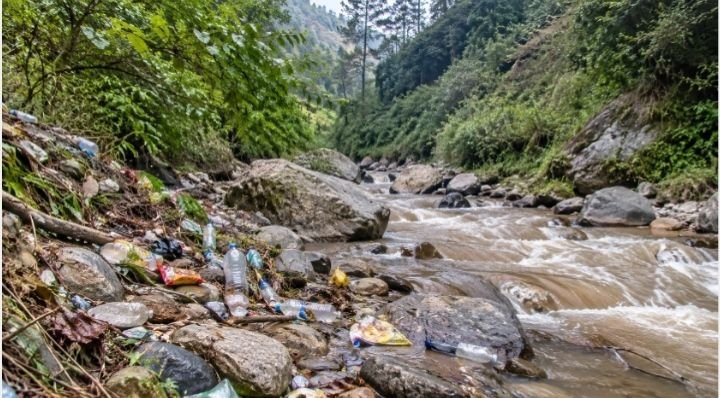
SHIMLA: The growing pollution crisis in Ashwani Khad, one of the important watercourses flowing through the Shimla region, has come under renewed judicial scrutiny after the National Green Tribunal (NGT) identified dangerously elevated levels of organic pollution at two locations in its catchment.
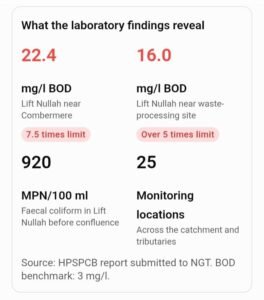
The latest findings present an uncomfortable picture of environmental management in Himachal Pradesh’s capital. Water samples collected by the Himachal Pradesh State Pollution Control Board (HPSPCB) have recorded Biochemical Oxygen Demand (BOD) levels of 22.4 mg/l near Combermere and 16 mg/l near the city’s waste-processing site, against the prescribed benchmark of 3 mg/l.
The higher reading is approximately 7.5 times the prescribed limit. The second is more than five times the benchmark.
The findings are significant because the problem is no longer confined to general allegations about polluted drains or inadequate sanitation. Laboratory-tested samples, a mapped network of potential pollution sources and directions from the country’s environmental adjudicatory body have brought the issue into sharper focus.
During its November 25 hearing, the NGT directed the Pollution Control Board to continue tracing the sources of contamination, verify wastewater discharge routes and examine the functioning of sewage treatment facilities. It also made clear that remedial and regulatory action should follow wherever unauthorised discharges or violations are established.
The matter is now scheduled for further hearing on March 5, 2027.
The numbers behind the pollution alarm
The most important evidence comes from the HPSPCB’s report submitted to the NGT on November 16, 2026.
The board collected water samples from 25 locations across Ashwani Khad and its tributaries on September 29, 30 and October 1. The samples were analysed at the State Board Laboratory in Shimla, which is accredited by the National Accreditation Board for Testing and Calibration Laboratories (NABL).
The results showed that 23 of the 25 monitoring locations had BOD levels within the prescribed 3 mg/l benchmark. However, two locations on Lift Nullah recorded substantially higher readings.
What the laboratory findings reveal
22.4
mg/l BOD
Lift Nullah near Combermere
7.5 times limit
16.0
mg/l BOD
Lift Nullah near waste-processing site
Over 5 times limit
920
MPN/100 ml
Faecal coliform in Lift Nullah before confluence
25
Monitoring locations
Across the catchment and tributaries
Source: HPSPCB report submitted to NGT. BOD benchmark: 3 mg/l.
The findings indicate that the pollution problem is concentrated in particular stretches rather than being uniform throughout the entire catchment. This distinction is important because it provides investigators with specific locations where the sources of contamination need to be traced.
BOD measures the amount of oxygen consumed by microorganisms while breaking down organic matter in water. Higher BOD indicates a greater organic pollution load and can reduce the oxygen available to aquatic organisms.
The reading of 22.4 mg/l therefore represents a serious environmental warning, particularly in a fragile Himalayan ecosystem where untreated wastewater can affect downstream water quality and aquatic life.
However, BOD alone does not establish whether a watercourse is safe or unsafe for drinking. That determination requires additional testing against applicable drinking-water standards.
1. Ashwani Khad: A river system passing through Shimla’s expanding urban landscape
The geographical importance of Ashwani Khad makes the latest findings particularly concerning.
The watercourse originates from the Churath and Jagroti nullahs and travels approximately 16 kilometres through Shimla district before entering Solan district near Sadhupul.
Its catchment extends across several densely inhabited and developing areas, including:
– Shimla town
– Dhalli and Bhattakufer
– Shanan and Malyana
– Vikasnagar and Kasumpti
– Fagli and Tutikandi
– Taradevi and Beolia
– Pujarli and Chaminan
Over the years, urban expansion, construction activity, commercial establishments and increasing pressure on sewerage infrastructure have created additional challenges for the management of the area’s natural drainage system.
The presence of sewage treatment facilities, automobile workshops, institutional establishments and other wastewater-generating units makes continuous monitoring essential.
The Pollution Control Board has identified 13 sewage treatment facilities and establishments requiring assessment in the catchment.
These include sewage treatment plants at Dhalli, Malyana and Lalpani, captive treatment facilities operated by SJVNL and Himachal Estate, automobile workshops, the municipal slaughterhouse at Krishna Nagar, APG University and AIIMS Chamiyana.
It is important to clarify that these establishments have been identified as potential pollution sources requiring verification. Their inclusion in the monitoring exercise does not establish that each is responsible for illegal discharge.
The real question now is whether the administration can establish the exact pathways through which untreated or inadequately treated wastewater reaches the natural watercourses.
2. Sewage treatment plants: Infrastructure exists, but treatment quality needs closer scrutiny
One of the most revealing aspects of the Pollution Control Board’s report concerns the performance of sewage treatment plants.
Samples from the Dhalli, Lalpani and Malyana treatment plants generally showed satisfactory results for several important parameters, including:
– pH
– Biochemical Oxygen Demand
– Chemical Oxygen Demand
– Total Suspended Solids
– Faecal coliform
However, total nitrogen levels at most of the treatment plants did not comply with the norms prescribed by the NGT in its proceedings concerning sewage treatment.
This finding deserves particular attention.
Sewage treatment is not simply about removing visible waste or reducing organic pollution. Nutrients such as nitrogen also require appropriate management. Excessive nitrogen entering natural water systems can contribute to nutrient enrichment and ecological imbalance.
The findings suggest that even where conventional treatment parameters appear satisfactory, the overall performance of a treatment facility must be assessed against all applicable environmental standards.
For the state administration, this means that operational monitoring cannot stop at checking whether a sewage treatment plant is functioning. Its actual treated-water quality, compliance records and discharge arrangements must also be verified.
3. Krishna Nagar slaughterhouse raises another environmental concern
The Pollution Control Board’s report also identified an unusually high pH reading of 9.80 in a sample collected from the Municipal Corporation slaughterhouse at Krishna Nagar.
The prescribed pH range cited in the report was 5.5 to 9.0.
The establishment is connected to the Lalpani sewage treatment plant.
A pH value outside the prescribed range warrants investigation because wastewater from slaughterhouses can contain organic material and other pollutants requiring appropriate treatment before discharge.
The authorities must establish whether the sample represents an isolated operational problem or indicates a continuing treatment deficiency.
The report does not establish that this particular reading caused the high BOD levels at Combermere or near the waste-processing site. Those pollution pathways remain to be verified.
4. Faecal coliform findings: A warning that cannot be ignored
Another important aspect of the monitoring exercise relates to faecal coliform.
The report recorded:
– 920 MPN/100 ml in Lift Nullah before its confluence with Ashwani Khad.
– 540 MPN/100 ml in Ashwani Khad downstream of the confluence.
The Pollution Control Board reported these readings as being within the applicable limits, but they were considered worthy of continued scrutiny by the tribunal.
Faecal coliform is an indicator of possible contamination from human or animal waste. Its presence makes it important to examine sewage connections, wastewater discharge routes and the effectiveness of treatment systems.
The significance of these findings is that they provide another line of investigation alongside the elevated BOD readings.
The authorities now need to establish whether the contamination is linked to sewage leakage, inadequate treatment, unauthorised discharge or other sources.
5. The biggest infrastructure question: Why is the new 3.1 MLD sewage treatment plant still incomplete?
Perhaps the most concerning infrastructure-related detail in the report is the progress of the proposed common sewage treatment plant at Dogra Bridge, Panthaghatti.
The 3.1 million litres per day (MLD) facility is being constructed by Shimla Jal Prabandhan Nigam Limited (SJPNL).
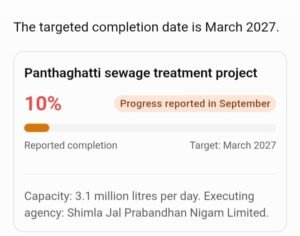
However, according to the progress information recorded in the proceedings, only approximately 10 per cent of the construction work had been completed as of September 14, 2026.
The targeted completion date is March 2027.
Panthaghatti sewage treatment project
# 10%
Progress reported in September
Reported completion
Target: March 2027
Capacity: 3.1 million litres per day. Executing agency: Shimla Jal Prabandhan Nigam Limited.
The project is intended to strengthen sewage treatment infrastructure in the Panthaghatti area. Its timely completion could improve wastewater management, provided that adequate sewer connections are also established and the plant operates in compliance with environmental norms.
But the reported progress raises a legitimate question about whether the March 2027 deadline can be achieved.
The NGT has given the Jal Shakti Department and SJPNL two weeks to submit their respective progress reports and responses.
The administration will need to explain the reasons for the slow progress, the remaining construction schedule and how sewage generated in the intervening period is being managed.
6. NGT intervention: From identifying pollution to fixing accountability
The November 25 proceedings are significant because the tribunal has moved the matter beyond general observations about environmental degradation.
The case originated after a December 4, 2023, news report titled *Ashwani Khad: The Most Polluted River in Himachal Pradesh* drew attention to the condition of the watercourse.
The NGT took cognisance of the pollution concerns and sought reports from the relevant authorities.
In its latest proceedings, the principal bench comprising NGT Chairperson Justice Prakash Shrivastava and Expert Member Dr Afroz Ahmad considered the Pollution Control Board’s November 16 report.
The tribunal directed the board to:
1. Continue identifying pollution sources, particularly at locations with elevated BOD and faecal coliform.
2. Verify wastewater discharge routes and identify the actual destinations of different discharges.
3. Examine the functioning and compliance of sewage treatment facilities.
4. Take appropriate remedial and regulatory action wherever unauthorised discharge or environmental violations are established.
The Pollution Control Board’s regional office also acknowledged that its report did not clearly specify whether all identified discharges were treated sewage or trade effluent and sought additional time to clarify the position.
SJPNL was permitted to withdraw a statement made before the tribunal on September 1, 2026, after its representative explained that it had been submitted inadvertently without complete information.
The matter has been listed for March 5, 2027.
7. The larger question: Is Shimla’s urban growth outpacing its environmental infrastructure?
The Ashwani Khad issue reflects a wider challenge confronting hill towns across Himachal Pradesh.
Shimla’s population, tourism activity, institutional establishments and construction requirements place growing pressure on its limited natural and civic infrastructure.
Unlike many plains cities, hill settlements have geographical constraints that make sewerage planning, wastewater transportation and treatment more complicated.
Natural streams and drainage channels often pass through inhabited areas, while sewer networks may not cover every settlement or newly developed pocket.
The problem becomes more serious when urban development progresses faster than the supporting infrastructure.
A sewage treatment plant cannot provide an effective solution unless wastewater is properly collected, transported through a functioning sewer network and treated before release.
Similarly, a treatment facility that is operational but fails to meet all prescribed parameters cannot be considered a complete environmental solution.
The Ashwani Khad findings therefore raise a broader governance question: are urban development permissions, sewerage expansion, municipal sanitation and environmental monitoring being planned together, or are they operating as separate administrative exercises?
That is a question the state government and municipal authorities must address.
8. What the government must do now: Five priorities for environmental recovery
The latest findings should be treated as an opportunity to develop a time-bound restoration programme rather than another cycle of inspections and departmental reports.
First, identify every discharge point. The Pollution Control Board should prepare a publicly accessible map of wastewater discharge locations, identifying whether each outlet carries treated sewage, untreated sewage or trade effluent.
Second, conduct regular independent testing. Water quality should be monitored at all 25 locations, with additional testing around the two high-BOD sites. Results should be published periodically so that residents and environmental organisations can assess progress.
Third, accelerate sewerage infrastructure. The Panthaghatti plant and associated sewerage network require close monitoring. Construction deadlines must be supported by measurable milestones and accountability for delays.
Fourth, enforce treatment standards. Every treatment facility, including institutional and commercial installations, should undergo compliance inspections. Violations must result in corrective directions and regulatory action in accordance with the law.
Fifth, establish a catchment-level restoration plan. The government should coordinate the Municipal Corporation, Pollution Control Board, Jal Shakti Department and SJPNL to develop an integrated strategy covering sewage collection, treatment, drainage management and protection of natural watercourses.
The editorial takeaway: Ashwani Khad needs restoration, not another round of assurances
The latest NGT findings have brought a serious environmental problem back into public focus. The figures are specific, the monitoring locations are identified and the administrative agencies responsible for corrective action are known.
What remains uncertain is whether the authorities can translate these findings into measurable environmental improvement.
The fact that 23 out of 25 monitoring locations recorded BOD levels within the prescribed limit is encouraging and should not be overlooked. It indicates that the problem is not uniform across the catchment and that targeted intervention may produce meaningful results.
But the two severely affected locations, the faecal coliform observations, non-compliance with total nitrogen norms at most treatment plants and the slow progress of the Panthaghatti project collectively demand urgent attention.
Shimla’s natural watercourses are not merely geographical features. They are part of the ecological system that sustains the region, its communities and its downstream environment.
The state government must now demonstrate that environmental protection is an integral part of urban governance rather than a responsibility activated only after judicial intervention.
**The real measure of success will not be another report submitted to the NGT in March 2027. It will be whether the next round of laboratory tests shows a measurable reduction in pollution and whether the people of Shimla can see genuine improvement in the health of their natural watercourses.
Fact-check: Key figures and qualifications for publication
| Issue | Verified information |
| —————————— | ———————————— |
| NGT hearing | November 25, 2026 |
| HPSPCB report | Submitted November 16, 2026 |
| Water sampling | September 29–October 1, 2026 |
| Monitoring locations | 25 |
| BOD at Combermere | 22.4 mg/l |
| BOD near waste-processing site | 16 mg/l |
| Prescribed BOD benchmark | 3 mg/l |
| Faecal coliform readings | 920 and 540 MPN/100 ml |
| Panthaghatti STP capacity | 3.1 MLD |
| Reported construction progress | Approximately 10% as of September 14 |
| Target completion | March 2027 |
| Next NGT hearing | March 5, 2027 |