
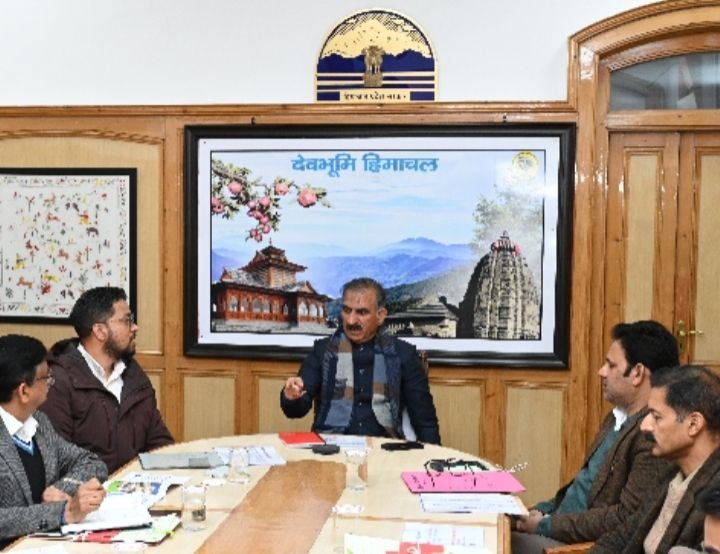
Shimla witnessed a major policy push in the tourism sector as Chief Minister Thakur Sukhvinder Singh Sukhu chaired a high-level review meeting to assess the progress of tourism development projects across Himachal Pradesh. The review marked a significant milestone in the state’s long-term strategy to rebuild, modernize and globally reposition Himachal Tourism as a world-class brand.
Backed by financial assistance from the Asian Development Bank (ADB), the tourism development programme represents a massive investment of Rs. 2,350 crore. Of this, Rs. 1,620 crore has been allocated under Tranche-1, while Rs. 730 crore has been earmarked for Tranche-2, reflecting a phased and structured execution model designed to ensure sustainability, quality, and long-term economic impact.
During the meeting, Chief Minister Sukhu laid strong emphasis on construction quality, project timelines, and global standards. He directed officials to maintain world-class engineering and architectural benchmarks, stressing that tourism infrastructure must reflect international standards if Himachal Pradesh is to compete with established global destinations. He also issued clear instructions that delays and compromises in quality would not be tolerated, reinforcing a governance model based on accountability and performance delivery.
The Chief Minister articulated a clear vision: transforming “Himachal Tourism” into a globally recognised brand identity, not merely as a hill destination but as a comprehensive tourism ecosystem. This includes spiritual tourism, adventure tourism, wellness tourism, eco-tourism, heritage tourism and experiential travel. The state government’s approach links tourism directly with economic growth, employment generation, and youth self-employment, making it a core pillar of Himachal’s development strategy rather than a standalone sector.
A key focus area of the strategy is infrastructure strengthening and connectivity. The government is prioritising heliport construction, improved road access, and the expansion of Kangra airport, aimed at reducing travel barriers and improving tourist accessibility to remote and high-potential destinations. These connectivity projects are designed to integrate tourism hubs with rural and semi-urban regions, enabling inclusive growth rather than tourism concentration in limited pockets.
One of the most ambitious components of the plan is the transformation of Kangra district into Himachal Pradesh’s “Tourism Capital.” This vision positions Kangra as a central tourism hub combining culture, spirituality, adventure and modern infrastructure. Substantial investments are already underway in Palampur and Nagrota Bagwan, where projects worth Rs. 77.70 crore are in active development.
In Palampur, the development model blends urban convenience with tourism aesthetics. Multi-level parking facilities, renovation of the iconic Neugal Café, and the creation of modern social spaces such as a library-integrated café reflect a new-age tourism philosophy that combines leisure, culture and lifestyle infrastructure. These initiatives aim to enhance visitor experience while creating employment opportunities for local youth.
Nagrota Bagwan is undergoing large-scale urban beautification and infrastructure modernisation. Projects include the redevelopment of bus stands, temple surroundings and public grounds, alongside drainage systems and road upgrades. This integrated approach reflects the government’s intent to upgrade entire tourism ecosystems rather than isolated tourist spots.
Tourism development is also being decentralised across districts. In Hamirpur, Rs. 51.09 crore is being invested in the Shree Baba Balak Nath Temple complex, strengthening spiritual tourism infrastructure. Dharamshala is set to receive modern ice-skating and roller-skating rinks worth Rs. 33.78 crore, positioning it as a hub for youth-oriented and sports tourism. In Kullu and Manali, wellness centres worth over Rs. 56 crore are being developed, aligning with global wellness tourism trends focused on holistic health, yoga, and natural healing.
Heritage conservation is also a major pillar of the strategy. The historic Naggar Castle is undergoing specialised restoration and conservation work to preserve its cultural and architectural legacy, ensuring that heritage tourism grows alongside modern tourism infrastructure.
Future phases under the ADB partnership will expand adventure tourism with projects such as a rafting complex in Nadaun and adventure sports centres equipped with hostels, creating integrated tourism circuits that combine sports, stay facilities and local employment generation.
The review meeting also included detailed project briefings by R. S. Bali, Chairman of the Himachal Pradesh Tourism Development Corporation, along with Principal Secretary Devesh Kumar and Director Tourism Vivek Bhatia. Senior officials reaffirmed institutional coordination to ensure timely execution and alignment with the Chief Minister’s development vision.
Chief Minister Sukhu’s tourism strategy reflects a structural shift in governance — from short-term tourism promotion to long-term tourism nation-building. By integrating infrastructure, employment, sustainability, connectivity, and global branding, the state government is positioning tourism not just as an economic activity, but as a core driver of Himachal Pradesh’s future development model.
This Rs. 2,350 crore tourism overhaul is not merely about building projects — it represents a strategic transformation of Himachal Pradesh into a globally competitive, economically resilient, and socially inclusive tourism destination, anchored in strong governance, institutional planning, and long-term vision.