
The ongoing Vidhan Sabha session in Himachal Pradesh has turned into a political flashpoint over the Centre’s decision to abolish RDG, with the issue rapidly evolving into a full-scale confrontation between the ruling Congress and the opposition BJP. What began as a policy dispute has now become a symbolic battle over federal rights, state autonomy, and political accountability, with both sides positioning themselves as protectors of public interest.
The Congress leadership has framed the Centre’s move to discontinue RDG as a direct blow to the constitutional and economic rights of the people of Himachal Pradesh. According to the ruling party, RDG is not merely a financial or administrative mechanism, but a legitimate entitlement of the state, rooted in its special developmental needs and geographical challenges. Congress leaders argue that the decision affects nearly 7.5 million residents and undermines the state’s ability to plan welfare, infrastructure, and long-term development independently.
In the Assembly, Congress has adopted a confrontational stance, accusing the Centre of imposing unilateral decisions without consensus or consultation with the state government. The party maintains that the issue goes beyond party politics and reflects a deeper struggle between central authority and state rights. The narrative being built is clear: RDG is being projected as a matter of constitutional principle, not political convenience.
On the other side, the Bharatiya Janata Party has taken a more guarded but strategic position. While defending the Centre’s policy direction, the party has avoided making explicit commitments on RDG in public forums. This has given rise to sharp criticism from the Congress, which accuses the BJP of political ambiguity and indirect support for a decision that allegedly harms Himachal’s interests. The ruling party claims that the BJP is attempting to balance loyalty to the Centre with electoral sensitivity within the state.
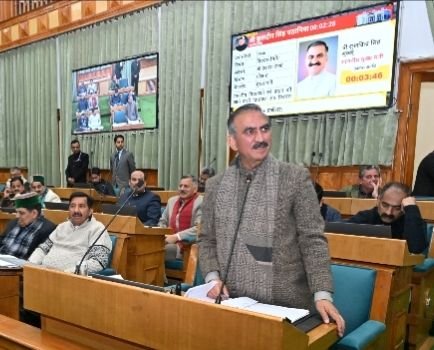
Inside the Vidhan Sabha, the atmosphere reflects deep polarization. Speeches, counter-allegations, and procedural disruptions have turned RDG into the central political narrative of the session. Both parties are no longer just debating policy—they are shaping public perception. Congress is presenting itself as the defender of state rights and federal balance, while the BJP is positioning itself as a responsible national party safeguarding broader governance reforms.
This political standoff is not limited to legislative proceedings. On the ground, both sides are actively mobilising public opinion. Congress leaders are framing the issue as a struggle for Himachal’s dignity and autonomy, while the BJP is working to portray the Centre’s approach as necessary administrative restructuring rather than political injustice.
RDG has thus transformed from a technical policy issue into a mass political symbol. It now represents competing visions of governance—centralised authority versus cooperative federalism, national policy uniformity versus state-specific rights.
As the Vidhan Sabha session continues, RDG remains the defining issue shaping political discourse in Himachal Pradesh. The confrontation is no longer just between two parties, but between two narratives: one that sees RDG as an inviolable state right, and another that views it as part of a larger national policy framework. In this charged environment, the real contest is not only in the Assembly but in the minds of the people, where both Congress and BJP are striving to establish moral and political legitimacy over the future of the state.