
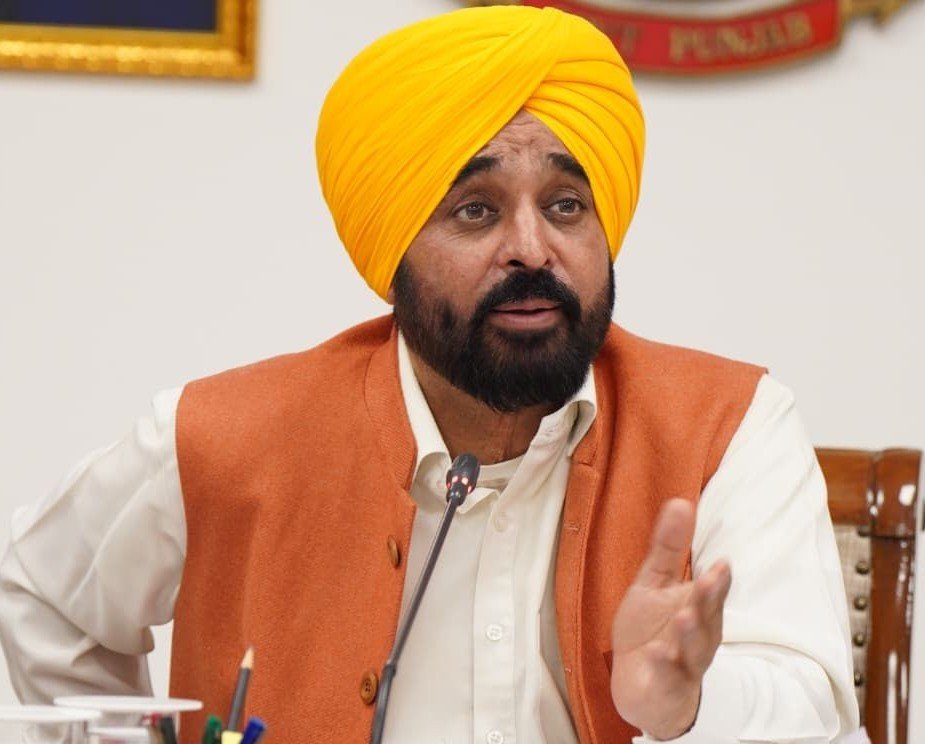
In a significant policy move blending welfare expansion with fiscal consolidation, the Cabinet led by Chief Minister Bhagwant Singh Mann has approved a comprehensive food support initiative titled the Punjab Government Food Programme, aimed at strengthening food security for nearly 40 lakh beneficiary families covered under the National Food Security Act. The decision, taken during a meeting of the Council of Ministers, signals an assertive governance approach as Punjab moves closer to the presentation of its annual financial roadmap and prepares for the evolving political climate in the state.
Under the newly cleared programme, eligible households will receive wheat along with essential kitchen staples including sugar, mustard oil and salt through the state’s Public Distribution System beginning in April. The initiative is being projected as one of the most expansive food welfare interventions undertaken in Punjab in recent years, designed to reduce household expenditure burdens and enhance nutritional access for economically vulnerable sections. By broadening the basket of subsidized commodities beyond grain, the government is positioning the move as a calibrated response to inflationary pressures and rural distress, particularly in agrarian belts still recovering from climatic and economic shocks. Officials maintain that strengthening the distribution chain and ensuring quality supplies will be central to the scheme’s success, with district administrations directed to streamline delivery mechanisms to prevent leakages.
The Cabinet’s welfare push was accompanied by a firm revenue strategy. The state approved its Excise Policy for 2026-27, setting an ambitious collection target of ₹12,800 crore, reflecting a substantial increase over the revised figures of the previous financial year. The Mann government has highlighted that excise collections, which were significantly lower at the beginning of its tenure, have shown a steady upward trajectory and are projected to double over a five-year period. This revenue augmentation, the government argues, is critical to financing large-scale social sector programmes without placing additional tax burdens on ordinary citizens. Political observers note that balancing welfare expansion with stronger internal resource mobilization is emerging as a core pillar of the administration’s governance narrative ahead of future electoral contests in Punjab.
In another humanitarian decision, the Cabinet approved one-time compensation for farmers who suffered crop losses during the monsoon floods of 2025 while cultivating government-owned land. Many such cultivators were earlier excluded from compensation due to technical changes in revenue records following judicial and administrative directives issued in 2015. The government has clarified that compensation will now be extended on humanitarian grounds to those recorded as cultivators prior to the cut-off date, or to their legal heirs if they continue to till the land. However, the measure does not grant ownership rights and will remain a one-time relief exercise. Verification committees comprising local revenue officials and village representatives will oversee the identification process, reflecting the administration’s attempt to blend legal compliance with social sensitivity in addressing agrarian grievances.
The Cabinet further extended the validity of the One-Time Settlement scheme for government departments and public sector undertakings until June 30, 2026. The extension will allow eligible allottees and PSUs to clear pending dues with interest, potentially unlocking stalled industrial assets and improving fiscal discipline. This move is expected to support industrial revival efforts while improving the financial health of state-linked entities.
On the law and order front, the government approved a structured Reward Policy to institutionalize incentives for information leading to the arrest of wanted criminals. By formalizing reward disbursement mechanisms and vesting sanctioning authority in senior police officials including district chiefs and the Director General of Police, the state aims to strengthen intelligence networks and reinforce public cooperation in crime control. The decision comes at a time when law and order remains a politically sensitive issue in Punjab’s public discourse.
Administrative restructuring was also part of the Cabinet’s agenda. Two additional Vice-Chairperson posts were sanctioned for the state’s Economic Policy and Planning Board, increasing the total strength to five. The government believes this expansion will enable sector-focused oversight, improved coordination with district planning bodies, and faster implementation of development schemes, reinforcing its governance reform agenda.
In preparation for the fiscal roadmap, the Cabinet confirmed that the Budget Session of the 16th Punjab Legislative Assembly will be convened from March 6 to March 16, with the Governor’s Address on the opening day and the presentation of the 2026-27 Budget scheduled for March 8. The forthcoming session is expected to showcase the government’s development blueprint, with a likely emphasis on welfare delivery, rural infrastructure, employment generation and fiscal stability.
Strengthening the health sector also featured prominently in the Cabinet decisions. The government approved the revival and filling of 361 vacant Staff Nurse posts in the Department of Health and Family Welfare, with recruitment to be conducted through Baba Farid University of Health Sciences. Additionally, Covid volunteers and contractual health workers will receive age relaxation and additional marks in recruitment processes until the end of 2026, acknowledging their service during the pandemic and integrating experienced personnel into the regular health framework.
Taken together, the Cabinet’s decisions reflect a governance strategy that combines welfare expansion, revenue strengthening, administrative restructuring and targeted sectoral reforms. As Punjab approaches the budget presentation and navigates a politically dynamic environment, the Mann government appears intent on reinforcing its pro-people image while underlining fiscal responsibility. Whether this blend of social outreach and financial assertiveness translates into sustained public support will become clearer as policy implementation unfolds across districts in the months ahead.
This is a web generated news report.