
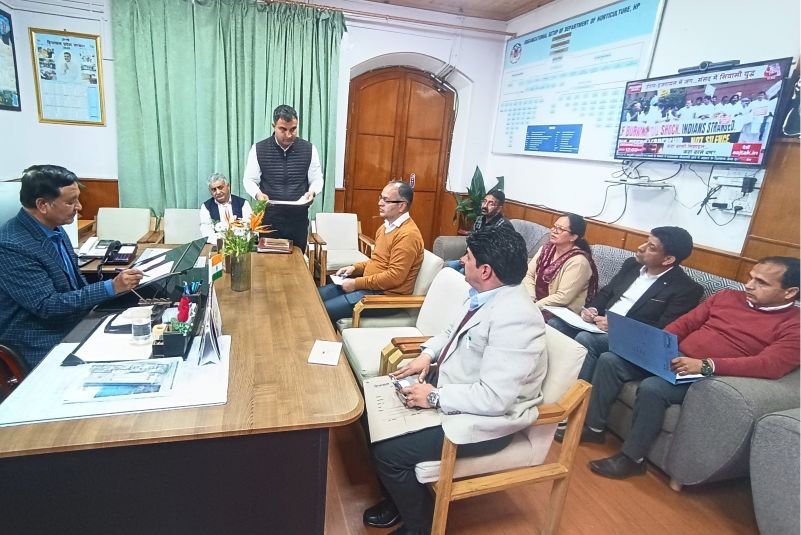
Shimla – In a significant move aimed at resolving long-pending land ownership and revenue record issues in Himachal Pradesh, the state’s Revenue and Horticulture Minister Jagat Singh Negi has directed revenue authorities to dispose of all pending land lease cases in the Kumarsain and Kotgarh regions within a strict timeline of one month. The directive was issued during a high-level review meeting held in Shimla where the minister interacted with revenue officers from Kumarsain and Kotgarh and discussed multiple land-related issues affecting local residents for decades. The meeting focused particularly on cases where land allotments were made under various government schemes around five decades ago but procedural formalities were never completed, leaving many families without proper ownership documentation in official revenue records.
During the review, the minister highlighted that in many cases land leases had been granted to residents nearly fifty years ago, yet the mutation process, which officially transfers ownership or occupancy rights into government revenue records, had not been completed. He pointed out that in several other instances the leases were formally approved and even the required premium or “nazrana” had been deposited by the beneficiaries, but the actual lease documents were never issued. These administrative gaps have left numerous landholders in Kumarsain and Kotgarh facing prolonged uncertainty regarding legal ownership and documentation of their land holdings.
Jagat Singh Negi stated that the matter was brought to his attention by residents of these regions who expressed concern over the decades-long delay in resolving their cases. Taking serious note of the issue, the minister instructed the concerned revenue officials to examine every pending case and ensure that all such matters are resolved within one month. He emphasized that the government is committed to ensuring that genuine beneficiaries receive their rightful documentation and that administrative lapses from the past should not continue to affect citizens in the present.
The minister also directed revenue officers to conduct a special drive in Kumarsain and Kotgarh to identify, review, and dispose of all such cases in a systematic manner. He asked the officials to ensure strict compliance with the instructions and to remove any procedural hurdles that may be delaying the finalization of land records. As part of the accountability mechanism, he further instructed that a detailed progress report be submitted after one month outlining the number of cases reviewed, resolved, and pending along with reasons for any delays.
Officials present in the meeting acknowledged that the issue has persisted for several years due to incomplete records and administrative gaps in earlier decades. The special drive ordered by the minister is expected to streamline the process and bring clarity to land ownership for many residents whose cases have remained unresolved for generations.
Following the meeting, a delegation of residents from Kumarsain and Kotgarh met the Revenue Minister and expressed their gratitude for taking up the issue and prioritizing their long-pending concerns. Members of the delegation stated that resolving these cases will provide legal clarity and security to landholders who have been cultivating or residing on the land for decades but lacked complete documentation in government records.
Senior officials also participated in the meeting, including Additional Secretary (Revenue) Anil Chauhan along with other revenue department officers. They discussed procedural steps required to accelerate case disposal and assured the minister that all necessary administrative support would be provided to implement the directives within the stipulated timeframe.
The decision is being seen as an important administrative step by the Himachal Pradesh government to address legacy land record issues in rural areas, particularly in apple-growing regions like Kotgarh and Kumarsain where land tenure and documentation play a crucial role in agricultural planning, property rights, and access to government schemes. If implemented effectively, the special drive could resolve decades-old disputes and bring long-awaited relief to a large number of families in the region while strengthening the transparency and efficiency of the state’s revenue administration system.