

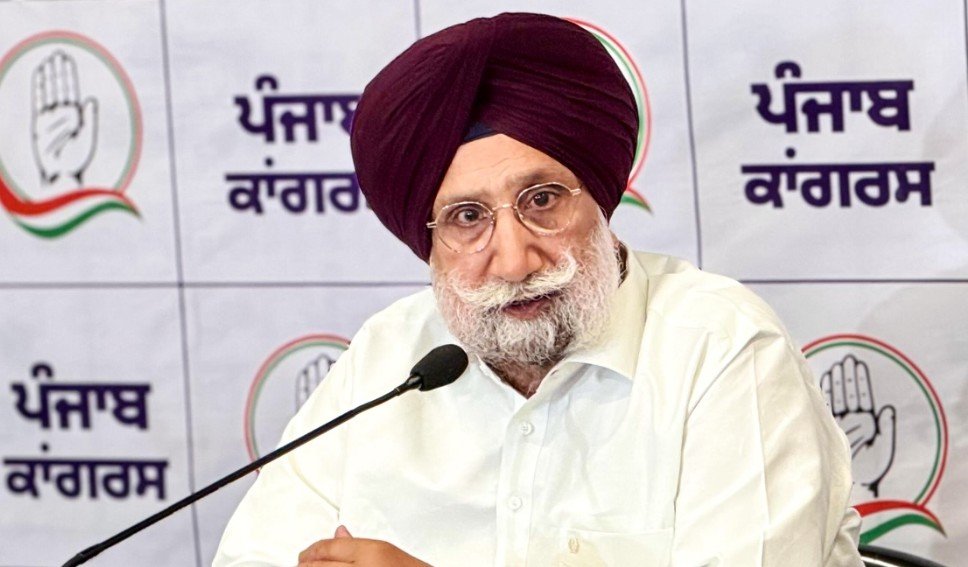
Punjab’s political landscape has entered a phase of heightened confrontation after senior Congress leader and Member of Parliament Sukhjinder Singh Randhawa launched a sharp attack on the ruling Aam Aadmi Party government, raising serious questions over both its political stability and handling of law and order.
Drawing from his administrative experience, Randhawa asserted that the current government led by Chief Minister Bhagwant Mann is facing internal instability and could struggle to retain its majority in the coming days. He alleged that the ruling party’s decision to convene a special legislative session on Labour Day is not merely symbolic but politically motivated, suggesting that it may be aimed at demonstrating strength on the floor of the Assembly amid fears of defections.
According to Randhawa, there is growing unease within the ruling party, with speculation that several legislators are in touch with the Bharatiya Janata Party. He claimed that this perceived threat has forced the leadership to adopt defensive strategies to safeguard its government. However, he firmly denied any such vulnerability within the Congress, stating that none of its legislators or Members of Parliament are considering switching sides, despite persistent rumours.
The Congress leader shifted focus to governance concerns, urging the state administration to prioritize public safety over political survival. Referring to the recent explosion incident near a railway track in Punjab, he described it as a deeply troubling development that could disturb communal harmony and public confidence. He questioned the response of the state leadership, arguing that such a serious security incident warranted immediate on-ground assessment and high-level emergency coordination, which, in his view, was lacking.
Randhawa also expressed concern over what he described as a deteriorating law and order situation in the state. He criticized the functioning of the police leadership, suggesting that decisive action is required to counter emerging threats. He warned that isolated incidents, if not addressed firmly, could escalate into broader security challenges, potentially reviving fears reminiscent of past instability.
The debate further intensified as Randhawa raised questions about earlier allegations made by members of the ruling party regarding attempts to influence legislators. He pointed out that despite formal complaints, there has been no visible progress in investigations, questioning the credibility and seriousness of those claims. His remarks reflect a broader attempt to challenge the ruling party’s narrative and highlight inconsistencies.
Another significant aspect of his criticism revolved around decisions related to national security measures. He sought clarity on policy decisions concerning individuals previously detained under stringent laws, suggesting that such steps require transparency and careful consideration given their potential implications. He argued that any perceived leniency or miscalculation could embolden disruptive elements.
Randhawa also highlighted concerns about the alleged convergence of extremist elements and organized crime networks, describing it as a dangerous trend that could threaten social cohesion in Punjab. He stressed the need for coordinated action by both state and central agencies to dismantle such networks and prevent future incidents.
In conclusion, his remarks underscore an increasingly charged political atmosphere in Punjab, where governance, security, and political survival have become deeply intertwined. With the ruling party facing scrutiny from opposition leaders and internal speculation, the coming days are likely to be crucial in determining both the political direction and administrative stability of the state.