
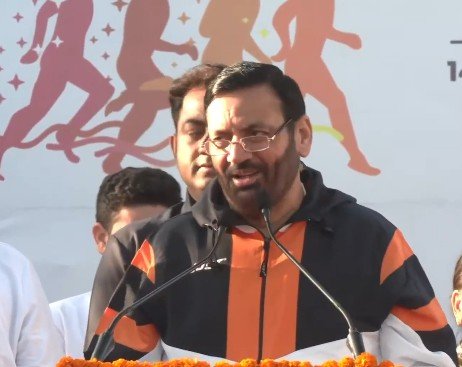
Haryana Chief Minister Nayab Singh Saini on Tuesday led a symbolic and socially significant initiative by flagging off the “Samta Marathon” from Yavanika Park in Sector-5, dedicating the event to Bharat Ratna B. R. Ambedkar. The marathon, organised to commemorate Ambedkar’s 135th birth anniversary, emerged as a powerful expression of the state’s commitment to equality, social justice, and constitutional values.
The event witnessed enthusiastic participation from youth, students, and citizens, who gathered in large numbers to be part of the run that culminated at Tau Devi Lal Sports Stadium in Sector-3. The atmosphere was charged with patriotic fervour, as participants raised slogans celebrating unity and national pride, reflecting the enduring relevance of Ambedkar’s vision in contemporary India.
Upon his arrival, the Chief Minister received a warm welcome from young participants and local residents. In a gesture that added emotional resonance to the event, he not only flagged off the marathon but also encouraged the runners by showering flower petals, boosting their morale and underlining the spirit of collective participation. The marathon, he said, was not merely a sporting event but a symbolic movement aimed at spreading the message of equality and inclusiveness across society.
Addressing the gathering, Saini paid rich tributes to Dr. B. R. Ambedkar, describing his life as an extraordinary journey of struggle, sacrifice, and determination. He emphasized that Ambedkar’s contribution extended far beyond the drafting of the Indian Constitution, highlighting that his ideals of justice, liberty, equality, and fraternity continue to guide the nation’s democratic framework. The Chief Minister noted that the marathon was a meaningful effort to take these principles to every section of society.
He underscored that discrimination, inequality, and injustice have no place in a progressive society and called upon citizens to work collectively toward building an India where every individual has equal opportunities and dignity. According to him, such initiatives are essential reminders of the constitutional ethos and serve to strengthen social harmony.
Reaffirming the state government’s commitment to inclusive development, Saini highlighted various welfare initiatives aimed at uplifting marginalized sections. He pointed out that schemes related to education, employment, and social security are being implemented with a focus on ensuring that the benefits of development reach the last person in the queue. The government, he said, is actively working to bridge socio-economic gaps and bring weaker sections into the mainstream.
In his interaction with the youth, the Chief Minister emphasized their crucial role in nation-building. He invoked Ambedkar’s famous call for education, organization, and struggle, urging young people to adopt these principles in their lives. He stressed that education remains the most powerful tool for empowerment and social transformation, and that an aware and united youth can drive meaningful change in society.
Saini concluded his address by urging citizens to draw inspiration from Ambedkar’s ideals and contribute to building a nation rooted in equality, justice, and brotherhood. He reiterated that the vision of an inclusive and equitable India can only be realized through collective effort and a steadfast commitment to constitutional values.
Several dignitaries, including Social Justice and Empowerment Minister Krishna Kumar Bedi, BJP state president Mohan Lal Badoli, Rajya Sabha MP Rekha Sharma, Haryana Women Commission Chairperson Renu Bhatia, and other senior officials, were present at the event, reflecting its importance at both administrative and political levels.
The Samta Marathon, beyond its immediate significance as a commemorative event, highlighted the ongoing efforts of the Haryana government to align governance with the ideals of social justice and inclusivity, reinforcing Ambedkar’s enduring legacy in shaping India’s democratic and social fabric.