
Saptrishi Soni:
Education is emerging as a fresh political battleground in Punjab as the Aam Aadmi Party increasingly turns the performance of government schools into a central part of its campaign narrative ahead of the 2027 Assembly election.
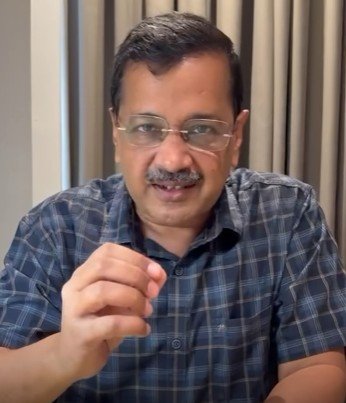
AAP national convenor Arvind Kejriwal challenged the BJP to compare 1,000 government schools each in Punjab and Gujarat, arguing that the exercise would provide an objective assessment of the two models of governance. The challenge came as AAP leaders intensified their public engagement with schools in Punjab, a development that has simultaneously strengthened the ruling party’s governance narrative and triggered criticism from the opposition.
Kejriwal’s intervention is politically significant because education has long been one of AAP’s most recognisable governance themes. The party built much of its national political identity around its claims of transforming government schools in Delhi and has subsequently sought to present Punjab as another example of the model.
With the 2027 election approaching, however, the argument is changing. AAP is no longer selling education reform simply as a promise of future change. It is seeking to make the condition of government schools under its Punjab government part of the electoral record on which voters will judge the party.
Kejriwal’s proposed comparison with Gujarat therefore carries an unmistakable political message. AAP wants the contest to be framed around measurable governance outcomes rather than conventional partisan claims.
The BJP, Congress and Shiromani Akali Dal are unlikely to accept that framing without challenge. Opposition parties have already begun questioning the timing and political purpose of visits by AAP leaders to government schools, arguing that such programmes are being used to create an electoral narrative only months before the Assembly election. Recent reports have highlighted criticism from opposition leaders and educators over the growing political attention around school visits.
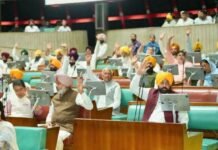
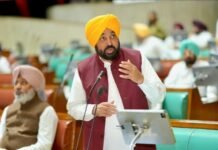
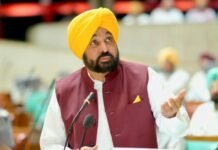
For Chief Minister Bhagwant Singh Mann, education is particularly important because it allows the government to connect a visible public service with its broader claim of delivering change.
The Mann government has repeatedly highlighted investment in government schools, improved infrastructure, smart classrooms, teacher recruitment and other reforms as evidence of its governance model. The political objective is straightforward: demonstrate that AAP has moved beyond promises and created tangible improvements in institutions used daily by ordinary families.
But the political test is also becoming tougher.
The 2022 election was largely a referendum on the previous political establishment. AAP won 92 of Punjab’s 117 Assembly seats, securing a dominant mandate and displacing Congress and the Shiromani Akali Dal from their traditional positions of influence. In 2027, the electorate will instead be assessing the performance of an incumbent government.
That makes every governance sector potentially electoral.
Education could become especially influential because school performance is relatively easy for voters to judge through everyday experience. Parents, teachers and students can assess infrastructure, staffing, teaching conditions and accessibility without relying entirely on political claims.
This is why the opposition is likely to focus on the gap between government announcements and actual implementation.
For AAP, the answer is to invite comparisons. The Kejriwal challenge to the BJP effectively asks the opposition to move away from allegations and towards measurable evidence. If such a comparison were to take place, the political debate could shift towards school infrastructure, teacher availability, student outcomes and expenditure rather than slogans.
The BJP, however, has its own political advantage in the debate. Gujarat has been governed by the BJP for decades and remains an important part of the party’s national political narrative. By challenging the BJP to compare government schools in the two states, Kejriwal is attempting to turn that long period of BJP rule into a direct governance comparison.
The timing also matters.
The BJP has now announced that it will contest all 117 Punjab Assembly seats independently in 2027, rejecting speculation over a possible alliance with the SAD. This means the party has a strong incentive to establish its own political identity in Punjab rather than depend on an alliance framework.
The education debate could therefore become part of a much broader BJP-AAP confrontation.
Congress, meanwhile, will seek to ensure that the contest does not become a simple two-party argument between AAP and BJP. The party is attempting to establish itself as the principal alternative to the Mann government and will likely continue highlighting governance failures while presenting its own record and policy proposals.
For the Mann government, the challenge is to ensure that education remains a governance achievement rather than becoming another political controversy.
There is also a broader strategic calculation for AAP. The party is increasingly campaigning around sectors where it believes government performance can be demonstrated visually — schools, hospitals, sports grounds and public infrastructure. This approach allows the government to present physical changes as evidence of administrative performance.
Its opponents, however, will ask a different question: whether these improvements are sufficiently widespread and whether they have translated into better outcomes for ordinary citizens.
That debate is likely to intensify as the election approaches.
The emerging political contest over schools also illustrates how Punjab’s 2027 election is beginning to move beyond traditional questions of party identity. Drugs, agriculture, employment, law and order and the state’s finances will remain central issues, but governance delivery is becoming increasingly important.
AAP wants voters to compare its record with the governments that preceded it. The BJP wants to challenge AAP’s claims while expanding its own footprint. Congress wants to turn dissatisfaction into an alternative government narrative. The SAD is attempting to reclaim its regional political space.
In that crowded field, education offers AAP an issue on which it believes it has a distinctive advantage.
Whether that advantage survives political scrutiny will depend not on the number of school visits or competing claims, but on what parents and students see when they walk through the gates of Punjab’s government schools.
For the Mann government, that is ultimately the most important comparison of all.
The 2027 election is beginning to look less like a contest over who can promise change and more like a contest over who can persuade Punjab that change has already happened — and education may become one of the clearest arenas in which that argument is tested.