
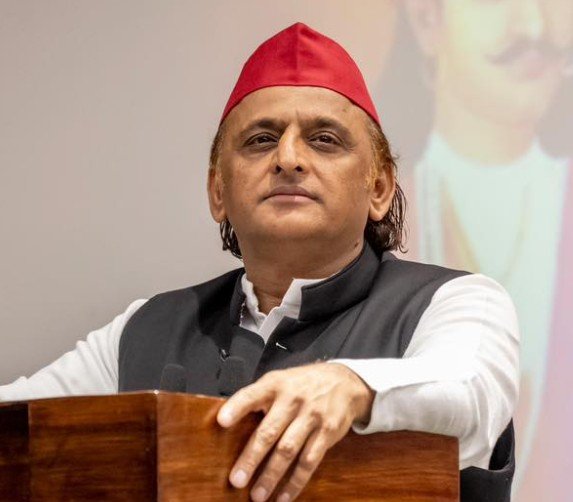
In a sharp political intervention ahead of the upcoming West Bengal elections, Samajwadi Party chief Akhilesh Yadav has intensified his attack on the Bharatiya Janata Party, alleging that the party is bracing for defeat and attempting to influence the electoral environment through administrative maneuvers. Positioning himself firmly in support of West Bengal Chief Minister Mamata Banerjee, Yadav asserted that the ruling Trinamool Congress leader would retain power, declaring that “Didi will remain.”
The remarks come at a politically sensitive moment, as election preparations gather pace in one of India’s most closely watched battleground states. Yadav’s comments were made through a detailed post on social media, where he also referenced a media report highlighting the large-scale transfer of police personnel and administrative officials across West Bengal. Using this as the basis of his critique, he questioned the timing and intent behind such decisions.
According to Yadav, these transfers cannot be dismissed as routine administrative exercises. Instead, he framed them as actions with potential electoral implications, alleging that they point towards an attempt to influence the fairness of the poll process. He went further to suggest that the scale of these changes reflects a deeper political anxiety within the Bharatiya Janata Party, which, in his view, is preparing for what he described as a “respectable defeat” in the state.
In his public statement, Yadav structured his argument in multiple layers, beginning with a direct political forecast that the BJP is losing ground in West Bengal. He then expanded on this by claiming that the party’s organisational strength in the state has weakened over time. He argued that, for the first time, there appears to be an implicit acknowledgment within the BJP of its electoral limitations in Bengal, reflected in what he termed as “pre-emptive arrangements” for defeat.
A significant part of his criticism was directed towards the broader institutional framework overseeing elections. Yadav raised concerns about the role of the Election Commission of India, questioning whether such large-scale administrative reshuffles align with the principles of neutrality and transparency expected during the election period. While he stopped short of making direct allegations against the Commission, his remarks संकेत a growing विपक्ष narrative around institutional accountability in high-stakes elections.
He also drew a distinction between governance-related administrative actions and those taken in the context of elections, suggesting that the current developments fall into the latter category. By describing the situation as “electoral interference” rather than routine governance, Yadav sought to elevate the political stakes and frame the issue as one of democratic integrity.
The Samajwadi Party leader’s remarks are likely to resonate beyond West Bengal, as they tap into a broader national discourse on electoral fairness, the autonomy of institutions, and the use of administrative machinery during elections. His endorsement of Mamata Banerjee also reflects an emerging pattern of opposition alignment, where regional leaders publicly support each other against the BJP in key states.
The BJP has not officially responded to these specific allegations, but party leaders have consistently maintained that administrative decisions in poll-bound states are carried out in accordance with established procedures and under the supervision of constitutional authorities. They argue that such claims are politically motivated and aimed at creating doubt in the minds of voters.
As West Bengal moves closer to elections, the political narrative is expected to sharpen further, with competing claims over governance, development, and institutional integrity taking centre stage. Yadav’s intervention adds another layer to this evolving contest, highlighting how state-level elections are increasingly becoming arenas for national political messaging.
With heightened scrutiny on administrative actions and electoral conduct, the coming weeks are likely to witness intensified political exchanges, as parties seek to shape public perception and consolidate their respective support bases in one of India’s most politically significant states.