
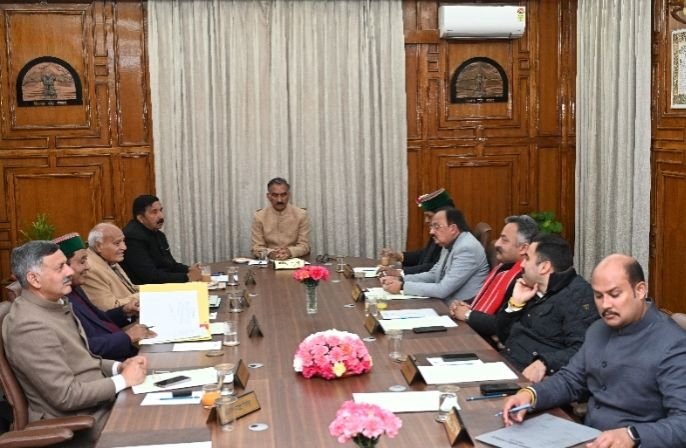
Chief Minister Thakur Sukhvinder Singh Sukhu on Saturday presided over an important Cabinet meeting in Shimla, where a detailed review and deliberation were held on the decision of the Central Government to abolish the Revenue Deficit Grant (RDG) for Himachal Pradesh. The meeting focused on assessing the financial, administrative, and developmental implications of this move on the hill state’s economy and governance structure.
During the meeting , the Chief Minister underlined that Himachal Pradesh, due to its difficult geographical terrain, fragile ecology, limited revenue-generation capacity, and high cost of infrastructure development, has historically depended on special category support and central assistance to maintain fiscal stability. The abolition of RDG, which was designed to bridge the gap between the state’s revenue expenditure and revenue receipts, was described as a serious concern that could impact essential public services and long-term development planning.
Senior ministers and officials presented a comprehensive assessment of how the withdrawal of RDG could affect key sectors such as healthcare, education, rural development, road connectivity, disaster management, and social welfare schemes. Special emphasis was placed on the financial stress that may emerge in sustaining welfare-oriented programmes, particularly in remote and tribal regions of the state, where service delivery costs are significantly higher than in plains.
Chief Minister Sukhu stressed that Himachal Pradesh is not merely seeking financial assistance, but fair and just fiscal treatment in line with its special needs as a Himalayan state. He stated that the state government would pursue a structured and constitutional approach to engage with the Centre, ensuring that Himachal’s interests are protected through dialogue, negotiation, and institutional mechanisms. The Cabinet discussed the possibility of formal representations to the Central Government and relevant constitutional bodies, highlighting the state’s unique developmental challenges.
The meeting also focused on evolving alternative financial strategies to reduce dependency on central grants in the long term. These included strengthening internal revenue generation, improving financial discipline, optimizing public expenditure, promoting sustainable tourism, and attracting responsible investment while safeguarding environmental and ecological balance.
The Cabinet deliberations reflected a clear policy approach of combining fiscal responsibility with social justice, ensuring that developmental priorities are not compromised due to structural funding changes. The Chief Minister reiterated that the state government remains committed to protecting public interest, safeguarding welfare schemes, and ensuring uninterrupted development despite emerging financial challenges.
The Shimla meeting marked a significant policy moment, setting the direction for Himachal Pradesh’s financial and administrative response to the abolition of RDG. It also signaled the government’s intent to adopt a balanced strategy that integrates dialogue with the Centre, fiscal reforms, and long-term economic resilience, while keeping the welfare of citizens at the core of governance.