
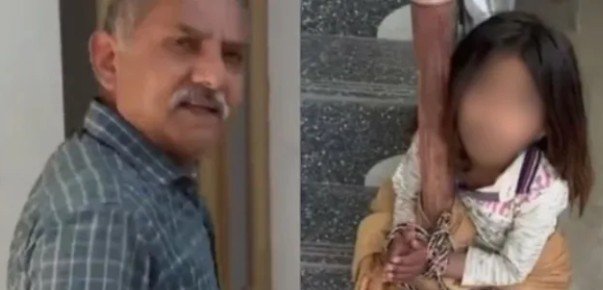
A deeply disturbing incident from Una district has sent shockwaves across Himachal Pradesh, a region widely regarded for its social harmony and community-oriented values. A four-year-old girl was allegedly tied up and physically assaulted by a local resident over a trivial act—plucking a guava from a tree—triggering widespread outrage and renewed concern over child safety even in India’s most शांत and socially cohesive regions.
According to preliminary reports, the accused, identified as a former Army personnel, allegedly restrained the child by tying her hands and legs with a rope inside his residence. The young girl was then subjected to physical violence, during which she could be heard crying for help. Her repeated pleas for rescue, captured in a now-viral video, have become a haunting reminder of the vulnerability of children in situations of unchecked authority and anger.
The incident came to light only after a video recording surfaced on social media platforms, rapidly gaining attention and drawing condemnation from across the state and beyond. In the footage, villagers can be seen intervening and rescuing the child from the आरोपी’s house. Their timely action is believed to have prevented further harm, highlighting the crucial role of community vigilance in such cases.
Following the circulation of the video, authorities acted swiftly. Teams from the local police unit in Una district reached the village and initiated an investigation. According to officials, the मामला was formally registered after a complaint was received through the emergency helpline 112 Emergency Helpline India. Law enforcement agencies have since begun gathering evidence, recording witness statements, and taking appropriate legal action against the accused.
What makes the incident particularly unsettling is its occurrence in Himachal Pradesh, a state often associated with peaceful coexistence, strong community ties, and a culture of respect towards children and the elderly. Such an घटना challenges the perception of rural safety and underscores the reality that instances of abuse can surface even in the most unlikely settings.
Experts in child rights and social behavior argue that this case reflects a deeper issue of anger management, misuse of authority, and lack of awareness regarding child protection laws. India has stringent legal provisions under frameworks such as the Protection of Children from Sexual Offences (POCSO) Act and other child welfare laws, which also cover physical abuse and cruelty against minors. However, the effectiveness of these laws depends heavily on awareness, timely reporting, and strict enforcement.
The viral nature of the video has once again demonstrated the double-edged role of social media—while it raises ethical concerns about privacy, it also serves as a powerful tool for accountability, bringing hidden crimes into the public domain and compelling authorities to act swiftly.
As investigations continue, the focus remains on ensuring justice for the young victim and preventing recurrence of such incidents. The case has sparked a broader conversation about the need for stronger grassroots awareness on child rights, stricter monitoring of abuse cases, and community-based interventions to safeguard vulnerable individuals.
This incident from Una is not just a criminal मामला—it is a wake-up call. It urges both authorities and society to re-examine the assumptions of safety associated with peaceful regions and to reinforce the systems that protect those who are most defenseless.