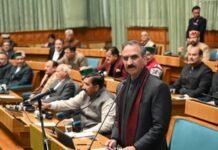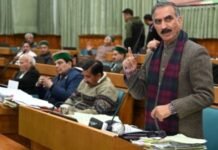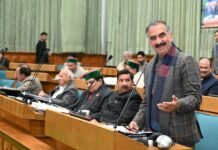

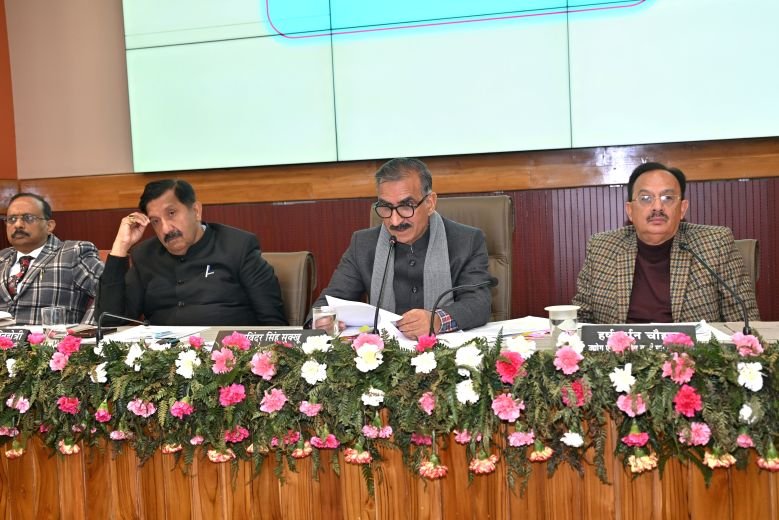
Shimla, February — Chief Minister Thakur Sukhvinder Singh Sukhu on the first day of the first session of the Assembly sent out a clear political and administrative message: his government is tightening execution on the ground while preparing to confront a serious fiscal challenge posed by decisions at the national level. Chairing a detailed meeting with MLAs from Una, Hamirpur and Sirmaur districts to finalize priorities for the financial year 2026–27, the Chief Minister positioned himself as both a hands-on administrator and a leader focused on steering Himachal Pradesh’s economy back onto a stable and growth-oriented path.
At the core of the discussion was development financing. CM Sukhu informed the legislators that during 2025–26, the state government had already secured NABARD approval for 73 projects worth ₹713.87 crore, reflecting an aggressive push to unlock institutional funding despite tight fiscal conditions. Of these, 55 MLA priority projects amounting to ₹512.31 crore relate to the Public Works Department, while 18 projects worth ₹201.56 crore pertain to the Jal Shakti Department. The emphasis, he said, was not merely on approvals but on execution and accountability.
Directing officers and MLAs alike, the Chief Minister underlined that the allocated budget must be fully utilized and reimbursement claims submitted to NABARD before March 15, 2026. He made it clear that delays and under-utilisation would not be tolerated, adding that the government was simultaneously working to get more MLA priority projects approved by NABARD before the end of March 2026. The message was unmistakable: development funds must translate into visible work on the ground.
Reflecting on the broader political narrative of his three-year tenure, CM Sukhu said the present government had consistently focused on public welfare policies, transparent governance and wide-ranging structural reforms. According to him, the objective of these policies was to strengthen Himachal Pradesh’s economy, empower youth and women, provide security to weaker sections of society and establish the hill state as a prosperous, green-energy-driven and economically self-reliant region. He reiterated that the government remained committed to rapid, inclusive and sustainable development across sectors and regions, even in the face of mounting fiscal pressures.
It was on the issue of federal finances that the Chief Minister struck his strongest political note. Expressing deep concern over the decision of the 16th Finance Commission to discontinue the Revenue Deficit Grant (RDG) provided to states under Article 275(1) of the Constitution, CM Sukhu termed the move unjust, particularly for hill states like Himachal Pradesh. He pointed out that this grant had been provided continuously since 1952 until the 15th Finance Commission to ensure financial stability of states with structural disadvantages. Stopping it for the first time, he argued, ignored the difficult geographical conditions under which hill states function.
The Chief Minister emphasized that Himachal Pradesh plays a significant national role in environmental protection, having imposed a complete ban on tree felling, and also supplies water to other states through rivers originating in its territory. In such circumstances, he said, discontinuing the RDG was against the interests of the state and undermined the spirit of cooperative federalism. He reminded the gathering that the 15th Finance Commission had recommended a revenue deficit grant of ₹37,199 crore for Himachal Pradesh, and that during the COVID-19 period, the previous BJP government had received ₹11,431 crore as RDG based on the interim report of the Finance Commission. The cumulative impact of the current decision, he warned, would be a loss of nearly ₹50,000 crore to the state.
Against this backdrop, CM Sukhu said his government would now be compelled to take tough decisions to enhance revenue while ensuring stricter financial management. He also launched a pointed critique of the upcoming Union Budget, alleging that it ignored the concerns of the middle class and farmers. Agriculture and horticulture, he said, are the backbone of Himachal Pradesh’s economy, yet the central budget had neither announced meaningful subsidies for orchardists nor addressed infrastructure development for them. He further noted the absence of concrete announcements regarding the expansion of the Bhanupalli–Bilaspur and Chandigarh–Baddi railway projects, calling the budget anti-federal and detrimental to small hill states that are already grappling with debt.
The Chief Minister demanded restoration of the revenue deficit grant and sought a special economic package for Himachal Pradesh, framing it as essential not for political reasons but for economic survival and balanced regional development.
The meeting also served as a platform for constituency-specific demands, reflecting the government’s attempt to align macroeconomic management with micro-level development. From Una district, Chintpurni MLA Sudarshan Babloo thanked the Chief Minister for providing ₹130 crore for the expansion of the Chintpurni Temple and pressed for early completion of the Stothar Bridge and Chowki–Manyar college, along with a sub fire station at Jol and strengthening of roads. Gagret MLA Rakesh Kalia sought completion of hospital and ITI projects, sewerage facilities and flood protection works, while Una MLA Satpal Satti raised demands related to sewerage, drainage, bridges and irrigation schemes. Kutlehar MLA Vivek Sharma highlighted drinking water and sewerage needs and sought better road connectivity and judicial infrastructure.
From Hamirpur district, Bhoranj MLA Suresh Kumar focused on drinking water schemes, urban infrastructure and judicial facilities, while thanking the government for sanctioning ₹23.75 crore for a Critical Care Unit. Sujanpur MLA Ranjit Singh pushed for health infrastructure, road upgrades and filling of doctor vacancies. Barsar MLA Inder Dutt Lakhanpal raised demands for new bus stands, improved health services and enhanced connectivity, including services to AIIMS.
Sirmaur district MLAs emphasized tourism, health and connectivity. Pachhad MLA Reena Kashyap highlighted the tourism potential of Habban Valley and prominent temples, while Nahan MLA Ajay Solanki pressed for upgrades at the medical college and power infrastructure. Shree Renukaji MLA Vinay Kumar sought religious tourism promotion, lake rejuvenation and faster progress on the zoo project, while Paonta Sahib MLA Sukh Ram Chaudhary underlined the need for educational infrastructure, inter-state connectivity and industrial power load improvement.
State Planning Commission Vice-Chairman Bhawani Singh Pathania expressed confidence that the suggestions made by MLAs would accelerate the pace of development, while Chief Secretary Sanjay Gupta proposed the vote of thanks. Principal Secretary (Finance) Devesh Kumar welcomed the Chief Minister. Deputy Chief Minister Mukesh Agnihotri, Industries Minister Harshwardhan Chauhan, senior officers and district administrations were present.
Politically, the meeting reinforced CM Sukhu’s image as a Chief Minister attempting to balance grassroots development demands with a larger battle for fiscal space. As Himachal navigates shrinking central support and rising expectations, Sukhu’s approach appears focused on disciplined spending, institutional funding and a renewed push to put the state’s economy back on the right gear, even as the debate over federal fairness intensifies.