
Saptrishi Soni:
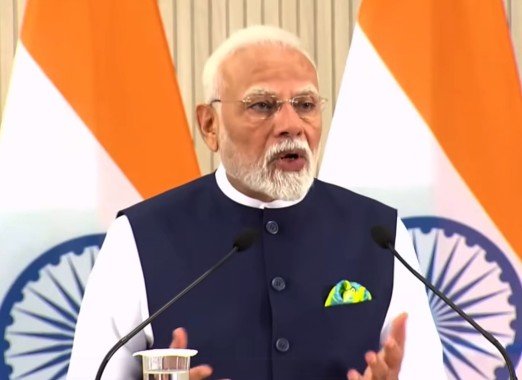
In Indian politics, not every prime ministerial visit is merely about inaugurating projects or making official announcements. Some visits are carefully watched for the political messages they send, the constituencies they target, and the organisational momentum they seek to generate. Prime Minister Narendra Modi’s visit to Jalandhar on July 17 falls squarely into that category. While the official agenda revolves around unveiling railway and infrastructure projects, political observers believe the visit carries a much deeper significance. With the Bharatiya Janata Party (BJP) having already declared that it intends to contest the 2027 Punjab Assembly elections independently, without relying on traditional alliances, the Prime Minister’s visit is widely being viewed as the beginning of a long-term political campaign rather than a routine government engagement.
For decades, the BJP has built its electoral strategy on a principle that distinguishes it from many regional and national competitors: elections are rarely fought only during election season. Instead, the party invests years in strengthening its organisational network, cultivating local leadership, understanding social dynamics, and creating narratives that resonate with regional aspirations while remaining aligned with its broader national vision. The party’s rise across several Indian states has demonstrated that organisational expansion, rather than short-term electoral rhetoric alone, often becomes the foundation of long-term political success.
Punjab presents one of the BJP’s most complex political landscapes. Historically, the party remained largely confined to urban constituencies while sharing political space with its long-time ally, the Shiromani Akali Dal. The alliance offered electoral stability but simultaneously limited the BJP’s independent organisational expansion across rural Punjab. The political equations changed dramatically after the farmers’ movement and the eventual breakdown of the alliance. Overnight, the BJP found itself confronting both a challenge and an opportunity. The challenge was obvious—it now had to establish itself as an independent political force in a state where regional politics has traditionally dominated electoral outcomes. The opportunity, however, was equally significant: for the first time, the party could build its own political identity across every region of Punjab.
It is against this backdrop that Prime Minister Modi’s Jalandhar visit assumes strategic importance.
One of the BJP’s defining characteristics has been its ability to adapt national political messaging to local realities. While the party projects a unified national vision, its electoral strategy has often been tailored to suit regional aspirations, cultural identities and social priorities. Rather than imposing a uniform campaign across states, the BJP has repeatedly demonstrated an ability to identify local concerns and integrate them into its broader political narrative.
Punjab, perhaps more than most Indian states, requires precisely such an approach. Politics here is deeply influenced by religious traditions, community institutions, agricultural concerns, regional pride and social identity. Development projects undoubtedly matter, but symbolism often carries equal political weight.
Jalandhar, located in Punjab’s Doaba region, represents one of the state’s most politically significant constituencies. The region is home to one of the largest Scheduled Caste populations in Punjab, accounting for nearly one-third of the state’s SC electorate. Electoral analysts have long argued that no political party can realistically aspire to govern Punjab without making meaningful inroads into this demographic.
The BJP appears to have recognised this reality well in advance.
Over the past few years, the party has steadily increased its engagement with the Ravidassia community, one of the most influential social groups in the Doaba belt. Prime Minister Modi’s earlier visit to Dera Sachkhand Ballan during Guru Ravidas Jayanti was viewed by many analysts as part of this outreach. Now, his decision to flag off the Shri Guru Ravidas Ji Maharaj Express connecting Jalandhar with Varanasi adds another important layer to that engagement.
Viewed purely from an administrative perspective, the new railway service improves connectivity for thousands of devotees who travel annually between Punjab and Varanasi, regarded as the birthplace of Guru Ravidas. However, politics is rarely separated from symbolism. Varanasi also happens to be Prime Minister Modi’s parliamentary constituency. The symbolic linkage between faith, convenience, cultural identity and political leadership is unlikely to be overlooked by either supporters or political observers.
This reflects another recurring feature of the BJP’s political strategy: the careful blending of governance with cultural symbolism. Infrastructure projects are often designed not merely to address developmental needs but also to reinforce emotional and cultural connections with specific communities. Whether one interprets such initiatives as genuine social outreach or strategic political messaging depends largely on political perspective. Yet few would dispute that symbolism has become an increasingly important instrument of modern electoral politics.
Another aspect that distinguishes the BJP is its organisational culture.
Unlike many parties that revolve around individual regional leaders, the BJP has invested heavily in creating a structured organisational hierarchy extending from the national leadership to booth-level workers. The party’s leadership pipeline often allows grassroots workers to gradually rise through organisational responsibilities before assuming electoral positions. This system has enabled the BJP to develop durable political structures in several states where it once had only marginal influence.
Punjab now appears to be following that organisational blueprint.
Beyond high-profile political rallies, the party has quietly expanded its presence at district, mandal and booth levels. It has intensified outreach among youth, women, professionals, entrepreneurs, Scheduled Castes and religious organisations. Political strategists often argue that electoral victories become sustainable only after organisational networks mature. The BJP’s experience in states such as Haryana, Assam, Tripura and even West Bengal demonstrates that organisational expansion frequently precedes significant electoral gains.
Prime Minister Modi remains the party’s most recognisable political asset. His public engagements rarely focus exclusively on announcing government schemes. Instead, they seek to weave together narratives of infrastructure development, economic growth, national security, welfare programmes and India’s long-term aspirations. This broader narrative has become central to the BJP’s political communication model.
For party workers, therefore, a Prime Ministerial visit is not merely a government function—it often becomes a source of renewed organisational confidence.
That appears to be one of the objectives behind the Jalandhar visit as well.
Punjab has witnessed significant political volatility over the past decade. The Aam Aadmi Party currently governs the state, the Congress continues to retain considerable organisational presence, while the Shiromani Akali Dal still commands influence among sections of the traditional electorate. Entering such a competitive political environment requires more than campaign speeches. It demands sustained political investment, organisational patience and community engagement over several years.
Whether the BJP can successfully replicate its expansion model in Punjab remains an open question. The state’s political culture differs significantly from many other regions where the party has expanded successfully. Farmers’ issues, federal relations, employment, industrial revival, border security, drug abuse, migration of youth and religious sensitivities all occupy central positions within Punjab’s political discourse. Addressing these concerns consistently will likely determine whether the BJP’s organisational growth translates into electoral success.
Yet if political history offers one lesson about the BJP, it is this: the party rarely approaches elections as isolated events. Instead, it tends to treat them as the culmination of years of groundwork.
In that sense, Prime Minister Narendra Modi’s visit to Jalandhar may represent more than the inauguration of railway projects or development initiatives. It could mark the beginning of the BJP’s most determined effort yet to redefine its political position in Punjab.
Whether this strategy ultimately reshapes Punjab’s electoral landscape will only become clear in 2027. However, one conclusion already appears difficult to dismiss. The road to the next Punjab Assembly election may well begin not with campaign slogans, but with carefully chosen symbols, calibrated organisational expansion, community outreach and the political messaging that accompanies a Prime Minister’s visit.
For the BJP, Jalandhar is not simply another stop on the Prime Minister’s itinerary. It is potentially the first chapter of a much larger political story whose outcome will unfold over the next two years.