
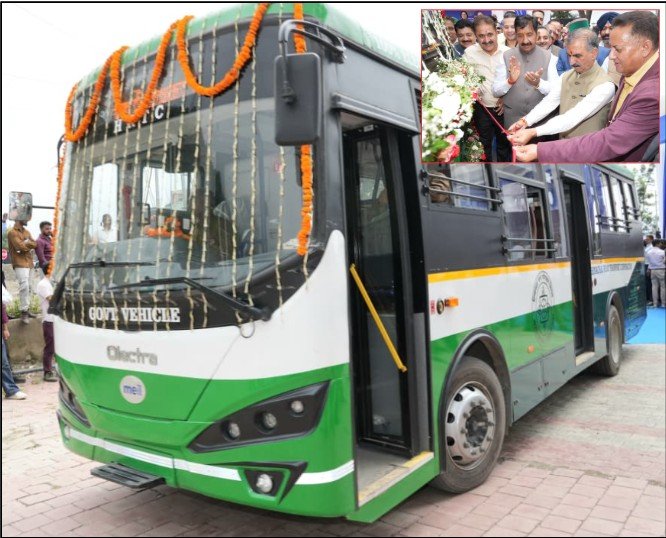
Himachal Pradesh has taken one of its biggest strides towards sustainable public transportation with Chief Minister Thakur Sukhvinder Singh Sukhu flagging off 297 new Type-I electric buses for the Himachal Road Transport Corporation (HRTC), marking a significant expansion of the state’s green mobility network. Alongside the launch, the Chief Minister also introduced the HimBus Plus Card, a digital travel initiative designed to make public transport more affordable, convenient and cashless for regular commuters.
The twin initiatives underline the state government’s broader strategy of transforming HRTC into a financially stronger and environmentally sustainable public transport system while positioning Himachal Pradesh among the leading states promoting clean mobility.
The fleet of new electric buses was flagged off from Kyarighat in Solan district before being deployed across various HRTC depots. With the induction of these buses, the total number of electric buses operating under HRTC has now reached 500, making it one of the largest electric public transport fleets in the hill states.
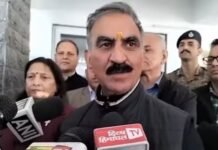
Addressing the gathering, Chief Minister Sukhu described the initiative as more than a transport upgrade, saying it represents a long-term commitment towards protecting the fragile Himalayan ecosystem while delivering safer and more comfortable travel to passengers.
He said the government was working with a clear vision of creating a transport network that is modern, efficient and environmentally responsible. According to him, reducing dependence on fossil fuels is essential not only for lowering operational costs but also for ensuring cleaner air and a healthier environment for future generations.
The newly inducted buses are expected to significantly reduce diesel consumption and carbon emissions while improving passenger comfort through quieter and pollution-free travel. To support uninterrupted operations, the government has already established charging infrastructure at multiple HRTC depots across the state, laying the foundation for large-scale electric mobility in the coming years.
The Chief Minister said that the financial advantages of electric buses are equally significant. He explained that while a diesel bus costs approximately Rs. 76 to Rs. 86 per kilometre to operate, including staff and maintenance expenses, an electric bus incurs an operational cost of only around Rs. 36 to Rs. 38 per kilometre. The savings of nearly Rs. 40 to Rs. 50 per kilometre, he said, would substantially improve HRTC’s financial health and help the corporation move towards self-reliance.
The government has already begun planning the next phase of its transport transition. Sukhu announced that Himachal Pradesh intends to procure another 1,000 electric buses during the current year, with the tendering process set to begin shortly. In addition, the government is exploring the introduction of 100 hydrogen-powered buses as part of its long-term clean energy roadmap.
He said future electric buses will also feature improved battery technology capable of travelling between 250 and 300 kilometres on a single charge, compared to the present range of around 200 kilometres.
In another major initiative aimed at modernising public transport, the Chief Minister launched the HimBus Plus Card, which introduces a fully digital and cashless payment system for HRTC passengers.
Under the new system, regular commuters using the card will receive a five per cent discount on fares, while senior citizens will be entitled to a 15 per cent concession. Depending on monthly travel frequency, passengers can also receive cashback of up to Rs. 2,000 every month, making public transport more economical for daily users.
The digital card is expected to encourage greater adoption of public transport while reducing cash transactions and improving operational efficiency across the HRTC network.
The Chief Minister said the government’s commitment to electric mobility was first outlined in its maiden budget, where Himachal Pradesh’s transition into a Green Energy State was identified as a key development priority. The expansion of the electric bus fleet, he said, is one of the flagship initiatives under that vision.
While highlighting the transport reforms, Sukhu also used the occasion to draw a political contrast with the previous BJP government. He alleged that HRTC employees and pensioners had frequently experienced delays of nearly two months in receiving salaries and pensions during the previous administration, whereas the present government has ensured timely disbursement of both.
Speaking to reporters after the event, the Chief Minister reiterated his government’s target of making Himachal Pradesh economically self-reliant by 2027. Referring to the state’s financial position, he criticised the discontinuation of the Revenue Deficit Grant following the recommendations of the 16th Finance Commission, arguing that the decision had adversely affected the state’s finances despite Himachal’s unique geographical challenges.
He maintained that despite financial constraints, the government has focused on improving fiscal management, preventing leakages and safeguarding public assets. Sukhu claimed that his government had successfully secured Rs. 421 crore related to the Wildflower Hall matter and Rs. 150 crore from JWS, while expressing confidence that the Kishau Hydroelectric Project would generate nearly Rs. 1,000 crore in future revenue for the state.
The Chief Minister also reaffirmed Himachal Pradesh’s position that pending arrears from the Bhakra Beas Management Board (BBMB), outstanding since 2011, should be cleared by Haryana before the state signs the Kishau project agreement. He asserted that the government would continue pursuing what it considers the legitimate financial rights of Himachal Pradesh.
The event was attended by Deputy Chief Minister Mukesh Agnihotri, Health and Family Welfare Minister Dr. (Col.) Dhani Ram Shandil, legislators Hardeep Bawa and Kuldeep Rathore, senior Congress leader Shiv Kumar, Chief Minister’s Advisor (Infrastructure) Anil Kapil, Additional Chief Secretary Onkar Chand Sharma, HRTC Managing Director Dr. Nipun Jindal, Deputy Commissioners Anupam Kashyap and Manmohan Sharma, along with senior officials from HRTC and the state administration.
With the launch of nearly 300 additional electric buses and the introduction of a technology-driven travel ecosystem, Himachal Pradesh has moved decisively towards a cleaner, smarter and more sustainable public transport future. The government’s next challenge will be to successfully scale this transition while ensuring financial sustainability and reliable connectivity across the state’s difficult mountainous terrain.