

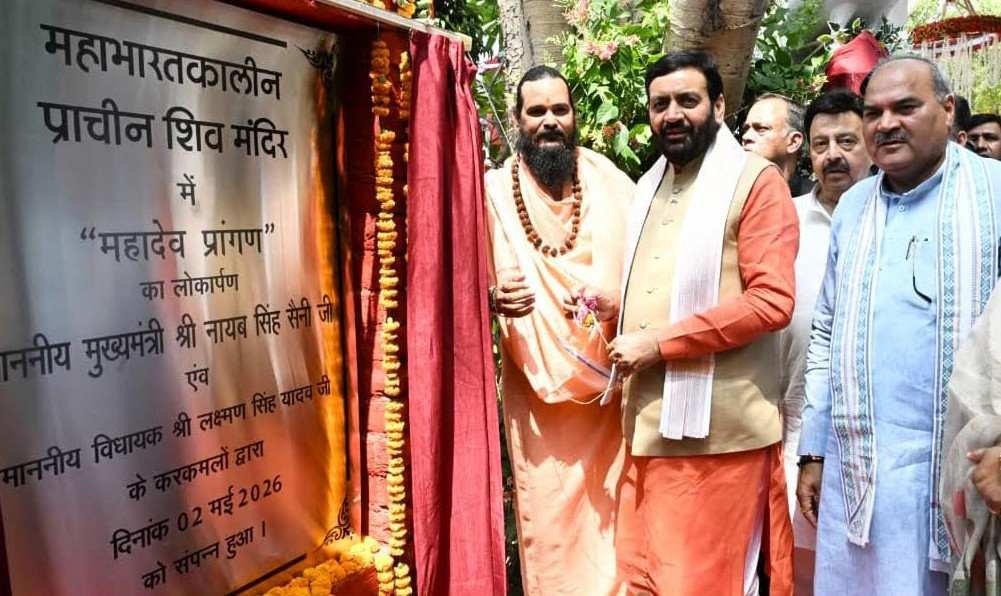
In a carefully calibrated message that blends governance with cultural identity, Nayab Singh Saini has emphasized that Haryana’s development trajectory is being shaped not only by economic expansion but also by the strengthening of spiritual and cultural values deeply rooted in its social fabric. Speaking at a religious gathering at the Gokalpura Ashram in Rewari, the Chief Minister presented a broader vision of governance—one that seeks to align infrastructure growth with heritage preservation and community welfare.
Addressing devotees and local residents, Saini described Haryana as a land historically shaped by saints, warriors, and a tradition of service. He underlined that the state government is consciously working to ensure that rapid economic progress does not come at the cost of cultural erosion. Instead, policies are being framed to reinforce traditional values alongside modernization, creating what he termed a “balanced model of development.”
The event, held at the historic temple complex in Gokalpura, carried symbolic weight. The Chief Minister referred to the site as a living testament to India’s ancient civilizational ethos, linking its legacy to the broader identity of the region. He praised ongoing religious and social initiatives at the ashram, including community feasts and large-scale ritual gatherings, describing them as instruments of social cohesion that transcend economic and social divides.
Saini also acknowledged the role of spiritual leaders such as Swami Dheeraj Giri, whose initiatives—ranging from animal welfare and cattle care to supporting underprivileged families and facilitating education—were described as examples of grassroots humanitarian service. The Chief Minister’s remarks reflected a broader political narrative that positions religious institutions as partners in social development, particularly in rural and semi-urban regions.
A key highlight of his address was the state’s increased financial commitment toward cattle welfare. Saini noted that budgetary allocations for cow protection and related initiatives have expanded significantly over the past decade, signaling a policy shift toward institutional support for traditional practices. He encouraged religious organizations to formally register their facilities to access government assistance, thereby integrating informal community efforts into the formal welfare framework.
Beyond cultural messaging, the Chief Minister placed his government’s approach within the larger national context shaped by Narendra Modi. He credited the central leadership with reviving and restoring major pilgrimage centers across the country, presenting these efforts as part of a wider cultural renaissance. Haryana, he suggested, is following a similar path by promoting pilgrimage tourism and facilitating access for economically weaker sections through state-sponsored travel programs.
Under such initiatives, thousands of citizens have reportedly been enabled to visit key religious destinations, reinforcing both spiritual engagement and social inclusion. The Chief Minister portrayed these programs not merely as welfare schemes, but as instruments of cultural integration that connect citizens with their heritage.
The event also carried an economic undertone. State Industry and Commerce Minister Rao Narbir Singh highlighted the parallel transformation underway in southern Haryana, particularly the Ahirwal region. He pointed to improvements in infrastructure, including highways, logistics networks, and educational institutions, which have begun to attract industrial investment and generate employment opportunities. According to him, enhanced connectivity has played a pivotal role in integrating the region into broader economic corridors.
Political observers note that such events serve a dual purpose: reinforcing cultural identity while projecting administrative achievements. By linking spiritual heritage with policy outcomes, the state leadership appears to be crafting a narrative that resonates across both rural and urban constituencies.
As Haryana continues to position itself as an emerging economic hub, the emphasis on cultural continuity suggests a deliberate attempt to anchor development within tradition. Whether this model can sustain long-term growth while maintaining social cohesion will remain a key question, but for now, the government’s messaging is clear—progress and tradition, it insists, are not competing forces, but complementary pillars of the state’s future.